


Column
The Slow Death of Democracy

An Independent Newsweekly



Column
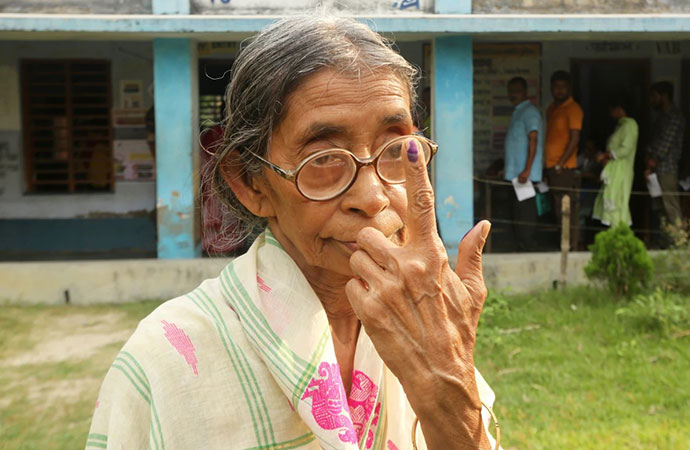
Photo: AP/UNB
We live in an age of political contradiction.
More countries than ever claim the mantle of democracy. States once notorious for military coups now hold elections, maintain constitutions, and preserve parliaments. Sending generals back to the barracks has become the norm rather than the exception.
And yet, in many democracies, elections no longer fully determine who governs. Increasingly, outcomes are shaped long before a single ballot is cast.
Democracies today rarely collapse overnight beneath the rumble of tanks or through military takeovers. They erode gradually-through legal manipulation, institutional capture, voter suppression, information warfare, and the slow hollowing-out of public trust. Political scientists have a name for this phenomenon: electoral authoritarianism.
Two recent examples come from India and the United States-the world's two largest democracies.
Bitter truth about Indian democracy
About 75 years ago, as newly independent India prepared to adopt its democratic constitution, one of its principal architects, B. R. Ambedkar, issued a warning. Indian democracy, he said, would be little more than "a top dressing on an undemocratic soil." Institutions might look democratic; the deeper political structure might not be.
That warning now feels unsettlingly prescient.
India's recent regional elections revealed a growing convergence between majoritarian nationalism and electoral engineering. On paper, the process remained democratic. In practice, the outcome raises troubling questions about whether the public will was fairly represented.
Consider the arithmetic.
In West Bengal, the BJP, the ruling part at the center but a languishing minority in the state, won 46 percent of the vote and captured 207 seats. The Trinamool Congress, longtime ruling party in the state, won 41 percent but secured only 80 seats. A five-point difference in votes translated into a near monopoly of power.
Equally striking was another number: millions were reportedly unable to vote following what authorities described as a Special Intensive Revision (SIR) of electoral rolls.
"This cannot be called democracy," Congress MP Shashi Tharoor argued in an interview with The Times of India. He noted that 9.1 million names had reportedly been removed from voter rolls and that 3.4 million people challenged their exclusion. Many, he said, possessed valid documentation, including passports.
Whether or not one accepts Tharoor's conclusion, his larger point is harder to dismiss: modern electoral manipulation no longer requires stolen ballot boxes or soldiers in the streets. The game can be tilted long before Election Day arrives.
Erosion of democracy in United States
The same logic increasingly shapes politics in the United States, once celebrated as democracy's "shining city upon a hill," in Ronald Reagan's famous phrase. Today, that light appears dimmer.
One need only examine the intensifying battle over electoral maps.
Every ten years congressional districts are redrawn to reflect census changes. But ahead of the coming midterm elections, both Republicans and Democrats have increasingly sought partisan advantage through redistricting.
The immediate push came after President Donald Trump urged Republican-controlled states to redraw congressional boundaries amid fears of electoral losses tied to economic concerns and the fallout from the Iran war. Democrats quickly responded in kind.
The logic is brutally simple: if voters cannot be changed, redraw the map instead.
This practice-gerrymandering-dates back to 1812, when Elbridge Gerry approved a Massachusetts district map so grotesque that critics said it resembled a salamander. A newspaper called it the "Gerry-mander," and the name stuck.
Today's gerrymandering is far more sophisticated.
Political strategists possess immense demographic and behavioral data. They know where supporters live, how racial groups vote, and which neighborhoods can be split or merged to maximize partisan gain. Electoral districts are no longer drawn around communities; communities are rearranged around electoral outcomes.
The goal is not persuasion. It is preemption. Politicians still proclaim that voters choose elections. Increasingly, elections are designed so that politicians choose their voters first.
Managing democracy from above
Ambedkar warned against judging democracy by outward appearance alone. Constitutions, elections, and parliaments may survive while the substance beneath them steadily decays. Sadly, this is no longer just a theoretical possibility.
Today democratic erosion is quieter, but its implications deeper and wider.
In India, those allegedly removed from voter rolls disproportionately appear to be religious minorities and poorer citizens. The case of West Bengal is well documented.
In the United States, gerrymandering often dilutes the electoral strength of African Americans and other marginalized groups. Take Tennessee. The state has nine congressional seats. Under previous district arrangements, African American voters had a realistic opportunity to elect a candidate of their choice in at least one district. Following redistricting, the map was redrawn in ways that strongly favored Republicans across all nine seats, despite nearly one-third of the state's population being nonwhite.
This is not democracy in its classical sense. It is democracy managed from above.
Hasan Ferdous is a journalist and author, based in New York
A Independent Newsweekly
© Copyright 2026 | Designed by ARK Reepon & Developed by Cosmos Group Software Team




Leave a Comment
Recent Posts
An unaccountable process leave ...
The latest price hike of all four major petroleum products by Tk 20 pe ...
The French Connection in South ...
France Ambassador to Bangladesh Jean-Marc Séré-Charlet h ...
Ties with China enter new phase
Happy 61st birthday, Singapore!
In defiant speech, Pezeshkian calls out Trump and sa ..
The banality of evil