


Reportage
The Mecca Moment: Security, Sovereignty and Strategic Choice


An Independent Newsweekly
Reportage

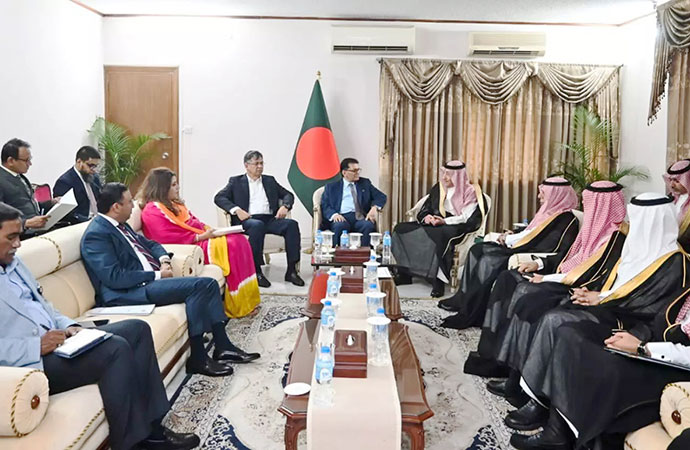
Bangladesh's positive stance toward the Mecca Joint Defence Agreement has triggered debate at home and abroad, amid speculation that Dhaka could eventually seek to join the pact. The possibility will depend largely on the intentions of the three founding members - Saudi Arabia, Turkey and Pakistan - and whether they move to expand the agreement beyond its current membership.
Any move by Bangladesh to join the pact, if invited, however, could have significant implications for its foreign relations, particularly its already strained ties with neighbouring India. Relations between Dhaka and New Delhi have deteriorated since Bangladesh accused Indian border forces of forcibly pushing people into the country. The two sides have also been at odds over Bangladesh's request for the extradition of former Prime Minister Sheikh Hasina, who has lived in exile in India since August 5, 2024.
Officials of Bangladesh and India have been in touch with each other for several weeks on the possibility of a bilateral visit by Prime Minister Tarique Rahman to India. However, this process was "vitiated" by the open press interaction in New Delhi on 5th August by Sheikh Hasina who has been convicted by the International Crimes Tribunal for committing crimes against humanity, Dhaka says, noting that they are of the view that a propitious environment needs to be created for the visit.
Bangladesh reiterated that it will continue to pursue its "Bangladesh First" policy to promote friendly bilateral relations with other countries, including our neighbours, on the basis of sovereign equality, national dignity, non-interference in each other's internal affairs and mutual benefit. Addressing Parliament on Thursday (Aug. 27), Foreign Minister Khalilur Rahman appeared to push back against concerns expressed over the prospect of Bangladesh joining the pact. He described the agreement as an internal matter among Muslim-majority countries and said there was no reason for other countries to be concerned.
"This is an internal matter of our family, the Muslim family. Therefore, there is no scope for others to be concerned about it," he told Parliament. Rahman added that Bangladesh would positively consider joining the Mecca Joint Defence Agreement if its existing members extended an invitation.
The remarks signal Dhaka's openness to closer security cooperation with the three countries, while leaving open questions about how far Bangladesh is prepared to align itself with an emerging regional defence arrangement and how such a move could reshape its delicate strategic balance between India and the wider Muslim world. Analysts said New Delhi is unlikely to welcome Bangladesh's membership of a security alliance that includes knowing foe Pakistan.
"We continue to closely follow developments that are happening in West Asia. This is what I have to say at this point of time," Randhir Jaiswal, Official Spokesperson at the Indian Ministry of External Affairs, told reporters in New Delhi on August 21. Foreign Minister Dr Khalilur said Bangladesh's possible participation in the arrangement is not an issue at this stage, as the matter will depend primarily on the intention of the countries currently involved in the pact.
"If they express an intention to invite Bangladesh to join this pact, we will certainly have to consider the matter," he said. Dr Khalilur said that it will be premature to discuss the advantages and disadvantages of Bangladesh joining the arrangement before any such invitation is made. "We will certainly keep all these matters under consideration," he said.
Leader of the Opposition in Parliament and Bangladesh Jamaat-e-Islami Ameer Dr Shafiqur Rahman said joining the Pact is an entirely sovereign and internal matter for Bangladesh. "If Bangladesh takes any decision considering the needs and interests of the country and its people, there is no reason for anyone else to feel disturbed or distressed by it," he said.
On August 24, State Minister for Foreign Affairs Humaiun Kobir said Bangladesh views the "Mecca Defence Pact" involving Saudi Arabia, Pakistan and Türkiye positively, noting that it would not be unusual for Bangladesh to participate in such an initiative among Islamic nations. "We have expressed interest in the Mecca Defence Pact. So, if something happens in the Middle East, like a security pact among Islamic nations, it isn't unusual to participate. Let's see. It's being viewed positively," he told reporters at the Ministry of Foreign Affairs in response to a question.
The newly appointed State Minister said Bangladesh is now a country of recognition, with stakeholders in the Middle East and around the world showing interest in engaging with Dhaka. "They are inviting the leadership of Bangladesh, particularly Prime Minister Tarique Rahman, to come and participate," he said, adding that Mecca has always held a special place for Bangladesh and its people.
"Mecca is in the heart of Bangladesh and in the hearts of the people," Kobir said.
The State Minister said Bangladesh's foreign policy has entered a new phase, with the government focusing on strengthening bilateral and multilateral relations while enhancing the country's global visibility and influence. Speaking to reporters at the Ministry of Foreign Affairs on his first working day as State Minister, Kobir said the new responsibility is a continuation of the work he was doing as the Prime Minister's Adviser on Foreign Affairs.
"It is not the first day of work as such. Work is about continuity," he said, adding that the new assignment requires the government to "hit the ball... ground running." He said a strategic framework for Bangladesh's foreign policy has been established over the past six months and that the government would now begin rolling out engagements based on that foundation.
Security at a Premium
Earlier this month, Saudi Arabia, Türkiye and Pakistan signed a defence agreement under which an attack on one country would be treated as an attack on all three, officials said, solidifying cooperation among the three regional powers amid growing security concerns, according to the Associated Press. The agreement was signed in the Saudi holy city of Mecca by Saudi Crown Prince Mohammed bin Salman, Turkish President Recep Tayyip Erdogan and Pakistani Prime Minister Shehbaz Sharif, according to statements issued by the three countries.
The "Mecca Joint Defence Agreement" brings together three Sunni Muslim-majority states: oil-rich Saudi Arabia, nuclear-armed Pakistan and Türkiye, which has NATO's second-largest army and a rapidly growing defence industry. The pact is intended to enhance cooperation and deterrence amid increased regional uncertainty and security threats linked to the war in Iran.
"The agreement is intended to strengthen collective deterrence against any act of aggression, and stipulates that any armed attack against any one of the three states shall be regarded as an attack against them all," the statements said. It also provides for "the enhancement of all aspects of defence cooperation among the three States," they said.
A Saudi visit beckons
Prime Minister Tarique Rahman's visit to Riyadh, at the invitation of Saudi Crown Prince and Prime Minister Mohammed bin Salman, is likely to be finalised soon after the summer. Mohammed bin Salman has invited the Prime Minister to visit Saudi Arabia to discuss ways to strengthen bilateral relations and exchange views on regional and international issues. Saudi Ambassador to Bangladesh Dr Abdullah Zafer H bin Abiyah handed over the invitation letter to Tarique Rahman during a recent meeting with him at the Prime Minister's Office in the Secretariat.
In the letter, the Saudi Crown Prince expressed his country's keenness to further strengthen bilateral relations with Bangladesh in areas of mutual interest, with a view to fulfilling the aspirations of the two countries and their brotherly peoples. He said Saudi Arabia was pleased to invite the Bangladesh Prime Minister to visit the Kingdom to discuss ways to enhance bilateral ties and consult on regional and international issues.
A Independent Newsweekly
© Copyright 2026 | Designed by ARK Reepon & Developed by Cosmos Group Software Team






Leave a Comment
Recent Posts
The international community mu ...
For nine years, Bangladesh has carried a burden that was never meant t ...
A Question of Attitude
Journalists are professionals who gather, assess, and present news and ...
The Mecca Moment: Security, Sovereignty and Strategi ..
The Economist’s Embarrassing Proxy War Over AI Polic ..
Look East for Lessons in Democratic Resistance
Why Shibir's landslide victory did not translate to ..