


Featured 1
The international community must not ignore its duty towards the Rohingya


An Independent Newsweekly

Featured 1
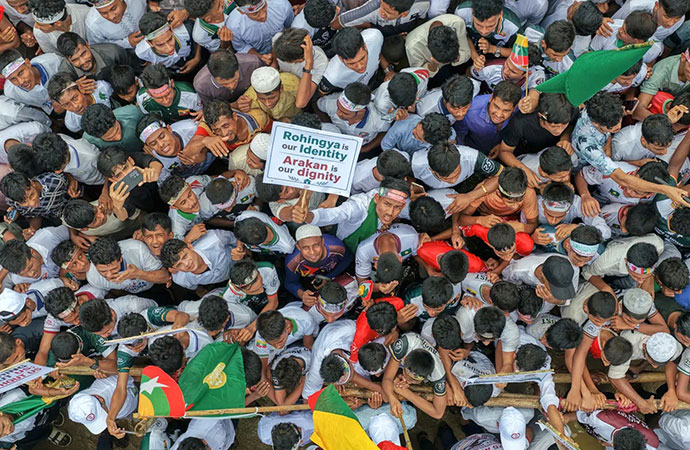
Photo: AP/UNB
For nine years, Bangladesh has carried a burden that was never meant to be its own. More than a million Rohingya refugees now live in Bangladesh, most of them in the camps of Cox's Bazar, after fleeing successive waves of violence in Myanmar, including the mass exodus of 2017. In terms of both scale and intensity, this would be the result of the largest atrocity they have faced, and they have faced plenty - enough for Amnesty International to once brand them "the world's most persecuted minority."
The Rohingyas were hounded out of Myanmar in droves in 1978, 1992-3, 2012, and 2016. Large numbers crossed the border on those occasions too, but the world mostly turned a blind eye to their plight. This time though, they couldn't. Along with Rohingya youth who showed, and continue to show remarkable resilience and enterprise in documenting their plight and raising their voices, the international community finally came together to shine a light on the despotic behaviour of Myanmar's rulers towards them, particularly its Army, the Tatmadaw.
To the extent that they got hauled in front of the International Court of Justice by a clutch of countries including Bangladesh, and led by The Gambia. While a final ruling on accountability is pending, the court previously issued binding provisional measures in 2020 requiring Myanmar to prevent acts of genocide against the Rohingya. On August 25, the ninth anniversary of the 2017 exodus, Rohingya refugees once again took to the streets of the camps to demand what should never have become an extraordinary demand: the right to return home.
Earlier this year, Malaysia's prime minister, Anwar Ibrahim, made waves by announcing Myanmar's willingness to take back 300,000 refugees from Bangladesh alongside a smaller group from Malaysia, following sustained pressures within the Asean bloc of countries. The Myanmar government seemed to follow up on that by announcing that it had successfully verified that more than 300,000 Rohingya refugees living in the world's largest such settlement in Bangladesh are former residents of western Rakhine state, and that it would accept their return once security conditions improve.
It is true that current military realities in the beleaguered Rakhine state, like most of Myanmar wracked by civil war, coupled with the absence of legal protections, security guarantees, and unified territorial control, diminish the feasibility of Myanmar's proposed large-scale repatriation. Accordingly, durable resolution of the Rohingya crisis depends not on periodic political declarations but on verifiable structural changes within Myanmar and sustained international engagement that ensures any future repatriation is safe, voluntary, dignified, and genuinely sustainable.
Bangladesh should continue to make repatriation the central objective of its policy. It is neither sustainable nor just to expect Bangladesh to host a displaced population indefinitely. The camps impose enormous humanitarian, economic, social and environmental pressures on Bangladesh, while generations of Rohingya children are growing up without a secure future. Nobody will be able to give them back the years they have lost. But we must at least endeavour to let them have their homes back.
A Independent Newsweekly
© Copyright 2026 | Designed by ARK Reepon & Developed by Cosmos Group Software Team






Leave a Comment
Recent Posts
The international community mu ...
For nine years, Bangladesh has carried a burden that was never meant t ...
A Question of Attitude
Journalists are professionals who gather, assess, and present news and ...
The Mecca Moment: Security, Sovereignty and Strategi ..
The Economist’s Embarrassing Proxy War Over AI Polic ..
Look East for Lessons in Democratic Resistance
Why Shibir's landslide victory did not translate to ..