


Society
The Economist’s Embarrassing Proxy War Over AI Policy


An Independent Newsweekly

Society
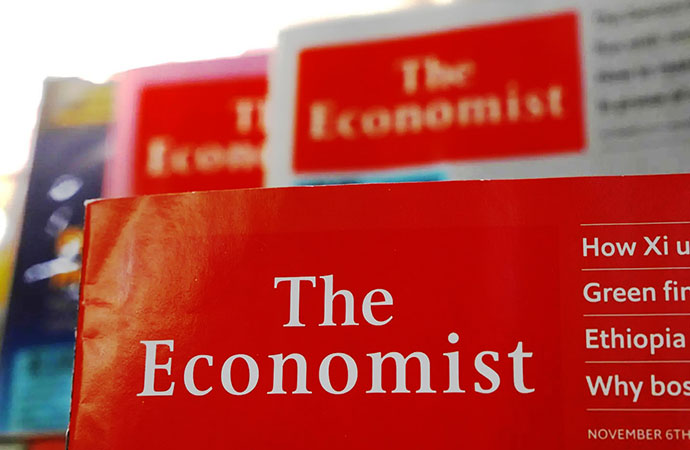
Photo: AP/UNB
The disagreements between the Nobel laureate economist Daron Acemoglu and his opponents are consequential—and so are the opponents. But rather than engage in good faith with Acemoglu's arguments, the venerable British news magazine recently stooped to bibulous calumny by unnamed critics of his work.
By publishing a recent article smearing the Nobel laureate economist Daron Acemoglu, The Economist has demonstrated bad judgment, overweening arrogance, and bad faith. The magazine engages with Acemoglu's academic work disingenuously, quoting the snarky comments of unnamed economists interviewed over drinks to support its argument that his influential research makes sweeping, unfounded claims. Acemoglu's research linking institutions to long-run prosperity-the work that the Nobel committee honoured two years ago-supposedly is little better than glib. And Acemoglu's pessimism about AI and his preference for steering technological change through public policy rest on dubious assumptions and underestimate AI's potential economic benefits.
An AI agenda seems to be behind The Economist's decision to order up a hit piece against Acemoglu, who has been a tireless advocate for AI policies that are job-centered, humanistic, and compatible with liberal democracy. Acemoglu's proposals are anathema to titans of the AI industry like Elon Musk and Mark Zuckerberg. For them and other prominent figures, workers and democracy are irritating obstacles on the path to ever-greater wealth and power.
The Economist is not necessarily taking its marching order from the AI companies (though it should be noted that the CEO of The Economist's largest shareholder has sat on Meta's board since 2025). Instead, its attack on the academic credentials of a researcher who has been publishing in peer-reviewed journals for more than 30 years seems more like a frenzied defence of the faith by an offended true believer.
Obviously, there is nothing improper about criticising Acemoglu's scholarship and reckoning with his ideas, no matter the timing. Nobel laureates deserve scrutiny just like everyone else. But The Economist's piece raises a question: Why does an article ostensibly reassessing the quality of Acemoglu's academic work end by attacking his influence over AI policy?
That structure is revealing. In The Economist's traditional anonymous house voice, the piece recruits anonymous sources. One "well-known economist" accuses Acemoglu of using models to support failed "populist policies"; another is quoted on his genius. It then tours old controversies over settler mortality, institutions, and technology before arriving at AI. Only there does the article disclose the stakes. These academic disputes, it says, "could end up mattering a great deal" because Acemoglu worries about AI's effects on jobs and democracy.
That pivot deserves more attention than the "econometric archaeology" preceding it. The Economist has a recognisable position on AI policy. In a 2023 Leader, it rejected both laissez-faire and maximal precaution, advocating a "measured approach" on which further rules could later be built. In July 2026, another Leader called for better regulation while warning that America should not "imprison frontier AI" or lock others out of the technology.
That is, no doubt, a defensible position: regulate risks, but preserve innovation, diffusion, and strategic advantage. It is also broadly congenial to the interests of the AI giants whose valuations depend on rapid deployment and relatively permissive rules.
Acemoglu's agenda is different, and much more disruptive of the plans of the architects of AI. With his MIT colleagues David Autor and Simon Johnson, he has argued that the direction of AI is a policy choice, not a technological inevitability. Their 2023 "pro-worker AI" programme proposed equalising the tax treatment of labor and equipment or algorithms, limiting intrusive workplace surveillance, strengthening workers' voice, funding human-complementary technologies, building public AI expertise, and steering adoption in education and health care.
Their follow-up 2026 programme goes further, adding antitrust enforcement and intellectual-property protections for workers' expertise. The objective for Acemoglu and his colleagues is not merely safe AI, but AI designed to increase the value of human capabilities rather than automate them away. On August 21, Acemoglu published a very clear statement of this policy path in the World View section of Nature.
This agenda directly questions who sets the technological trajectory and who captures its rents. Against that background, diminishing Acemoglu's academic standing has an obvious political effect: it weakens the authority of one of the most prominent economists arguing for a worker-centered approach to AI's development. The more interesting charge is ideological, not conspiratorial. By turning disagreement with Acemoglu's policy prescriptions into snide questions about the merits of his scholarship and academic "stardom," The Economist seeks to sabotage a debate that should be conducted openly and honestly.
The real question is not whether every empirical finding by Acemoglu from 2001 survives re-estimation. It is whether AI policy should accommodate the firms building the technology or give workers and the wider public greater power over what gets built. That is the argument that The Economist and the cheerleaders of AI should be having with Acemoglu. The disagreements between Acemoglu and his opponents are hugely consequential. But his opponents do not advance their cause by rejecting good-faith engagement in favour of bibulous calumny.
From Project Syndicate
A Independent Newsweekly
© Copyright 2026 | Designed by ARK Reepon & Developed by Cosmos Group Software Team






Leave a Comment
Recent Posts
The international community mu ...
For nine years, Bangladesh has carried a burden that was never meant t ...
A Question of Attitude
Journalists are professionals who gather, assess, and present news and ...
The Mecca Moment: Security, Sovereignty and Strategi ..
The Economist’s Embarrassing Proxy War Over AI Polic ..
Look East for Lessons in Democratic Resistance
Why Shibir's landslide victory did not translate to ..