


Reportage
A far-reaching judgement of the High Court


An Independent Newsweekly




Reportage
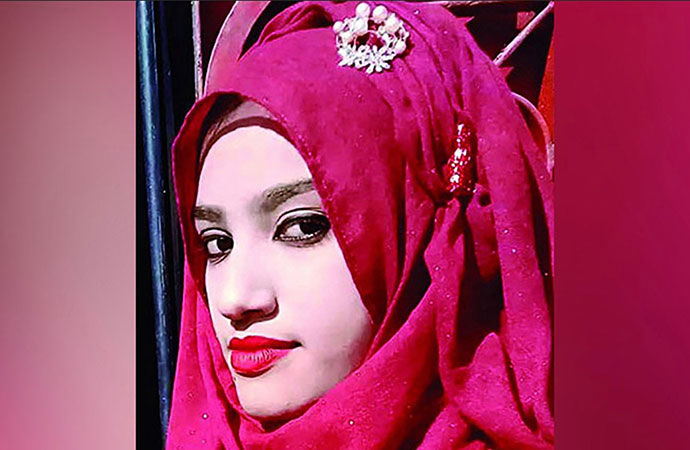
Nusrat Jahan Rafi. Photo: Collected
In October 2019, the Feni Women and Children Repression Prevention Tribunal sentenced 16 people to death for the murder of a student set on fire after accusing her teacher, indeed the principal of the madrasah she attended, of sexual harassment.
Nusrat Jahan Rafi, 19, died in April of that year in Feni. Nusrat, then an Alim examinee, had accused madrasah principal Siraj-ud-Daula of sexual harassment. After her mother filed a case, police arrested Siraj on March 27, 2019.
On April 6, Nusrat was lured to the roof of a cyclone shelter, doused with kerosene and set ablaze before an exam. Her brother initially filed a murder-attempt case naming eight people. After her death, it became a murder case, triggering nationwide protests.
She suffered 80% burns to her body. While being rushed to hospital, she used her brother's phone to record a statement, naming some of her attackers and vowing to fight the crime until her last breath.
"The teacher touched me, I will fight this crime till my last breath," she said, and her courageous stand became a powerful symbol against impunity for sexual abuse. The entire country egged her on to survive, but four days later, on April 10, she succumbed to her injuries.
Her murder shocked the country and led to a series of protests demanding justice for Nusrat. Those convicted of murder included the headteacher Nusrat had accused of harassment and two female classmates.
The initial trial was one of the quickest in a country where such cases usually take years to conclude. Prosecutor Hafez Ahmed told reporters it proved "that nobody will get away with murder in Bangladesh".
The then-Law, Justice and Parliamentary Affairs Minister Anisul Huq said the judgement would remain as a milestone in establishing the rule of law. But even then, it raised eyebrows - somehow, it didn't make sense that the state should kill 16 citizens to atone for the murder of one.
This week, the High Court described the trial court's decision to sentence all 16 suspects to death in the murder of Feni madrasa student Nusrat Jahan Rafi as "mindless". It also ordered the Law Ministry to withdraw the criminal judicial powers of Mamunur Rashid, who delivered the verdict as judge of Feni's Women and Children Repression Prevention Tribunal. Rashid, now a senior district judge-equivalent officer, serves as chairman of the Minimum Wage Board.
The High Court bench of Justice Bhishmadev Chakrabortty and Justice KM Rasheduzzaman Raja delivered the ruling on Monday (Aug. 24) after 17 days of hearings on the death reference, appeals and jail appeals. The trial court had sentenced all 16 suspects to death on Oct 24, 2019, along with a Tk 100,000 fine each. The High Court upheld two death sentences, commuted four to life imprisonment and acquitted the remaining 10.
Attorney General Ruhul Quddus Kazal said the High Court found Rashid had failed to apply the judicial mind required when deciding punishment. He stressed the observation applies specifically to Rashid and not judges generally. Kajal said he hoped the law ministry would consider the matter.
He also said judges must remain fearless and decide cases solely on evidence presented in court, without being influenced by outside statements or how issues are portrayed.
Judicial Standards and Evidentiary Evaluation
The High Court emphasized that lower courts must exercise extreme caution and strict legal standards when weighing evidence that leads to the death penalty.
Legal analysts note that overturning large portions of mass death sentences demonstrates the judiciary's active role in fixing weak or unsafe evidentiary evaluations made during initial trials. This strict review aligns with broader legal movements in Bangladesh-such as past rulings by the Supreme Court's Appellate Division-that reject mechanical or mandatory death sentences in favour of careful judicial discretion. Independent studies show that poor legal representation, low pay for defense lawyers, and rushed trials often drive unjust death sentences in lower courts.
Under Bangladesh law, any death sentence handed down by a lower court requires mandatory High Court approval before execution, serving as a critical safety check against flawed evidence.
Under the Awami League regime, a sort of 'Fashi Chai' ('We demand hanging') culture developed in the country, specifically tied to the movement to hang the war criminals of the 1971 Liberation War, for which the International Crimes Tribunal was constituted. Chants of 'Fashi Chai' became a rallying cry during the Shahbag protests in 2013, where hundreds of thousands gathered at Shahbagh demanding capital punishment for convicted war criminals from the Liberation War.
Sociologists and cultural critics note that the recurrence of "Fashi Chai" highlights a deep-seated public distrust in institutional reform, where citizens often lean toward retributive justice because formal legal and administrative systems have historically felt compromised or unjust.
Records kept by human rights organisation Odhikar clearly indicate the trend, and when it started. From 76, 97, and 77 death sentences handed down in each of the three years from 2012 to 2013, the number of death sentences suddenly jumps to 291 in 2013. From 2020-24, each of the five years saw more than 300 death sentences.
"There is an increasing trend, in the judiciary and parliament, to go for mindless death penalty," says Ridwanul Hoque, a former professor of law at the University of Dhaka, and now a governance and legal consultant based in Melbourne. "In Nusrat's case, it was unbelievable by any standard to see the trial judge awarding so many death sentences. Unfortunately, judges are protected-no punishment can be taken except that they can be transferred to non-criminal courts."
He then adds:
"In this region, death penalty was once the last resort. These days it is the first."
It remains to be seen whether this important judgement can in fact signal a turnaround ion this dangerous tendency.
Who gets the death penalty?
New research, commissioned by The Death Penalty Project and conducted by the University of Dhaka, exposes systemic failures in the effectiveness and quality of legal representation in capital cases - meaning unjust, unsafe and potentially irreversible outcomes are inevitable for those facing the death penalty in Bangladesh.
The right to effective legal representation is a cornerstone of a fair criminal justice system. Nowhere is this right more critical than in cases where the death penalty is on the table: inadequate representation can lead to irreversible miscarriages of justice.
More than 2,600 people are living under sentence of death in Bangladesh, one of the highest known death row populations in the world. Hundreds of death sentences continue to be imposed each year.
Both the Constitution and Bangladesh's international treaty obligations are unequivocal that there is an absolute right to effective state-funded legal representation in capital cases. Despite this, new research commissioned by The Death Penalty Project and authored by Professor Muhammad Mahbubur Rahman and Rafid Azad Saumik at the Centre for Advanced Legal Studies (CALS), University of Dhaka, reveals that the quality of legal representation in Bangladesh routinely falls short of the standards required in a capital case.
Drawing on interviews with individuals with lived experience of death row and their family members, alongside legal practitioners and civil society experts, the study examines the quality of representation provided by private lawyers, state defence lawyers and legal aid lawyers, in trial courts and appeal proceedings of the Supreme Court.
The research identifies serious structural gaps that compromise the effectiveness of legal representation in capital cases, including:
Grossly inadequate compensation for state-funded legal representation. Exceedingly low fees are disincentivising lawyers from taking on or prioritising capital cases.
Poor client-lawyer communication. Whether due to a lack of time or low remuneration, state-funded lawyers hardly ever meet their clients in prison. It is not unusual for clients to have their first interaction with their legal representatives on the day of their trial. Families typically do not have the resources to travel to meet with lawyers.
An acute shortage of suitably experienced lawyers, particularly at trial stage. This could be driven both by poor compensation, but also as death penalty cases, due to their gravity, often attract significant public attention and politicisation. Lawyers are therefore reluctant to take on these cases due to the risk of harassment.
A pattern of delayed appointment of legal representation. In almost all cases involving state defence lawyers, the lawyer was only appointed during the hearing stage. This is a deeply concerning trend in a system where torture, forced confessions and corrupt practices are common during the immediate period of detention after arrest.
The implications are stark. In Bangladesh, those who cannot afford private lawyers are more likely to receive poor quality representation and face unjust outcomes. This means economically disadvantaged people are far more likely to end up on death row, and to be wrongfully convicted.
As a clear violation of fair trial rights, these findings render the death penalty system inevitably arbitrary and discriminatory.
A broken system?
Existing research has already confirmed that Bangladesh's justice system is chronically under-resourced. Forced confessions are relied on as evidence in capital cases, wrongful convictions are commonplace and the experience of prolonged detention and solitary confinement on death row brings about intense and long-lasting psychological, social and emotional damage.
The new research builds on a previous study of the death row population published in 2020 with CALS and The Bangladesh Legal Aid and Services Trust, which found that:
Death row is predominantly populated by young men. None of the individuals interviewed in the study had been convicted of a crime before.
All of those interviewed came from low-income backgrounds: 72% were classified as 'economically vulnerable'. More than half were in low paid work or unemployed.
The documentary photography of artist and anthropologist Mosfiqur Rahman Johan has further exposed the harrowing experiences of people wrongfully convicted and sentenced to death in Bangladesh. Together, this evidence shows that unconscionable delays, torture and inequality plague the criminal justice system and undermine the rule of law. These critical issues must be addressed through urgent reforms.
A third of family members interviewed in the study also alleged that their family member had been tortured in custody.
What now for the new government?
This study comes at a critical moment for Bangladesh, where the newly elected government and demands for accountability are at the forefront of the public conversation. Its implications are clear: the new administration must not accept the failings of the criminal justice system it has inherited. As a starting point, the report calls for urgent reforms, including:
Stronger training and qualification standards for lawyers;
Fairer compensation, with dedicated fees for capital cases;
Guaranteed early and effective access to legal representation;
Protection of the presumption of innocence, particularly in high-profile cases;
And an urgent review of the continued use of the death penalty.
Current discourse about the death penalty in Bangladesh is focused on holding former Prime Minister Sheikh Hasina and her allies to account for state violence and human rights abuses.
But to debate capital punishment only within the context of Bangladesh's International Crimes Tribunal ignores the thousands of individuals sentenced to death and languishing in condemned cells around the country who are not from the ruling class, but instead disproportionately poor and marginalised. These people have also experienced human rights abuses and forms of state violence.
Justice and reconciliation in the aftermath of gross human rights abuses is essential. But these reckonings cannot stop at the prison gates. To ignore those on death row and allow the death penalty regime to persist under these conditions is to risk replicating the very brutality and injustice the new administration seeks to address.
The Death Penalty Project called on Bangladesh's government to initiate an urgent Commission of Inquiry to examine and report on all aspects of capital punishment and to declare an official moratorium on executions.
The death penalty constitutes a violation of the right to life and the right not to be subjected to cruel, inhuman or degrading punishment. In 2007, the UN General Assembly adopted a resolution emphasizing that "that the use of the death penalty undermines human dignity" and calling for the establishment of a moratorium on the use of the death penalty "with a view to abolishing the death penalty".
The resolution was reaffirmed in 2008, 2010, and most recently in December 2012, when an overwhelming majority of 110 UN Member States voted in favor of a worldwide moratorium on executions as a step towards abolition of the death penalty.
In addition, the International Commission of Jurists has also called on Bangladesh to join the great majority of States around the world in instating a moratorium on the death penalty, with a view to abolishing the death penalty in law and in practice.
A Independent Newsweekly
© Copyright 2026 | Designed by ARK Reepon & Developed by Cosmos Group Software Team






Leave a Comment
Recent Posts
The international community mu ...
For nine years, Bangladesh has carried a burden that was never meant t ...
A Question of Attitude
Journalists are professionals who gather, assess, and present news and ...
The Mecca Moment: Security, Sovereignty and Strategi ..
The Economist’s Embarrassing Proxy War Over AI Polic ..
Look East for Lessons in Democratic Resistance
Why Shibir's landslide victory did not translate to ..