


Featured 1
What Bengal thinks today

An Independent Newsweekly
Featured 1
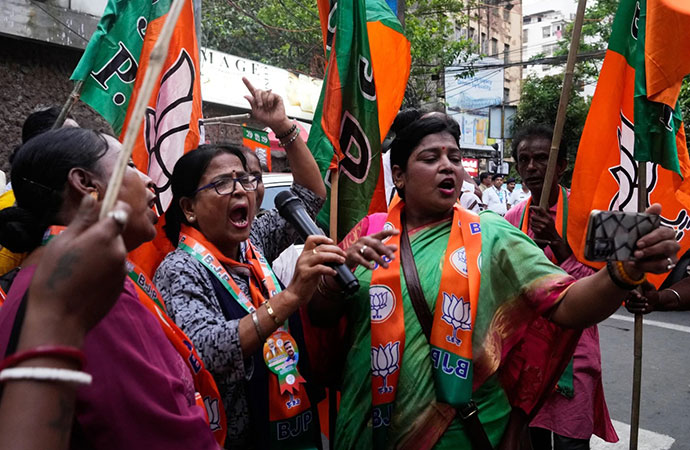
Photo: AP/UNB
The political earthquake we have just witnessed in our neighbouring Indian state of West Bengal has not occurred in a vacuum. Rather, it is the culmination of a process that began at least 10 years ago, when the BJP first set its sight on this sleeping giant of the East. Till 2016, the BJP candidates had never even won a seat in the state's legislative assembly. That year, they started off with just 2. Over the course of the next ten years, the sustained and overt courtship of Bengal by the BJP was visible to everyone who followed politics in the region. And even if 2021 would prove a disappointment for them, in 2026 they would grow that number over 100 times, to bag an incredible 208 seats and form the government with a two-thirds majority in results that were announced this week.
At the time of writing, we are still waiting to find out who they install as chief minister. Although that is completely the party leadership's prerogative, it would no doubt play some role in regulating the political temperature in the state, that incredibly heated around the time of the election and in its aftermath, with sitting chief minister Mamata Banerjee having declared her intention not to resign and hand over power peacefully, as she perceived the election had not been fair. And she may have had a point- but by agreeing to a so-called 'purification' of the rolls that took place just weeks out from the first polling day, she effectively conceded the argument, and the franchise rights of millions of her supporters. She has since been fired from her post by the Governor of the state, who is closely aligned to the central government in New Delhi.
Millions of people in West Bengal were stripped of their vote ahead of a critical state election this week, after a controversial electoral revision described by critics as a "bloodless political genocide" and mass disenfranchisement of minorities.
In West Bengal, a total of 9.1 million names have been deleted from the register, more than 10% of the electorate. While many were dead or duplicates, about 2.7 million people have challenged their expulsions, but still been removed.
The process of revising the electoral roll, known as a Special Intensive Revision (SIR), has been taking place in states and territories across India, justified by the Narendra Modi government as a way to stop "infiltrators" - a pejorative term largely referring to illegal Muslim Bangladeshi immigrants - from voting.
While the sheer disgruntlement in the state over the scant regard shown by the Indian Supreme Court for a citizen's right to franchise probably overshadowed even the anger built up over years for the TMC and its endless pyramid schemes and MLMs and chit funds. A change, most definitely was in the air. What the BJP did this time, was not become too arrogant or too aggressive against the figure of Banerjee herself - that was too polarising for a lot of people in 2021, and they decided to stick to Bengal's "own daughter" one more time. This time they were more circumspect, they were not predicting upward of 200 seats, they were not already making policy changes from the campaign stage, and Modi wasn't camping out in Kolkata - seemingly in neglect of the office of prime minister. Yet this time they got the result they hoped for.
A Independent Newsweekly
© Copyright 2026 | Designed by ARK Reepon & Developed by Cosmos Group Software Team



Leave a Comment
Recent Posts
An unaccountable process leave ...
The latest price hike of all four major petroleum products by Tk 20 pe ...
The French Connection in South ...
France Ambassador to Bangladesh Jean-Marc Séré-Charlet h ...
Ties with China enter new phase
Happy 61st birthday, Singapore!
In defiant speech, Pezeshkian calls out Trump and sa ..
The banality of evil