


Column
Three Poets without Quarrels: Shamsur Rahman, Hasan Hafizur Rahman, Al-Mahmud

An Independent Newsweekly




Column
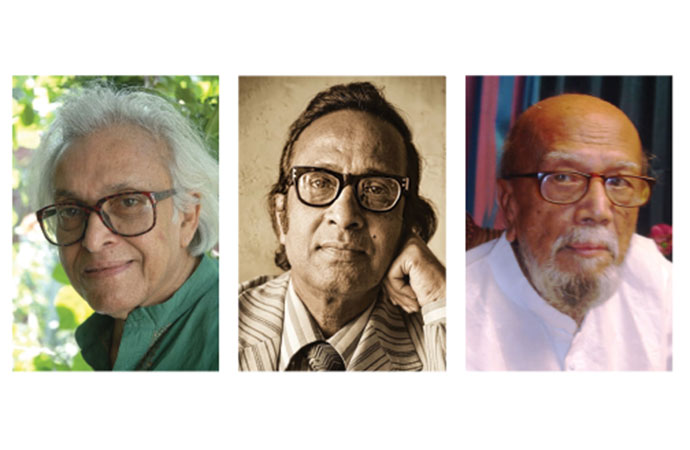
For those of us in our seventies, there is one great piece of good fortune: we had the opportunity to observe the leading literary figures of Bangladesh of that era from up close. They were like elders to us, but they drew us close. Even back then, the "culture of quarrels" had not quite gained a solid foothold in the country, though it was quite strong and growing in the political arena. Even so, I saw that personal relationships existed even with people of opposing views-something that is perhaps unimaginable today. This was a great gift for us. Warmth and affection could be had very cheaply; everyone distributed them with an open hand. This is neither good nor bad-it just is what it is, shaped by the face of that era.
During my university days, I became acquainted or close with writers of the immediate past generation. I had met the elders once or twice at various events, but we understood and accepted that they and we belonged to different generations. But one day, by a stroke of luck, through my job at the Liberation War History Project, I met the poet Hasan Hafizur Rahman, of whom I was a devoted reader. It was through him that I got the chance to know and grow close to many others. This piece is about a few memories from that time, particularly regarding the relationship I saw existing among them.
Two boyhood friends: Shamsur Rahman and Hasan Hafizur Rahman
I didn't even know that Hasan Bhai and Shamsur Rahman Bhai were childhood friends. Quite often, Rahman Bhai would come from his newspaper office (*Dainik Bangla*) to our History Project office in Purana Paltan to hang out. He came specifically to talk with his friend because it was not a general hangout spot; the conversations took place between two childhood friends.
Right next to the office was the well known Chittagong Hotel, and everyone ordered food from there. Their *Pangash* fish head was famous in Dhaka, as was the beef *bhuna*. These extremely oily foods were forbidden for Hasan Bhai, who had diabetes, but he did not follow restrictions much. He would even throw away a few potatoes from a *singara* and eat it, but that proved to be his undoing in the end-his kidneys could not cope.
The two friends would chat and share stories, occasionally inviting us into their conversation. It was a completely intimate affair. They did not speak only of literature; the two friends discussed many things under the sun. And there was a reason I was invited to join-allow me a little pride display and please forgive me for showing off...
It is that I was a voracious reader. I had read many books of Western literature and, by good fortune, all the writings of these two poets; hence, I was occasionally granted permission to join the conversation. Both of them placed Rabindranath above everyone else, saying that modern Bengali literature had come into being through his hands. Occasionally, other people would join in, particularly Imam Bhai , Shah Ahmed Reza, and later the poet Tridib Dastidar, all colleagues of mine at the History project.
Of course, larger gatherings were also arranged deliberately, attended by many journalists and literary figures. After returning from the UK, Syed Shamsul Huq Bhai, Fazal Shahabuddin Bhai, Belal Bhai, and many others would come. I would occasionally talk about literature with them, but a hangout was a hangout-it was filled with stories, gossip, jokes, and banter.
Al-Mahmud, the misplaced radical
There is a small reason behind writing this piece. Nowadays, I hear that there was supposedly a feud and conflict between the two poets, Shamsur Rahman and Al-Mahmud-that one represented refined liberal literature while the other represented Islamic and rural literature, and so on. I have seen long essays printed on this topic. I feel a bit puzzled because, having observed them from somewhat up close, I never saw this quarrel between them. Whom are these people talking about?
Al-Mahmud Bhai was the editor of the JSD (Jatiya Samajtantrik Dal) newspaper in the early 70s., and it felt to me even then that among the few politically naive, simple people working at that paper, he and poet Mashuk Helal Bhai were the main ones.
The police arrested him in 1974, and he went to jail, enduring a great deal of hardship. As an editor and writer, he had never expected these experiences as part of his life which was more political than anything else. He was deeply shaken, and a transformation began inside his mind while in prison. The gentle person transformed from a "leftist revolutionary "in some eyes -which he had never truly been-into a deeply religious person.
Shadows of these feelings can be found in his book *Mayabi Porda Dule Othe* (The Magical Curtain Trembles). He also understood that the JSD activists would no longer like him. The government administration understood this as well, which is why they released him, and Sheikh Saheb himself took the initiative to give him a job at the Shilpakala Academy.
A few days after his release, I met him near Sharif Mia's canteen at Dhaka university. With his release from prison and the assurance of a job, he seemed cheerful. In truth, Al-Mahmud Bhai was not an ideological revolutionary for whom politics would be everything in life. He was a poet, a genuinely good human being, a soldier fighting for a living in Dhaka city after coming from the village-nothing more of a revolutionary than that.
He was religious just as millions of Bangladeshi Muslims are, nothing beyond that; with advancing age, his religious emotions grew, like it does for many. Going to prison and family insecurity were not meant for him. He was a simple, ordinary man; no one needed to turn him into a Jamaati militant or a traitor to the revolution. And in the midst of all this, where does the issue of a feud with Rahman Bhai come from? I never saw them quarrel.
The admired poet
Perhaps because the generosity that lived in the hearts of these poets does not exist in today's Facebook-politics-inspired literary world of Bangladesh, we assume that they lacked it too. I remember liking one of Al-Mahmud's poems very much, and I mentioned it to the two friends. It had been published in a little magazine.
I recall a part of a line: *"O love, make a sound..."* Both of them read the poem and, nodding their heads, said, "Oh, he is perhaps the finest craftsman of poetry in this country; how many people can write within such a skillful structure?"
There was no envy in their voices, nor anything negative. I am talking about an event from 1980; various political events were ongoing back then, but nothing mattered when it came to their offering of praise.
In truth, we speak of feuds and conflicts between them perhaps to solidify our own conflict positions. Al-Mahmud himself understood that he was a man from the village living in an urban world, but not fully a part of it. Hasan Bhai and Rahman Bhai understood that too, but it made no difference to their relationship.
Sitting here today, we simply cannot accept that the intellectuals of Bangladesh at that time were somewhat different, more friends than we accept each other as.
Memories of prayers and poetry
Let me conclude by sharing an incident from around 1994-95. I met Al-Mahmud Bhai at an event when I was working as a BBC journalist. Before the programme started, we were standing on the veranda- balcony and chatting. In his characteristic gentle voice, he asked me if I would be interested in translating his poetry into English.
I declined, saying it would not turn out well because the poetry he wrote in Bengali would not translate effectively into English-adding that I said this because I knew English far better than Bengali. I understood what works well in English. He accepted what I said, perhaps out of regard for our relationship.
He was leaning against a railing in the corner of the balcony. Suddenly, he said something that left me stunned: "Sometimes I feel down these days; I can't seem to be able to cope. Occasionally, I go over to Shamsur Rahman's house. While he works at his table, I offer my prayers there-it makes me feel good."
I remained silent. Who knows why there was such sadness in his voice.
Literary conflict was arriving...
Their relationship was like that between two close human beings, not a relationship between two ideologically aligned warriors. They rarely even discussed literature. Where was the quarrel here? I do not know. I never saw any feud or conflict between them.
Parties and factionalism began after Ershad came to power, when he formed a literary group and some members used it to engage in the politics of favours. Since then, a new path for survival in the literary world emerged, which continues to this day and has grown much stronger.
For as long as time remains, we will not only quarrel among ourselves; we will find conflicts among those who came before us, whether they actually quarrelled or not.
A Independent Newsweekly
© Copyright 2026 | Designed by ARK Reepon & Developed by Cosmos Group Software Team






Leave a Comment
Recent Posts
The government passes the test ...
One of the cornerstones of the political earthquake Bangladesh witness ...
The government hiked the price ...
The government hiked the price of a 12kg cylinder of liquefied petrole ...
Police in France stand accused of using excessive fo ..
The India-Pakistan Cold War
A week on from DNCC’s eviction drive, Mirpur-10 rema ..
Equal Service, Unequal Pensions: Time for a Fairer S ..