


Column
History is a continuum


An Independent Newsweekly


Column
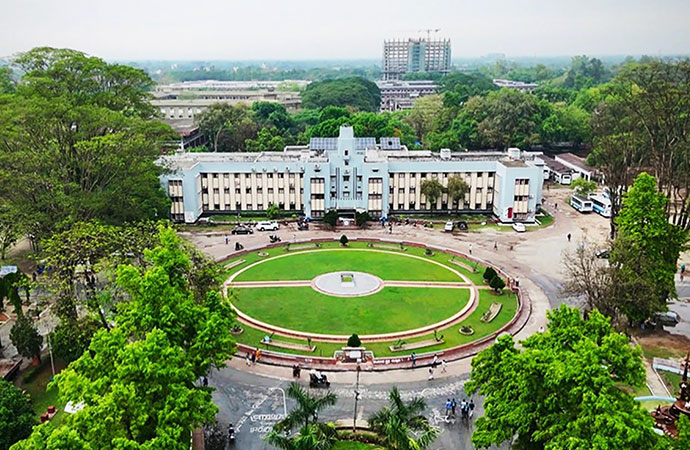
An artwork displayed at a Rajshahi University exhibition marking the 2024 mass uprising has been removed following criticism that it appeared to portray the uprising as being more significant than the 1971 Liberation War.
According to a Prothom Alo report, the artwork "depicts a clenched fist holding a weighing scale. The number '71' is written in red on one side of the scale, while '24' is written in dark colour on the other. The side marked '24' is tilted slightly downward(s)".
The political message appears obvious. However, the artist, speaking to the newspaper anonymously, described the artwork as an allegorical representation that "might appear at first glance to give less importance to 1971 than (to) 2024, but that was not the intention. According to the artist, since the July uprising, a group of people have been trying to pit 2024 against the Liberation War of 1971. The weighing scale was used as a visual metaphor, while small pebbles placed beside '24' made that side appear heavier".
Now, that explanation changes everything. It is the pebbles and not anything else that makes 2024 look more important than 1971. Of course, the question then arises: What are the pebbles? Allegorically, they could mean the political weight that one side in the so-called 1971-versus- 2024 debate attaches to the mass uprising. In this case, the allegorical representation does not take sides in the debate but leaves it to the visual imagination to decide how the weighing scale should look. The artist passes no judgement on the matter.
This, I think, is the role of art: to describe but not to prescribe, to present imaginative evidence but not to judge it. The judge is the viewer.
In that case, taking down the artefact resolves nothing. There will be no court of popular opinion, no presentation of artistic evidence, no aesthetes jousting between intellectuals acting like adversarial lawyers, even no public in court. No nothing.
This is a pity.
Just last week, I wrote about Bangladesh's history. In case you missed my column, here is a summary of it: The ultimate provenance of today's Bangladesh lies in 1947, when Pakistan broke away from India to form an independent state. There would have been no 20024 without 1971, but there would have been no 1971 itself without 1947. This is historically undeniable".
"However, in saying this, I am not privileging those who would draw a direct arc of causation from 1947 to 2004 while treating 1971 as an aberration along the way. Those people subsume the Bengali reality of Bangladesh to the Muslim reality of Pakistan. Well, Pakistan broke up in 1971. Bangladesh continues. Bangladesh is a Bengali-Muslim-majority nation where Constitutional provision is made for the religious and cultural protection of both non-Muslim and indeed non-Bengalis."
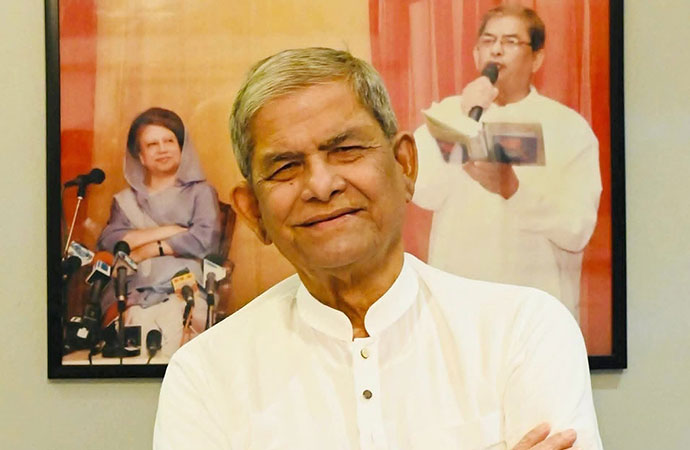
"Consequently, the danger posed by the deniers of 1971 came to the fore when (BNP leader and Minister) Mirza Fakhrul alleged that a certain group was deliberately trying to push the country towards division in the name of religion. 'We cannot allow extremism here. We cannot allow fundamentalism. We want to build a liberal, democratic Bangladesh,' he said."
I thank Mirza Fakhrul for having reminded Bangladeshis that their independence did not begin in 2024. It began in 1971. However, as I have just said, that beginning itself depended on an earlier beginning in 1947.
Essentially, Bangladesh history is a continuum from 1947 till today. And history never ends. What matters is what plebes and patricians make of it.
In the case of Bangladesh, the achievements of 1971 - which belonged to the plebes - was co-opted by the patricians of the Awami League who equated a nation's collective victory with the contributions of Bangabandhu Sheikh Mujibur Rahman and fellow-minded leaders. Those contributions were legendary; they cannot be denied in any way without distorting history beyond recognition and remembrance. But the co-optation of history marginalised and even excluded the activism and sacrifices of the population at large which were represented by the young nationalist Ziaur Rahman and the military heft that those like him brought to the War of Liberation. During the Awami League's time in power subsequently, one narrative was the orthodoxy, to question which was to deny the reality of 1971. When the party fell from power in 2024, its orthodoxy became heterodoxy. Then, it seemed to be that 1971 itself was unreal because it was associated so closely with a party that had to be driven from power. In other words, politics became the determinant of history.
To its credit, the Bangladesh Nationalist Party, tied umbilically to President Ziaur Rahman, has not sought to excise the Awami League from Bangladesh's liberation history. Bangabandhu remains Bangabandhu - without the political homilies paid to him once. He has not been replaced by President Zia or Begum Zia, who was Prime Minister.
I can only thank Prime Minister Tarique Rahman for ensuring the continuity of Bangladeshi history, in which the events of 2024 brought him to power ultimately but without him denigrating the legacies of either 1947 or 1971.
It takes a great deal of reticence for a prime minister to act impartially even when his own illustrious family's contribution of Bangladesh is involved.
As for those who still believe that the judging scales of Bangladeshi history privilege 2004 over 1947, I suggest that they take the sacaes to the nearest shop that deals with mechanical defects.
Defects can be cured.
The writer is Principal Research Fellow of the Cosmos Foundation. He may be reached at epaaropaar@gmail.com
A Independent Newsweekly
© Copyright 2026 | Designed by ARK Reepon & Developed by Cosmos Group Software Team





Leave a Comment
Recent Posts
An unaccountable process leave ...
The latest price hike of all four major petroleum products by Tk 20 pe ...
The French Connection in South ...
France Ambassador to Bangladesh Jean-Marc Séré-Charlet h ...
Ties with China enter new phase
Happy 61st birthday, Singapore!
In defiant speech, Pezeshkian calls out Trump and sa ..
The banality of evil