


Column
Dependent Bangladeshi intellectuals: Socio-historical roots


An Independent Newsweekly





Column
AI Generated Image
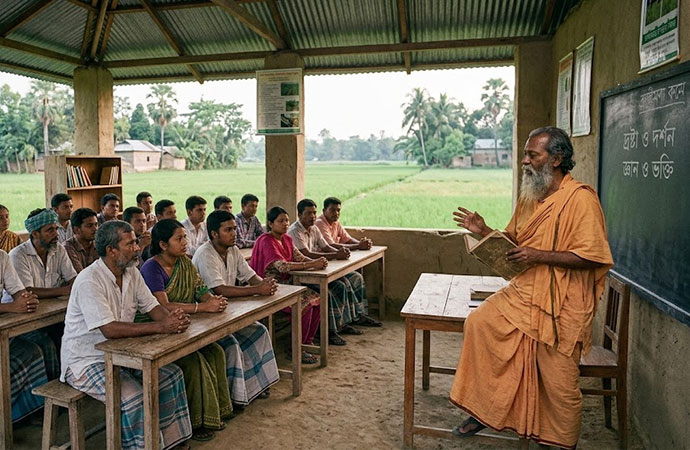
I was recently talking to a bunch of young scholars on various topics of their research and found that most are following paths and ways dug and built by previous era intellectuals. It's not like they were the giants of the mind of the past but the new generation talked more like a murid, a disciple, and not independent thinkers.
Many already had advanced degrees and some were already into their ph.d track but it seemed they felt more comfortable in following a loyalist path rather than be confidently independent.
This trend is many months old. Following the guru is part of our deep culture and interestingly our intellectual heroes are all European in origin even as they trash the West. Paradoxical but true.
Interestingly, if they can't find European as their mentor, personal or intellectual, the next best choice is as expected an Indian.
The Indo-European Marxist alliance
Of their gurus many are naturally Marxists. Though as an intellectual discipline it is on the wane in the global political and academic world, it's still popular in South Asia as the "great liberator." Since Marxism no longer bothers the West it is being allowed to die out gracefully.
A good example is the "subaltern" school, largely a product of Kolkata intellectuals of the Marxist variety but firmly located in the western academia. In the 60s it was influential but now with such ideas in general on the decline and the rise pf science-based academia it's a dying discipline.
Marxism is European sourced and failed in the two countries where it gained state power - Russia and China - it remains popular in South Asian because the intellectual is measured by activist indicators rather than academic achievements or rigor.
The South Asian mind also can relate to dogma much better than critical thinking. So just as religious ideas are accepted without question as its faith based and so considered beyond debate, so too is South Asian Marxism in many cases. Subjectivity is its main staple.
And just as the religious leaders are revered as "holy" so are these scholar-gurus. The end result is the production of Bangladeshi scholars with degrees from abroad who remain religiously loyal to an idea that has not succeeded anywhere and no application in the living world.
Religious leader or scholar?
But interestingly they are not the only group of scholars who are influential and faith based. They are the religious scholars spread all over the country whose brand is far more secure because religious belief structures are organic to society and just about anyone can be one without expensive stays abroad for years.
As a result, a nationwide network of scholars has also grown with their intellectual sources also located externally. Interestingly, these scholars too offer no new interpretation but are beholden to their scholars in history or elsewhere in the Middle Eastern world. What has already been said is as follows.
As it is more grounded than political ideologies of the West, it has millions of followers with local funding to which keeps them thriving.
Why does this pattern occur?
The peasant roots of Bangladeshi culture heavily shape political and religious loyalties through a traditional reliance on charismatic authority and communal solidarity. This often leads to dogmatic alignment rather than critical pragmatism. Innovation is further constrained by historical, social, and educational factors that prioritise conformity over independent critical inquiry.
Impact of Peasant Culture on Loyalty
Why this intellectual loyalty is so deeply entrenched can be understood in unpacking the peasant structural framework.
Patron-Client Ties: Traditional agrarian life relies on village leaders or landlords for security. This translates into modern political and intellectual devotion to strong iconic symbols and individuals.
Communal Solidarity: Peasant communities value group harmony and belonging. Disagreeing with the group feels dangerous or disloyal.
Religious Devotion: Religious traditions and rural piety foster deep emotional attachments to spiritual guides and sacred texts. Questioning these authorities is culturally discouraged.
Ideological Dogma: Marxism and religious fundamentalism both offer absolute answers. They mirror the need for a clear, protective moral framework.
Why Intellectual Innovation is weak
The memorial culture: Educational institutions often reward repeating facts instead of asking hard questions or testing new ideas. Memorising texts is held high as an achievement.
Social Hierarchies: Respect for elders and seniors discourages younger people from challenging established views.
Economic Survival Pressures: Daily financial struggles leave little room for risk-taking, creative research or innovative but "disloyal" thoughts and ideas.
Fear of Social Exile: Standing out with a novel or controversial idea risks rejection from the tight-knit community.
Hence what we see in the tradition of intellectualism in Bangladesh basically reflects the centuries old peasant realities and structures where independent thinking is risky and disruptive. Therefore, following the leader is considered more important than following up with any new ideas which will be considered subversive hence blasphemous, whether religious or political.
In the end, it's the history of agricultural social practises that decides the route of the Bangladeshi mind. History decides how we think.
A Independent Newsweekly
© Copyright 2026 | Designed by ARK Reepon & Developed by Cosmos Group Software Team






Leave a Comment
Recent Posts
The government passes the test ...
One of the cornerstones of the political earthquake Bangladesh witness ...
The government hiked the price ...
The government hiked the price of a 12kg cylinder of liquefied petrole ...
Police in France stand accused of using excessive fo ..
The India-Pakistan Cold War
A week on from DNCC’s eviction drive, Mirpur-10 rema ..
Equal Service, Unequal Pensions: Time for a Fairer S ..