


Column
All journalism is local


An Independent Newsweekly





Column
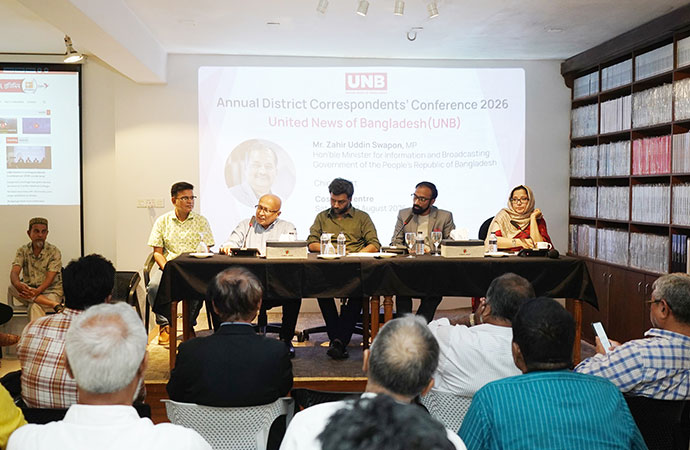
Photos: Tahiyat Nazifa Noor/ UNB
It was a pleasure to attend the United News of Bangladesh's annual District Correspondents' Conference in Dhaka on August 22. All 64 correspondents were there, giving me an opportunity to meet and hear first-hand from the people who make UNB a truly national news agency. To say this is not to play down the contributions of UNB's Dhaka reporters or the editorial staff at its headquarters in the Cosmos Centre. Dhaka is the capital of Bangladesh, and UNB is centred there. Yet, most of Bangladesh exists outside Dhaka, and the districts deserve their place in the Bangladeshi sun. It is this crucial fact that the conference confirmed.
Zahir Uddin Swapon, who was Information and Broadcasting Minister till the previous night, made an important point in his speech: the distinction between irresponsible "yellow journalism" and responsible "white journalism" was becoming increasingly blurred, thus posing a major challenge to the media industry. Calling on "white" journalists to help stop "yellow" journalists and isolate parasitic media and digital junk from mainstream journalism, Swapon said that the major challenge for new media, existing media and media policymakers was to ensure that information remained credible and objective.
Of course.
District or regional reportage plays an important role within that framework of news as the production, dissemination and receipt of trusted information.
In my humble remarks to the conference, I emphasised that all economics is global but that all politics is local. Likewise, all news is national but all readership is local. That is, while Bangladesh, say, cannot decide the outcome of the US-Iran war which is wreaking havoc on its energy market in a globalised economy, the government cannot leave the people to the mercy of the test of strategic wills between America and Iran. As a political entity, the government has to handle the effects of the crisis on the Bangladeshi people. The government is answerable to the people locally no matter what occurs globally.
In the same spirit, what happens in Dhaka in the economic, political and administrative spheres permeates down to places as far apart as Lalmonirhat and Chattogram. Different districts are affected differently. It falls therefore to district correspondents to reflect realities on the ground so that Lalmonirhat and Chattogram do not feel excluded from Dhaka's legitimate policy writ. This is apart from reporting on crime, violence, corruption and abuses of power in the districts. Such reportage, carried in UNB's portals, reminds readers and viewers in Dhaka that there is a Bangladeshi reality which extends far beyond the capital city, important though it is.
Indeed, district and grassroots journalism bridges the gap between national policies and constituent realities. Local correspondents highlight suburban and rural issues; track regional developments; and give a voice to marginalised populations, thus ensuring that the concerns of citizens outside major urban centres are heard.
In the quest to provide the communicative link between the capital and the districts, national news agencies such as UNB enjoy a certain advantage. They are by nature decentred. Their subscribers are publications that have to answer to the particular demographic profiles of their readers and viewers, but news agencies do not. They must cater to the needs of diverse news consumers. They are freer than others to reflect the realities of sub-divisions, districts and divisions because they know that different subscribers need this information to complement and complete their national coverage.
This diversification of news coverage is essential in Bangladesh, whose 64 districts compete for news space and time. Of course, Dhaka is important to all districts, but each district is also important to itself and seeks to be represented on the national information stage. That is why district correspondents are crucial to UNB and, indeed, to Bangladesh's journalistic knowledge of itself.
All journalism is a search for self-knowledge. In my interaction with the audience, I cited the legendary West Bengal editor Barun Sengupta, who founded the Bengali newspaper, Bartaman, in 1984. The story goes that, inspired by the paper's ability to speak truth to power, a poor farmer from a distant district sent in a letter about his problems and those of other farmers. Instead of cutting down the missive for the letters' page, Sengupta ran it as a Page One Lead. Kolkata woke up to the reality of farmers in the districts, whose agriculture fed the capital's intelligentsia.
This was local journalism at its best. A farmer's letter, turned into the chief news story of a Kolkata-based newspaper, proved that districts are crucial to the functioning of states within nations (as in the case of West Bengal) or countries themselves (as in the case of Bangladesh).
UNB is a national institution. Its district correspondents are constituent parts of the news nation.
I respect them for the work that they do.
Colleagues, so keep local journalism alive!
The writer is Principal Research Fellow of the Cosmos Foundation. He may be reached at epaaropaar@gmail.com
A Independent Newsweekly
© Copyright 2026 | Designed by ARK Reepon & Developed by Cosmos Group Software Team





Leave a Comment
Recent Posts
The government passes the test ...
One of the cornerstones of the political earthquake Bangladesh witness ...
The government hiked the price ...
The government hiked the price of a 12kg cylinder of liquefied petrole ...
Police in France stand accused of using excessive fo ..
The India-Pakistan Cold War
A week on from DNCC’s eviction drive, Mirpur-10 rema ..
Equal Service, Unequal Pensions: Time for a Fairer S ..