


Reportage
Teesta sets the course for Dhaka’s new direction


An Independent Newsweekly
Reportage
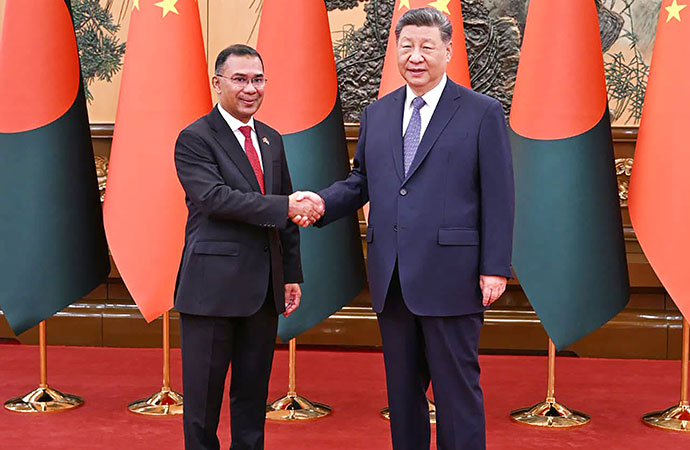
Bangladeshi Prime Minister Tarique Rahman with Chinese President Xi Jinping. Photo: Bangladesh Nationalist Party-BNP Facebook page
The leading takeaway from Prime Minister Tarique Rahman's visit to China as part of his first foray abroad, would have been the commitment secured on the Teesta River megaproject, an ambitious vision that dares to reimagine the landscape of northern Bangladesh along its banks.
A joint feasibility study was agreed upon as the most acceptable starting point, as China became more sensitive to Bangladesh's need to slow-ball the project.Bangladesh and China agreed to expedite a joint feasibility study on the Teesta River Comprehensive Management and Restoration Project (TRCMRP).
"We have agreed to conduct a joint feasibility study with experts from both sides. If the feasibility study justifies the project, China will extend adequate support for its implementation," Foreign Minister Khalilur Rahman told reporters at the Ministry of Foreign Affairs this week.
Seeking deeper cooperation with Bangladesh in integrated water resources management, China decided to provide support 'within its capacity' to the TRCMRP.
The Chinese side will also support experts from both countries in expediting the feasibility study of the project and relevant work, according to the joint statement shared by the Ministry of Foreign Affairs at the end of Tarique Rahman's visit to China, where he held summit level talks with Chinese President Xi Jinping.
The two sides agreed to deepen cooperation in such areas as integrated water resources management, water resources planning, hydrological forecasting, flood prevention and disaster reduction, river dredging, and related technology sharing.
On the same day in Beijing, reiterating its support for the TRCMRP, the Chinese side said cooperation between Bangladesh and China should be free from third party influence.
"I would like to stress that China-Bangladesh cooperation does not target any third party and should be free from third party influence," Chinese Foreign Ministry Spokesperson Guo Jiakun told reporters while responding to a question.
The spokesperson stated China's position after a reporter flagged India's concerns over Teesta cooperation between Bangladesh and China.
"The comprehensive treatment and restoration of the Teesta River is a livelihood project to which the Bangladeshi side attaches high importance. China is ready to do what it can to support this project," said Guo.
When Xi Jinping visited Bangladesh in 2016, the two sides signed numerous memorandums of understanding (MoUs). One of those included river management with dozens of others "on the basis of mutual benefit and equality." China pledged its technical support for land reclamation due to climate change both in the sea and river.
In reference to those MoUs, the Bangladesh Water Development Board and Power Corporation of China signed an MoU to work in the water sector in Bangladesh and they did a feasibility study based on the Teesta River. Then the Chinese Power Corporation submitted the TRCMRP report which was approved on May 30, 2019.
Thus, the Bangladesh government in partnership with China, designed the Teesta River Comprehensive Management and Restoration Project, in a bid to solve the long-standing Teesta River water crisis.
Dhaka's prerogative
On Thursday (Jul. 2), the Chinese Ambassador to Dhaka, Yao Wen, stated that in response to Dhaka's request, China had come forward with the large-scale Teesta project, which is directly linked to the lives and livelihoods of Bangladeshi citizens in the northern region. Beyond this, China has no other interests, he insisted.
Ambassador Yao Wen said this in response to journalists' questions during a briefing at the Chinese Embassy, that was organised in light of the recent visit of Bangladesh Prime Minister Tarique Rahman to China.
Yao Wen began by speaking on Prime Minister Tarique Rahman's visit to China.
He then answered various questions from the journalists. Highlighting the Teesta project as one of the most important outcomes of Prime Minister Tarique Rahman's visit, the Chinese Ambassador stated that the livelihoods of people around the river are linked to the project. At Bangladesh's request, China will provide maximum assistance for this project.
When attention was drawn to the signing of the MoU mentioned earlier between BWDB and Power Corporation of China regarding the Teesta project, the Chinese Ambassador said, "The previous Memorandum of Understanding was between a Chinese company and a Bangladeshi government entity. But we are talking about cooperation at a governmental level in this project. Chinese companies can conduct their surveys. We will conduct surveys with the best scientists. If the project is to move forward, surveys are necessary. The Chinese government will work with the Bangladesh government to advance these surveys. We are committed in this regard."
It was raised that India has some concerns about Chinese involvement in the Teesta, and whether it will be effective if India does not release water from upstream - an absurd suggestion that India would be so aggrieved as to start breaking international law.
In response, the Ambassador said, "You are talking about other elements. This is not our concern. China has come forward according to Bangladesh's expectations."
Yao Wen described the just-concluded visit of Prime Minister Tarique Rahman to China as a "complete success", stressing that the visit injected strong momentum to Dhaka-Beijing growing relations.
"It's a complete success. It's a milestone in Bangladesh-China relations which reached a new strategic height," he told reporters at the Embassy highlighting the outcomes of the visit.
The Ambassador said a new level of trust developed between the two countries with this visit and described the proposed Bangladesh-Mynamar China Economic Corridor as a new strategic opportunity.
Responding to a question, Ambassador Yao said the issue of building an Economic Corridor is not new as 15 years ago, there were discussions on Bangladesh-China-India-Myanmar (BCIM) Economic Corridor but there had been no progress.
He said China is determined to build the Bangladesh-China-Myanmar Economic Corridor for broader regional cooperation. The Ambassador said China remains open to India and any other countries to join, but those countries need to make decisions.
He also talked about the key achievements of the Prime Minister's visit to China - the launch of a strategic dialogue at the foreign minister level and the exploration of a "2+2" dialogue mechanism covering diplomacy and defence.
Talking about defence cooperation, Ambassador Yao said Bangladesh-China cooperation is comprehensive and defence cooperation is part of that. He declined to make comments on any specific defence purchase.
Nerves in the neighbourhood
The reason behind Ambassador Yao Wen's repeated reassurances of Beijing having no interests beyond the humanitarian, when it comes to the Teesta project, is of course the acute sensitivities across the border in India, the visible discomfort in New Delhi, at seeing Bangladesh take this step.
The BNP government's outreach to China on the Teesta project signals continuity with a diplomatic trajectory set during the interim government of Muhammad Yunus. During Muhammad Yunus's visit to Beijing in March 2025, the interim government had explicitly welcomed Chinese participation in the TRCMRP. The joint statement from the Yunus visit marked the first time Bangladesh had formally welcomed China's role in the Teesta project in a bilateral document.
In June 2025, after a five-day visit to China by a BNP delegation, party secretary general Mirza Fakhrul Islam Alamgir told reporters that the party would consider China's Teesta proposal positively if it came to power. "We explained our needs and requirements regarding this project, and they responded positively," Fakhrul said.
India has long opposed China's involvement in the Teesta project, viewing it as an expansion of Beijing's influence in a country where Chinese firms have already executed several high-profile infrastructure projects. But none of this transpired out of the blue. For anyone watching would have seen the cards fall precisely where we see them today.
It was during Foreign Minister Khalilur Rahman's mission to Beijing in May that the modalities of the Tarique visit were set, during which a formal request was entered for China's involvement in the Teesta River Comprehensive Management and Restoration Project. Indian Foreign Secretary Vikram Misri, suddenly sounding panicked, had told visiting Bangladeshi journalists in New Delhi at the time that India was ready to hold talks on the project with Dhaka.
Misri, in answer to China's proposal for a large-scale Teesta development project, said India had already submitted its own proposal to Bangladesh and remained prepared to advance discussions if Bangladesh's new government wished to pursue the matter.
Misri's meeting with the Bangladeshi reporters took place on the day that results came out from the West Bengal assembly elections, which the BJP won. Asked whether the change of government in Kolkata might create momentum for progress on the long-stalled Teesta water-sharing agreement, Misri said, "I do not wish to speculate in advance."
He added that meetings of the Joint Rivers Commission and relevant technical bodies would soon be held to discuss water-sharing issues involving the Ganges, the Teesta and other rivers.
The Teesta water-sharing agreement between India and Bangladesh has been stalled for over 15 years. In 2011, a proposed treaty on the allocation of the river's waters was blocked by then West Bengal chief minister Mamata Banerjee, who argued it would harm the state's agricultural interests.
Unable to secure the water-sharing pact, Bangladesh has been forced to move towards a conservation and management approach within its own territory, particularly to mitigate the effects of the dry season. The TRCMRP, estimated at around $1 billion, involves the construction of a large reservoir to store surplus monsoon run-off, deepening the Teesta's riverbed, and building wide embankment roads along with satellite cities.
It was typical of Xi at his worldly best. By including the MoU between the Bangladesh Water Development Board and Power Corporation of China to work in the water sector in Bangladesh, he opened the door to showing Bangladesh an alternative vision for the Teesta region, at a time when progress on the water-sharing pact with India had completely stalled. But with a subservient, pliant government installed in Dhaka, Delhi never had a thing to worry about. BWDB and China Power Corporation commenced the feasibility study based on the Teesta River.
Based on the final document they submitted in late 2019, the Chinese have been ready since 2020 to get involved, but Dhaka was always reluctant of course, under the old regime.
Bangladesh sought a $725 million soft loan from Beijing, but China was initially cautious about the project's long-term financial viability. In December 2023, the Chinese ambassador said at a conference in Dhaka that China had submitted a revised proposal for phase-by-phase implementation at a lower cost.
According to reporting in The Wire, India attempted to pre-empt China's role during Sheikh Hasina's state visit to New Delhi in June 2024. Prime Minister Narendra Modi announced that an Indian technical team would visit Bangladesh to discuss conservation and management of the Teesta. The offer had come after then foreign secretary Vinay Kwatra visited Dhaka and offered Indian assistance for the project. Hasina herself told reporters after her subsequent China visit in July 2024 that while Beijing was ready to take on the project, she preferred India to handle it. She would be gone in less than a month of course.
Reimagining the Barind Tract
Since the Teesta River is in the Barind Tract, the population of this area is largely dependent on agriculture. This area is a large supplier of Bangladesh's rice and vegetables. The Barind Tract is the largest Pleistocene-era physiographic terrace in Bangladesh, covering roughly 10,000 sq km across the Rajshahi and Rangpur divisions. Once a drought-prone, semi-arid landscape, it transformed into a major agricultural hub, but now faces severe climate challenges and groundwater depletion.
The Teesta, before it enters Bangladesh from India, has around 35 barrages to divert its waters. India has constructed dams on its side and withdraws water from the river. Due to this water withdrawal and riverbank erosion, the livelihoods and settlements of people living along the Teesta in Bangladesh are under threat.
Experts say that the lack of water in the Teesta during critical periods has hindered poverty reduction in the northern districts of Gaibandha, Nilphamari, Lalmonirhat, Rangpur, Kurigram, and Dinajpur.
In the rainy season, the river has around 280,000 cusecs of water; which comes down to around 10,000 cusecs at times. In some places, it is occasionally below 1,000 cusecs.
The Teesta River Project is a comprehensive management and restoration project that is designed to restore and manage a 100 KM stretch of the Teesta River in the Bangladesh territory. Indian and Bangladeshi formal transboundary water-sharing treaty with India has been stalled so Bangladesh pivoted to a localised engineering solution and with China's involvement.
The main objective of the project is to address Bangladesh's seasonal water crises. Its core features include river dredging to deepen the silted riverbed to prevent seasonal overflow of the water. Some of the core components of the project would involve embankment construction on the river banks as barriers to stop soil erosion that caused the displacement of families, construction of large internal water reservoirs for harvesting and restoration of monsoon water for the dry seasons, creating a large network of canals to safeguard agricultural productivity across the Teesta basin.
A Independent Newsweekly
© Copyright 2026 | Designed by ARK Reepon & Developed by Cosmos Group Software Team





Leave a Comment
Recent Posts
An unaccountable process leave ...
The latest price hike of all four major petroleum products by Tk 20 pe ...
The French Connection in South ...
France Ambassador to Bangladesh Jean-Marc Séré-Charlet h ...
Ties with China enter new phase
Happy 61st birthday, Singapore!
In defiant speech, Pezeshkian calls out Trump and sa ..
The banality of evil