


Reportage
Makkah Calling?


An Independent Newsweekly
Reportage
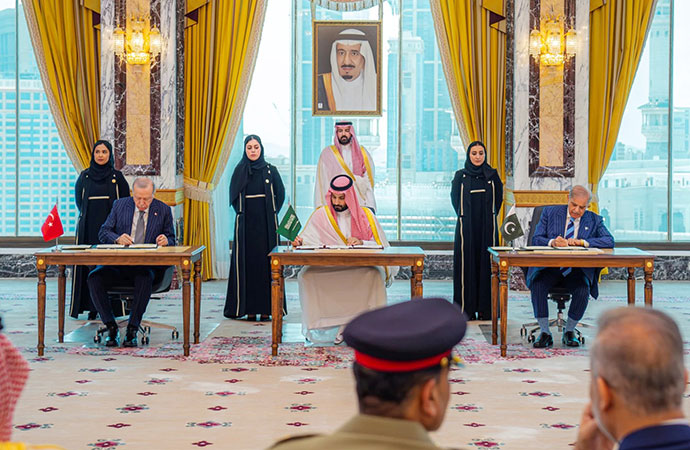
From left, Turkish President Recep Tayyip Erdogan, Saudi Crown Prince Mohammed bin Salman and Pakistani Prime Minister Shehbaz Sharif sign a trilateral defense agreement in Mecca, Saudi Arabia, Friday, Aug. 7, 2026. (Saudi Press Agency via AP/UNB)
Muslims don't invoke Makkah lightly. They are not meant to. And war has a way of accelerating decisions that diplomats or even leaders spend years deferring. That is essentially what happened last month, when Saudi Arabia, Turkey, and Pakistan chose to sign the Makkah Joint Defence Agreement (MJDA), a pact that is most notable for adopting a version of NATO's famed Article 5, by declaring that an attack on any one country that is a signatory will be treated as an attack on all the signatories.
Crown Prince Mohammed bin Salman, President Recep Tayyip Erdogan, and Prime Minister Shehbaz Sharif signed the agreement in Makkah at what the three governments called the 'Makkah Al-Mukarramah Summit for Joint Defence'. Al Mukarramah, an honorific for Makkah, highlights the holy and revered status of the city in Islam. The timing was not incidental, and nor was the naming. Eighteen months into a war pitting the United States and Israel against Iran, Saudi Arabia has absorbed repeated missile and drone strikes, and confidence in Washington's willingness to backstop Gulf security has visibly eroded.
Almost immediately touted as an "Islamic NATO," it can be tempting to assume membership must be open to all Muslim nations, considering the city it was named after. But that assumption would be wrong, even though the discourse in Bangladesh over the last few weeks may suggest Dhaka at least, holds an open invitation. That is why we must try and understand the finer points of the agreement first, before reaching a decision on whether it is for us, what benefits may accrue, and the assorted risks that would be part of the package.
The MJDA did not emerge from nothing. Riyadh and Islamabad had already built a bilateral floor for it through what is called the Strategic Mutual Defence Agreement, signed at Riyadh's Al-Yamamah Palace, the official seat of the House of Saud, in September 2025. That too committed both states to collective Defence and formalised a military relationship - Pakistani training of Saudi forces, chiefly, that predates the treaty by decades. Contrary to some of the wild speculation it ignited, the agreement did not extend Pakistan's nuclear umbrella to Saudi Arabia.
Pakistan holds the only nuclear arsenal in not just the MJDA, but also the Muslim-majority world, estimated at roughly 170 warheads, while it continues to develop a separate arsenal of 'tactical' nuclear weapons. Its inclusion in the pact inevitably raises the question of extended deterrence for Saudi Arabia. Yet there is nothing in the agreement that says so explicitly. For its part, Islamabad has long maintained that its weapons are aimed at a different adversary entirely, and fall outside the purview of its Gulf commitments.
A senior Saudi official, pressed on whether the kingdom could now count on nuclear cover, would go no further than calling the agreement "comprehensive" and covering "all military means". That is not a denial. It is also not a confirmation. Riyadh appears content to let the ambiguity itself do deterrent work against Iran, without ever having to test whether Islamabad would honor it.
Turkey's addition is drawn from a separate track: Ankara and Islamabad had spent years exchanging warships and training pilots, and in 2023 Saudi Arabia placed what Turkish officials at the time called their largest-ever Defence export order, for Turkish-made drones. Makkah therefore is not so much a new alliance as it is a merger of two bilateral relationships that were already converging. That matters for how durable the pact ultimately proves.
The Egypt Question
The most conspicuous name missing from the Makkah signature line is Egypt, and we are made to understand the omission was not for lack of trying. Cairo sat alongside Saudi Arabia, Turkey, and Pakistan in a round of foreign ministry-level talks on the sidelines of the Riyadh Summit of Arab and Islamic nations in March 2026, with Ankara reportedly pushing for a quadrilateral rather than trilateral arrangement. That track stalled, and by the time the treaty was signed in August, Egypt had dropped out of the frame entirely. There has been no satisfactory explanation for this from anyone.
A Turkish official, asked about the pact's scope, described it as open to other "brotherly nations" without naming Egypt specifically. Analysis by the Arab Center in Washington frames Cairo's absence as the result of incomplete negotiations, rather than deliberate exclusion. Yet another track that was simply slower than the other two, not a veto.
The joint statement issued by the Saudi Press Agency and Pakistan's Foreign Ministry describes the agreement's purpose as strengthening collective deterrence, with any armed attack on one signatory to be regarded as an attack on all three, alongside a general commitment to deepening Defence cooperation. Commentators moved quickly to the NATO comparison, pointing to the resemblance between this clause and Article 5 of the North Atlantic Treaty. The comparison may strike some as premature.
NATO's Article 5 sits inside 75 years of "integrated command structures, standing forces, and codified planning". The MJDA and its signatories, at least for now, can point to no such machinery, while nothing in the agreement's text, at least the parts of it released in public, obliges any signatory to take a particular military action if another is attacked. To be fair, lack of specificity is a feature of Article 5 itself, the suggestion being its ambiguity can be an advantage as much as the opposite.
After the Iran WarThe proximate cause is the war that began on February 28, 2026, when the United States and Israel struck Iran. Saudi Arabia has since taken fire from Iranian forces directly and from Tehran's regional partners, the Houthis in Yemen, allied militias in Iraq, while watching its oil exports and development plans absorb the cost. Reporting indicates that the United States has been unable to keep every partner supplied with sufficient air-Defence munitions while Israel's own needs compete for the same stockpiles, and Iran's periodic closure of the Strait of Hormuz has added a second layer of economic damage across the region. None of this has broken the US-Saudi relationship. It has, however, made Riyadh unwilling to treat that relationship as sufficient on its own.
That distinction is worth dwelling on, because it is where much of the commentary gets the pact wrong. Yasmine Farouk of the International Crisis Group has noted that all three signatories remain American partners and understand that no regional arrangement can substitute for Washington outright. This is hedging, not defection. Saudi Arabia is not choosing Ankara and Islamabad over Washington; it is declining to have only one option.
Turkey's calculus differs somewhat. Erdogan already extends security relationships to Qatar, Syria, and Libya, and Makkah folds Saudi Arabia's financial weight into what several Atlantic Council analysts now describe as a broader Muslim-world Defence network centered on Ankara. For Erdogan, the pact is less about diversifying away from any single patron and more about consolidating a role Turkey has been building for years.
Set the legal ambiguity aside for a moment and look at what each state actually brings to the table, because that is where the pact's real weight lies. Saudi Arabia supplies money and a well-equipped air force. Turkey supplies NATO's second-largest army and a Defence-industrial base already exporting drones and air-Defence systems into the kingdom. Pakistan supplies manpower with genuine combat experience and, unstated but unmistakable, its nuclear status.
Mansoor Ahmed has summarized this as Pakistan and Turkey providing Defence-industrial and personnel depth against Saudi capital, and the arrangement is already operational rather than theoretical: Pakistan has reportedly deployed some eight thousand troops, along with fighter aircraft, drones, and an air-Defence system, into the kingdom, and is separately negotiating a security-for-investment arrangement with Kuwait that suggests this model could extend well beyond the three original signatories.
Tehran's response was quick and unimpressed. A member of the Iranian parliament's national security committee dismissed the pact publicly, arguing that a paper agreement with Turkey and Pakistan would do no more for Saudi security than decades of dependence on Washington had. Israel offered no official comment, though the pact's implications for Israeli military freedom of action are being taken seriously in Israeli commentary that had, even before Makkah, described a Turkish-Pakistani axis as a potential hostile bloc.
India's Ministry of External Affairs gave the blandest possible response, that it was "closely following" the development, which, given India's historical sensitivity to anything touching Pakistan's nuclear posture, is itself a data point. Washington, for its part, had said nothing official in the days immediately following the signing.
Understanding the Pact
The Arab Center, which is patronised by Qatar's ruling family, has given a four-part breakdown of the MJDA's implications, that sounds eminently sensible.
First, the Arab Center says, this is not a NATO analogue, and treating it as one overstates both its binding force and its novelty. It is closer, the center says, to a formalised political signal than a military alliance with teeth.
Second, the pact's actual value to Riyadh may lie less in any specific Defence guarantee than in the ambiguity itself, as "an unspecified nuclear-adjacent commitment" can deter without ever being invoked, whereas a specific one would have to be tested.
Third, the durability of the arrangement is described by the Arab Center as "not really a function of the treaty text at all". In this reading, Washington still holds the cards to shape the future of this alliance. It all depends on how the Iran war ends, and on whether the United States responds to this hedge by tightening its own commitments, or by treating the pact as evidence that it can afford to step back.
Fourth, Egypt's absence is framed by the Center as a measure of how thin the pact's institutional commitments really are: a state with every stated interest in Gulf and Red Sea security, and a seat at the earlier quadrilateral talks, chose not to sign a document whose obligations cost so little on paper that Riyadh, Ankara, and Islamabad could commit to it within months. And so the MJDA answers a question about intent: these three states want more options, without yet answering the harder question of what any of them, Egypt included, would actually do if the clause were tested.
What pulls Bangladesh
Bangladesh's current government, headed by the center-right Bangladesh Nationalist Party (BNP), is in favor of the Makkah agreement.
"We view this pact positively," Bangladeshi Foreign Minister Khalilur Rahman said in response to a question in parliament last week.
But he insisted that the question of Bangladesh joining the pact, or even considering membership, had not yet arisen, as that would depend on the intentions of its current members.
"If they express an intention to include Bangladesh in the pact, we will certainly consider it positively," he said.
Describing the "Makkah Pact" as a unique pact, State Minister for Foreign Affairs Humaiun Kobir said Bangladesh sees no risk in the pact, saying the country will continue to maintain balanced relations with different international partners.
"What is the point of worrying about dying before you even live? I mean, if we start worrying about risks before even initiating the process, that becomes a problem," he told reporters at the Ministry of Foreign Affairs when a journalist drew his attention about the likely advantages and the potential risks associated with the pact.
The State Minister said this is a "unique pact" that has been initiated and these are new opportunities.
Entering into one specific sphere within today's volatile or crisis-driven international political climate does not mean a particular country cannot contribute to other alliances or fields, Kobir said. "It does not restrict your scope. Not necessarily. You have to approach," he said.
The State Minister said a country like Bangladesh must approach foreign policy and security cooperation in a "very integrated and flexible" manner, aligned with the dynamics of the current international political system.
Based on this, he said, there is no risk involved here. "We will balance our international relations. Bangladesh stands for global peace and stability, and wherever peace and stability are the primary goals, Bangladesh will always be present," Kobir said.
Asked about Bangladesh's position on the pact, he said the country's long experience in UN peacekeeping provides a strong basis for contributing to peace and stability in the Muslim world.
"Bangladesh is a huge contributor to international peacekeeping under the United Nations framework. Maintaining peace is not a new concept for Bangladesh; we have extensive experience and expertise in this area, and we are recognised globally for it. We do this all around the world, so why should we not do it for our Muslim brotherhood here? Especially when it involves Muslim nations, particularly the Kingdom of Saudi Arabia, who are the Custodians of the Two Holy Mosques," Kobir said.
Approaching this with a positive spirit to step forward and assist with some of the challenges in the Muslim world is not a bad thing at all, he said.
"Therefore, we view it positively. Discussions on these matters have progressed constructively, and let's see how things develop as we engage further. We view this very positively," he said.
Asked whether Bangladesh has discussed the issue with Saudi Arabia and Turkey on the sidelines of an OIC meeting and whether a formal invitation has been extended, Kobir said discussions are ongoing. "Yes, talks took place. Conversations were held, positively, very positively."
When a formal invitation is extended, Kobir said they will certainly inform the media. "We are currently holding discussions on this matter, and those discussions are progressing positively with all bilateral partners," he said.
"As I mentioned, Bangladesh's expertise and experience are actively sought after. We are not new to this field, nor are we novices in peace operations. We are experts, contributing one of the largest contingents to the UN peacekeeping system," Kobir said.
"Thus, we stand at the forefront of international ground security. We contribute because our participation brings distinct value - not because there are no other options, but because stakeholders recognize that Bangladesh genuinely adds value due to its rich experience and expertise," he added.
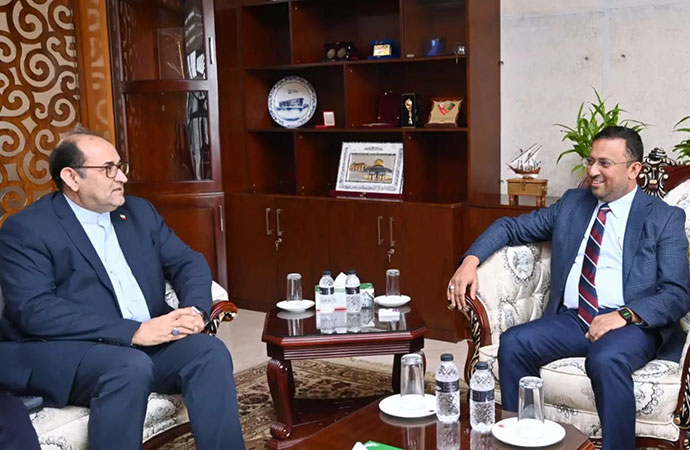
Earlier, Saudi Ambassador to Bangladesh Dr Abdullah Zafer bin Abiyah called on the State Minister for Foreign Affairs and both sides expressed satisfaction over the steady progress of cooperation between Bangladesh and Saudi Arabia across various sectors.
When asked about the remarks made by Bangladeshi officials, India said the pact had implications for its national security and that it was closely monitoring the situation.
"We continue to follow all developments that have a bearing on India's security and take all necessary steps to safeguard it," Randhir Jaiswal, a spokesperson for India's Ministry of External Affairs, told reporters in New Delhi last week.
Dhaka-based former diplomat M Humayun Kabir sees no reason for Bangladesh to join the pact. "Bangladesh has not joined any military alliance over the past 50 to 55 years. As far as I am concerned, I believe that position remains unchanged to this day," he said.
"They are talking about a regional security arrangement, but the region in question concerns Pakistan and the Middle East. We are not part of that region or geographical area. Bangladesh is located in the eastern part of South Asia. Therefore, there is no direct geographical rationale for Bangladesh to participate in such a military alliance," he added.
A Independent Newsweekly
© Copyright 2026 | Designed by ARK Reepon & Developed by Cosmos Group Software Team






Leave a Comment
Recent Posts
An unaccountable process leave ...
The latest price hike of all four major petroleum products by Tk 20 pe ...
The French Connection in South ...
France Ambassador to Bangladesh Jean-Marc Séré-Charlet h ...
Ties with China enter new phase
Happy 61st birthday, Singapore!
In defiant speech, Pezeshkian calls out Trump and sa ..
The banality of evil