


Reportage
Going East


An Independent Newsweekly

Reportage
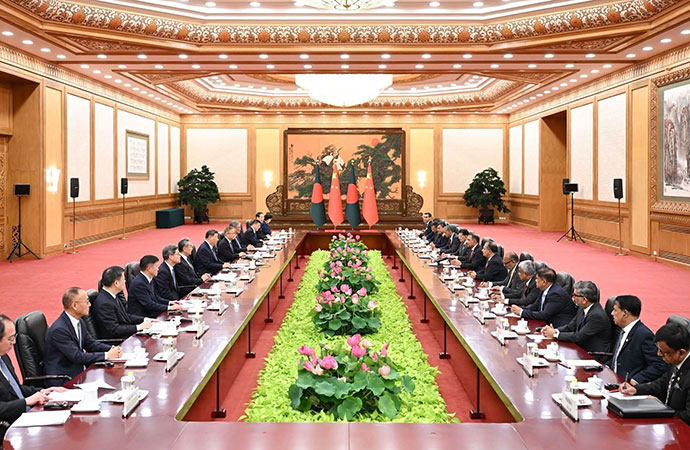
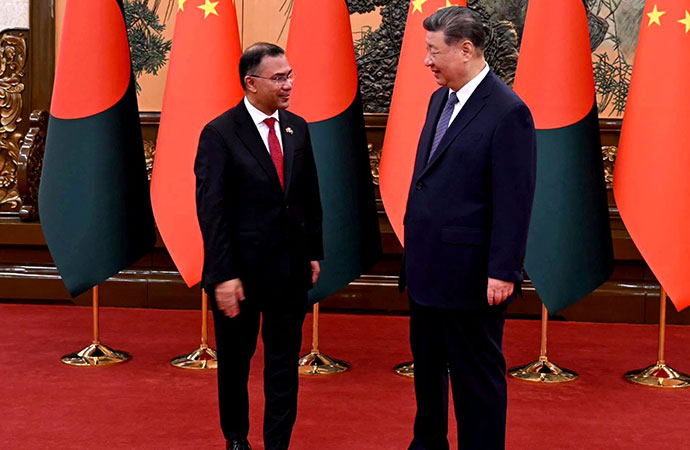
President Xi Jinping meets with Bangladeshi Prime Minister Tarique Rahman, who is on an official visit to China, at the Great Hall of the People in Beijing, capital of China, June 26, 2026. Photo: Bangladesh Nationalist Party-BNP Facebook page
Prime Minister Tarique Rahman on Friday (Jun. 26) completed a successful visit to China, part of his first foray abroad since his BNP government assumed power in Bangladesh last February, that started with a visit to Malaysia.
The Prime Minister's China visit concluded with a visit to the Museum of the Communist Party of China (CPC) after his meeting with Chinese President Xi Jinping on Friday morning at the Great Hall of the People.
The two leaders discussed trade, investment, infrastructure, connectivity and other issues of mutual interest.
Earlier in the day, Tarique Rahman paid tribute to the Chinese revolutionary heroes by laying a wreath at the Monument to the People's Heroes in Tiananmen Square. He also met Zhao Leji, Chairman of the Standing Committee of the National People's Congress.
On Thursday, the Prime Minister held bilateral talks with Chinese Premier Li Qiang. The two sides discussed expanding cooperation in trade, investment, infrastructure, water resources and other sectors.
Following the talks, Bangladesh and China signed 13 MoUs covering a wide range of areas of cooperation. Three more MoUs were signed between the Bangladesh Investment Development Authority (BIDA) and Chinese business organisations, while another was signed between the Bangladesh Nationalist Party (BNP) and the Communist Party of China (CPC), bringing the total number of agreements signed during the visit to 17.
During his stay in Beijing, Tarique Rahman also met Chinese Minister of Water Resources Li Guoying and Liu Haixing, Minister of the International Department of the CPC Central Committee.
He addressed the "Invest Bangladesh" conference, where he invited Chinese companies to expand investment in Bangladesh. Senior executives of several leading Chinese companies also met him to discuss investment opportunities and development cooperation.
The Prime Minister arrived in Beijing on Wednesday by high-speed train from Dalian after attending the World Economic Forum's Annual Meeting of the New Champions, widely known as Summer Davos.
During the forum, he addressed a session on climate leadership, took part in the plenary session and held a series of bilateral meetings with world leaders, including World Economic Forum President and CEO Alois Zwinggi.
The China tour followed his two-day official visit to Malaysia on June 21-22 at the invitation of Malaysian Prime Minister Anwar Ibrahim.
During the Malaysia visit, Tarique Rahman held bilateral talks with Prime Minister Anwar Ibrahim, met King Sultan Ibrahim, exchanged views with members of the Bangladeshi community and held meetings with executives of five leading Malaysian companies to encourage investment in Bangladesh.
He travelled directly from Kuala Lumpur to Dalian on June 22 night.
Xi pledges support
Xi Jinping on Friday pledged long-term support for Bangladesh's development and expressed China's readiness to support Prime Minister Tarique Rahman's development vision, as the two leaders held talks in Beijing aimed at taking bilateral relations to new heights.
Prime Minister's Foreign Affairs Adviser Humaiun Kobir disclosed the details while briefing reporters at the Diaoyutai State Guest House following the meeting.
During the talks at the Great Hall of the People, President Xi told Prime Minister Tarique Rahman that China will remain a trustworthy friend of Bangladesh in its development journey, the adviser said.
He said President Xi stressed that the friendship and partnership between the two countries will not be temporary but will constitute a long-term commitment by the People's Republic of China, under his leadership, to Bangladesh's development.
"President Xi emphasised that Prime Minister Tarique Rahman's visit will further accelerate the development of our country in every way," Humaiun said.
He said the Prime Minister also held a rare one-on-one meeting with Chinese President Xi Jinping following their official bilateral talks.
Humaiun described the private meeting as "unprecedented". "This is an unprecedented event. Prime Minister Tarique Rahman held a one-on-one meeting with His Excellency Chinese President Xi Jinping," he said, adding that it reflected the importance China attaches to both Prime Minister Tarique Rahman and Bangladesh.
He said China stands ready to support Prime Minister Tarique Rahman's vision for Bangladesh's development, economic transformation, regional cooperation and stability.
The adviser also said the Chinese President praised Tarique Rahman's vision and expressed full confidence in his leadership.
He also said China expressed support for Bangladesh's aspiration to join BRICS and become a partner of the Shanghai Cooperation Organisation (SCO), while backing Dhaka's interests regarding the Regional Comprehensive Economic Partnership (RCEP), which could significantly enhance Bangladesh's access to regional markets.
Earlier in the day, Humaiun said Tarique Rahman held a meeting with Zhao Leji, Chairman of the National People's Congress of China. Zhao is widely regarded as one of China's most influential leaders, serving as the third-ranking member of the Standing Committee of the Politburo and holding a position equivalent to that of a parliamentary speaker.
During the meeting, he said Zhao reaffirmed China's commitment to supporting Bangladesh's development and prosperity under Prime Minister Tarique Rahman's leadership.
The adviser said Zhao underscored China's strong alignment with Bangladesh's development priorities and assured continued Chinese support, including a constructive role in advancing the country's development agenda.
According to him, the Chinese leader highlighted prospects for cooperation in a range of sectors, including health, education, skills development, vocational training, water resources management and river management.
Humaiun said Zhao also conveyed that China viewed Bangladesh's leader as a close partner with whom it was keen to work more closely.
He quoted Zhao as saying that by working together, Bangladesh and China could become a united force representing the interests and aspirations of the Global South.
"This demonstrates the importance China's leadership at every level has attached to Prime Minister Tarique Rahman's historic visit," the adviser said.
He said the Prime Minister's engagements with Chinese business leaders and representatives of various industries were expected to generate billions of dollars in investment commitments.
In addition to investment opportunities, discussions also covered concessional financing and grant assistance.
"At a time when grant financing has become increasingly scarce globally, China has pledged grants worth more than US$300 million," Humaiun said.
Summing up the visit, he described it as both historic and transformative.
"This visit has not only been historic, but has also marked the beginning of a new era. It has highlighted Prime Minister Tarique Rahman's leadership, his vision for Bangladesh's development, and his approach to regional cooperation and stability, which are gaining recognition among major world leaders," he said.
Joint statement stresses cooperation
The 15-point joint communiqué was issued on Friday afternoon, containing important insights into the discussions.
It said seeking deeper cooperation with Bangladesh in integrated water resources management, China has decided to provide support within its capacity to the Teesta River Comprehensive Management and Restoration Project (TRCMRP).
The Chinese side will also support experts from both countries in expediting the feasibility study of the project and relevant work, according to the joint statement shared by the Ministry of Foreign Affairs.
The two sides agreed to deepen cooperation in such areas as integrated water resources management, water resources planning, hydrological forecasting, flood prevention and disaster reduction, and river dredging, and related technology sharing.
They also agreed to strengthen cooperation in maritime affairs.
Bangladesh commended China's constructive role in promoting the resolution of the issue concerning the forcibly displaced people from Rakhine State of Myanmar who have taken shelter in Bangladesh.
The Chinese side commended Bangladesh for providing humanitarian assistance to those people, and supported Bangladesh and Myanmar in finding a mutually acceptable solution through friendly consultations. China will continue to facilitate this process to the best of its capabilities.
During the visit, the two sides signed a number of cooperation documents in sectors including development cooperation, human resources cooperation, agriculture, education, trade and investment and media cooperation.
Prime Minister Tarique Rahman expressed his heartfelt appreciation to the government and the people of China for the warm and friendly reception extended to him and his delegation, and invited the Chinese leadership to visit Bangladesh at a mutually convenient time.
The two sides conducted an in-depth exchange of views on China-Bangladesh relations, and international and regional affairs of common interest and reached a broad consensus.
China will continue to support Bangladesh to the best of its capacity in advancing the economic and social development of Bangladesh, the joint communique said.
China will strengthen cooperation with Bangladesh in trade, e-commerce, industrial and supply chains, and investment, in order to upgrade its export capacity and jointly uphold the multilateral trading system, according to the joint statement.
Bangladesh appreciated China for the zero-tariff treatment for 100 percent tariff lines, and will foster a favorable environment for Chinese enterprises to invest in Bangladesh.
The two sides agreed to jointly advance the Mongla Port Facilities Modernization and Expansion Project and the development of the Chinese Economic and Industrial Zone in Chattogram.
The two sides agreed to strengthen cooperation in such areas as connectivity, scientific and technological innovation, information and communications, green energy, photovoltaic technology, disaster prevention and mitigation, and addressing climate change.
Both sides agreed to explore newer options for regional connectivity, including direct connectivity between China and Bangladesh.
The two sides agreed to deepen defense cooperation including exchanges, visits and training. Both sides agreed to maintain mutual understanding and engagement on U.N. peacekeeping affairs.
The two sides commended the successful commemoration of the 50th anniversary of China-Bangladesh diplomatic ties and the Year of China-Bangladesh People-to-People Exchanges in 2025.
They agreed to deepen people-to-people exchanges and cooperation in such areas as media, think tanks, education, films, publishing, youth, sports and culture.
The two sides will strengthen cooperation in human resources development and support closer cooperation between universities and vocational colleges. The two sides agreed to deepen practical cooperation in such areas as public health and traditional medicine.
Bangladesh welcomed and appreciated Chinese cooperation at subnational levels such as Yunnan Province in medical and health care.
Bangladesh appreciated and supported the vision of building a community with a shared future for humanity and the series of Global Initiatives put forward by President Xi Jinping, and stood ready to carry out cooperation with China.
China supported Bangladesh in playing a greater role in multilateral institutions such as the UN, and supported Bangladesh to participate in the BRICS and the application of Bangladesh to become the partner of Shanghai Cooperation Organization.
The two sides expressed readiness to continue promoting multilateral cooperation in the region and welcome more countries in the region to join in the process.
Both sides agreed to firmly safeguard the UN-centered international system, the international order underpinned by international law and the basic norms governing international relations based on the purposes and principles of the U.N. Charter, and continue efforts to promote an equal and orderly multipolar world and a universally beneficial and inclusive economic globalization.
Both sides agreed that it is essential to firmly uphold the outcomes of the victory of World War II and oppose any attempts for fascistic and militaristic revival.
The two sides expressed support for the postwar international order established by the Cairo Declaration, the Potsdam Proclamation and other international legal documents including the UN Charter.
The two sides shared the view that since the inception of their diplomatic relations in 1975, China and Bangladesh have continuously cemented their political mutual trust, strengthened traditional friendship, and carried out fruitful pragmatic cooperation, and their bilateral relations enjoy promising prospects.
The Chinese side congratulated Bangladesh for smoothly holding a general election in February 2026, expressed support for the governance of the new government of Bangladesh, and acknowledged that the new government of Bangladesh implemented the "Bangladesh Before All" policy.
The Bangladeshi side believed that China's 15th Five-Year Plan will bring important development opportunities to Bangladesh.
Both sides agreed to elevate their comprehensive strategic cooperative partnership to jointly build a China-Bangladesh community with a shared future in the new era, to bring about more benefits to the two countries and peoples.
Furthermore, the two sides agreed to keep the momentum of high-level interactions, increase exchanges of governance experience, and strengthen exchanges and cooperation between governments, legislative bodies and political parties.
They agreed to set up a mechanism for strategic dialogue between foreign ministers.
The two sides agreed to explore "2+2" dialogue mechanism on diplomacy and defense.
The two sides reaffirmed their firm support for each other on issues concerning their respective core interests and major concerns.
They stressed that the authority of the UN General Assembly Resolution 2758 brooks no question or challenge. UN General Assembly Resolution 2758, adopted on October 25, 1971, is the landmark United Nations agreement that expelled the representatives of Chiang Kai-shek (the Republic of China/Taiwan) and recognized the People's Republic of China (PRC) as the only legitimate representative of China to the United Nations.
Bangladesh reaffirmed its strong commitment to the one-China principle, and recognised that there is but one China in the world, Taiwan is an inalienable part of the territory of the People's Republic of China, and the Government of the People's Republic of China is the sole legal government representing the whole of China.
Bangladesh resolutely opposed any form of "Taiwan independence", and firmly supported efforts of the Chinese government in achieving national reunification.
China reaffirmed its policy of good neighborliness toward all people of Bangladesh, firmly supported Bangladesh in safeguarding its national independence, sovereignty and territorial integrity, and respected the choice of the people of Bangladesh for an independent development path suited to their national conditions.
The two sides agreed to promote high-quality cooperation under the Belt and Road Initiative and work together to realize their goals of modernization.
China will pursue greater synergy with Bangladesh on development plans, promote both major signature projects and "small and beautiful" livelihood projects, and continue to support Bangladesh in advancing industrialization and enhancing agricultural modernization and resilience.
The Malaysia leg
Before setting foot in China, the prime minister was warmly welcomed in Malaysia for the first leg of his first official trip abroad.
Malaysian Prime Minister Anwar Ibrahim underscored the need for further expanding cooperation between Malaysia and Bangladesh into new and emerging areas, including artificial intelligence (AI), energy and semiconductors.
"We are looking at a comprehensive partnership in all fields, not limited to trade and investment, but extending to research, new science, new technology, semiconductors and artificial intelligence, as these are the challenges for our people in the future," he said while addressing a joint press conference with Prime Minister Tarique Rahman at Perdana Putra, the office of the Malaysian Prime Minister in Putrajaya.
Anwar Ibrahim said the two countries will also strengthen cooperation in trade, investment promotion, culture, counterterrorism and research, noting that Bangladesh's vast market and economic potential offer significant opportunities for deeper engagement with Malaysia.
"Bangladesh is a big country with enormous potential. Together, we should enhance our bilateral trade and investments and expand cooperation in new areas beyond agriculture, including energy, advanced manufacturing and semiconductors," he said.
On labour migration, the Malaysian Prime Minister described Bangladeshi workers as vital to Malaysia's economy, saying both governments agreed to work closely to ensure a more transparent and fair labour migration system that safeguards the rights and interests of workers and their families.
He also said the two sides discussed cooperation in the petroleum sector, education, culture and tourism, alongside efforts to strengthen broader economic ties.
Anwar Ibrahim said Bangladesh and Malaysia will continue working together to address the Rohingya refugee crisis, including through engagement with Myanmar and relevant ASEAN mechanisms, to seek a sustainable solution.
Touching on global issues, he said the two countries share common positions on Palestine and supported efforts to promote peace and stability in conflict-affected regions.
The Malaysian Prime Minister expressed confidence that stronger bilateral cooperation will further deepen the long-standing friendship between the two nations and deliver mutual benefits for their people.
According to the joint statement issued after the meeting, both leaders noted that Bangladesh's future participation would strengthen regional economic integration, trade, investment, and supply chains.
The Bangladeshi side expressed its appreciation for Malaysia's support and reaffirmed its commitment to undertaking the necessary measures towards accession to the agreement, according to a joint statement shared by the Ministry.
The leaders exchanged views on the situation in the Middle East and reiterated their support for a just and lasting peace for the Palestinian people and expressed support for continued dialogue and diplomatic efforts towards a durable and comprehensive peace in the region.
They emphasised the importance of joint efforts in addressing traditional and non-traditional security challenges such as climate change, food security, human trafficking and transnational crime.
Both leaders emphasised the need to address these challenges in a holistic manner.
The two leaders also acknowledged the importance of coordinated actions within international organisations such as the United Nations (UN) and the Organisation of Islamic Cooperation (OIC). They also committed to jointly supporting initiatives to strengthen the world order, justice, and compliance with international law.
Both leaders expressed concerns over the prolonged Rohingya crisis, said the joint statement.
Malaysia commended Bangladesh's humanitarian endeavour in hosting the forcibly displaced Rohingyas and reaffirmed its solidarity with Bangladesh.
Malaysia reiterated its commitment to support efforts aimed at achieving a lasting resolution of the crisis which lies in the safe, dignified, and sustainable repatriation of the displaced Rohingyas to Myanmar.
Bangladesh expressed appreciation for Malaysia's continued support and principled advocacy on the Rohingya issue at the bilateral, regional, and international platforms, including within ASEAN, the Organisation of Islamic Cooperation (OIC), the United Nations, and other multilateral forums.
Prime Minister Tarique Rahman reiterated Bangladesh's strong desire to formalise its engagement with ASEAN by pursuing ASEAN Sectoral Dialogue Partner status.
Prime Minister Anwar Ibrahim welcomed Bangladesh's interest and expressed Malaysia's readiness to constructively support Dhaka's aspirations within the ASEAN framework.
A Independent Newsweekly
© Copyright 2026 | Designed by ARK Reepon & Developed by Cosmos Group Software Team





Leave a Comment
Recent Posts
A Battle for the Soul of The N ...
Two disturbing incidents came to light this week, even as they went un ...
Dhaka seeks concrete measures ...
State Minister for Foreign Affairs Humaiun Kobir on Thursday urged Sou ...
Bangladesh Embassy in Ireland begins operations
Dinesh Trivedi stresses proper preparations before T ..
The Hope Deficit: Why Bangladesh’s Revolution Must M ..
Iqbal Bahar Chy: Finding freedom in the unplanned