


Politics
A Future With Chinese Characteristics


An Independent Newsweekly
Politics
The world is undergoing a historical and cultural rupture. Just as Hollywood and other American exports once gave the rest of the world a glimpse of modern life and the future that awaited them, China is now doing the same for African, Latin American, and even American young people.
For much of the 20th century, the United States represented not just a place on the map. It was also a point in time. When Western Europeans looked at images of America after World War II-depictions of Hollywood's glamour, American cars, and newfangled labour-saving devices-they thought they were looking into the future.
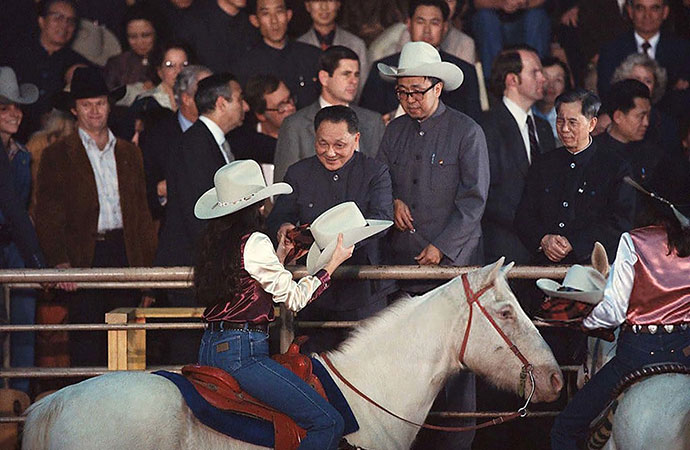
The American Dream had an especially irresistible draw for East Europeans behind the Iron Curtain, and for tens of millions of Chinese during the opening and reform era that began after Mao Zedong's death in 1976. China's great economic reinvention was inspired, in part, by Deng Xiaoping's awe at American modernity, which he witnessed firsthand during an official visit in 1979.
But fast-forward to 2026, and the positions have been reversed. For most people in most countries, the future can now be seen in China. Just as Hollywood once showed the world what modern life looked like, China is showing African, Latin American, and even American young people what an economy built on green energy, mobile payments and other services, and advanced robotics looks like. For Cobus van Staden of the China-Global South Project, the West is "increasingly being framed as backward-looking [and] associated with the past," a phenomenon presumably accelerated by Trumpism, with its rejection of renewable energy, diversity, and its social conservatism.
In many parts of the West, disillusionment has given rise to Chinamaxxing on social media, with American and European influencers performatively embracing Chinese mannerisms and aesthetics. And in the Global South, young people aren't just imitating Chinese practises like drinking hot water or trying out tai chi. They are watching as China reshapes their daily experiences.
This signals a genuine historical rupture. For generations, most countries defined themselves in relation to the West. Some sought (or were convinced) to emulate Western development models like the Washington Consensus, and many were keen to acquire Western technology and aid, or simply to get the West's approval. Other countries did push back against the West's influence and attack Western hypocrisy, but their counter-models were themselves defined by opposition to the West.
Either way, West-centrism was the prism through which geopolitics was conducted and interpreted. When countries in the Sahel invited Russia's Wagner Group mercenaries to help them deal with insurgencies, it was seen as a reaction against France and its traditional role in the region. When Angola invited Sinopec to exploit its oil fields, it was seen as a snub to Portugal and the United Kingdom. And then there are the many challenges to US hegemony in the Middle East, Latin America, and Southeast Asia. Around the world, memories of bloody Western interventions or financial crises still linger.
Yet younger generations around the world are not even pro- or anti-Western so much as they are post-Western. For them, China, not the US, is at the center of their conceptual universe and envisaged future.
What happened? One of the big differences between countries in the Global South and the Global North is their demographic profile. In the US and Europe, the median age is 40-50, compared to 19 in Nigeria, and 29 in South Africa, India, and Lebanon. That means some 70% of Nigerians aren't even old enough to have registered the 2003 US invasion of Iraq or the 2008 global financial crisis. As Cobus points out, young West Africans "never knew anything more than the US as we know it now." The era of Donald Trump encompasses their entire political memory, and they presumably are not very impressed.
This shift in perceptions is not just an African story, of course. In Vietnam, which has long had a fraught relationship with China, young people are becoming less reflexively Sinophobic than their elders. Chelsea Nguyen, a researcher at the London School of Economics, credits the COVID-19 pandemic for catalysing this change. The West's perceived mishandling of the pandemic undermined its status as a model worthy of emulation. Many Vietnamese turned to exploring their own history and that of their Asian neighbours, including China. As in much of Africa, growing exposure to China's rapid technological progress and Chinese consumer goods transformed the country's global brand.
Meanwhile, Loubna El Amine, a China scholar at King's College London, notes that in regions riven by instability-such as the Middle East, where the US itself is a big part of the problem-"a lot of the attraction of China is its absence rather than presence." The latest Arab Opinion Index bears this out, showing that 77% of respondents view US policies as a threat to the region's security and stability, compared with just 25% for China-and that was well before Trump launched his catastrophic war against Iran. And, of course, China carries none of the colonial baggage that complicates European interventions (or even peacebuilding efforts) in the region.
Still, China has been known to be aggressive in pursuing its economic agenda in the developing world, whether through predatory loans, acquiring critical national infrastructure, or deliberately exporting its domestic overcapacity. Such behaviour ruffles feathers as much in Thailand, Mexico, and Nigeria as it does in the US and Europe. Moreover, young people's widespread distrust of their governments can easily bleed into unhappiness with China when political leaders are seen to be giving it undue privileges.
Since the pivot to China as an exemplar of modernity is in many ways pragmatic and non-ideological, its hold on the popular imagination is still tenuous. Lots of leaders in the West want to compete with China for "soft power." But the key is not to counter Chinese "propaganda" or improve Western PR. The winners in the battle for hearts and minds will be those who offer real solutions to people's problems and create more opportunities for prosperity than are currently available.
From Project Syndicate
A Independent Newsweekly
© Copyright 2026 | Designed by ARK Reepon & Developed by Cosmos Group Software Team




Leave a Comment
Recent Posts
A Battle for the Soul of The N ...
Two disturbing incidents came to light this week, even as they went un ...
Dhaka seeks concrete measures ...
State Minister for Foreign Affairs Humaiun Kobir on Thursday urged Sou ...
Bangladesh Embassy in Ireland begins operations
Dinesh Trivedi stresses proper preparations before T ..
The Hope Deficit: Why Bangladesh’s Revolution Must M ..
Iqbal Bahar Chy: Finding freedom in the unplanned