


Featured 1
Auspicious beginnings, but a long way to go still

An Independent Newsweekly

Featured 1
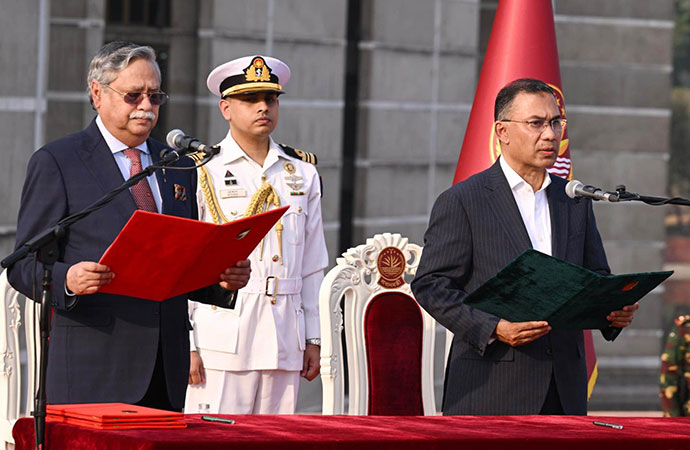
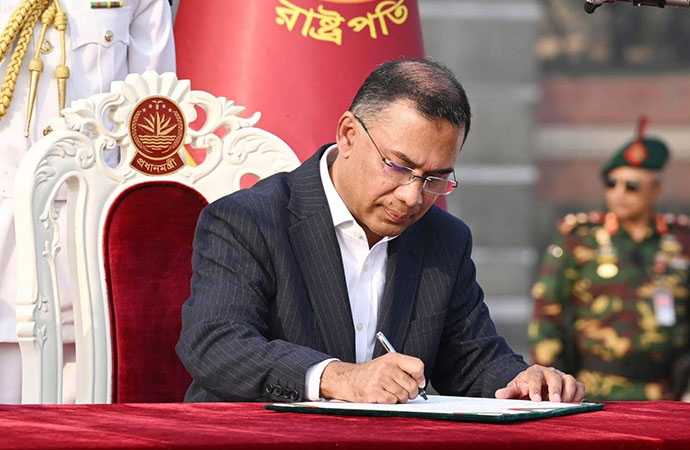
Photo: BNP Media Cell
The newly elected government of Bangladesh is now in office, and the expectations they must deal with are necessarily of a different magnitude and nature to those encountered by the interim government led by Dr Muhammad Yunus, who they replace. Prime Minister Tarique Rahman, fulfilling his destiny to follow in the footsteps of both his parents, has presented himself as a changed man to the one who exercised vast influence over the last BNP-led government in 2001-6, despite not holding any official post. This time the buck stops with him, and thus far at least, he has shown impressive signs of maturity and humility.
We are heartened, first of all, by the announcement that the BNP's newly elected MPs, of which there are a total of 209, will not avail themselves of some of the usual perks enjoyed by previous holders of their office, such as government plots and duty waivers on imported cars. In this they echoed an earlier announcement by the opposition bloc led by Jamaat e Islami, on the day they were all sworn in. In a move aimed at promoting austerity and reducing public suffering due to traffic, the new PM has also decided to reject the traditional, high-security official protocol, opting instead to travel in his own private vehicle.
On his instructions, the prime ministerial motorcade has been significantly reduced from the usual 13-14 vehicles to only four. The decision aims to minimise disruption to public traffic in Dhaka. He has instructed authorities not to stop traffic for his movement and has directed that the deployment of uniformed police on both sides of the road during his travel be stopped. Towards the end of the campaign period leading up to the election, a video went viral of Tarique Rahman refusing a traffic police's signal to circumvent a red light. While that was taken with a fair degree of skepticism, it seems he is set to continue the practice in office. We will see how long he can continue to do so, in view of Dhaka's terrible traffic situation. In a similar vein, he has also decided to hold cabinet meetings at the Secretariat instead of the Prime Minister's Office to reduce traffic congestion caused by ministers travelling.
These are all sensible, considerate decisions that will go down well with not only the 50% of voters who voted for the BNP in last week's landmark election, but beyond it as well. Ultimately it will come down to whether he can instil the ethos of good governance as standard practice throughout the state's vast machinery. Already reports indicate irrational price hikes in markets ahead of Ramadan. The interim government, we will recall, managed to rein in these elements. There should be no excuse for an elected government failing to do the same. That will be the true test of leadership, and what will determine whether the masses who came out and voted for the party in 2026 do so again in five years' time.
A Independent Newsweekly
© Copyright 2026 | Designed by ARK Reepon & Developed by Cosmos Group Software Team



Leave a Comment
Recent Posts
The right time for an apology
The publication of the posthumous memoirs of lawyer Abdur Razzaq, who ...
Human rights experts commissio ...
Human rights experts commissioned by the UN’s top human rights b ...
Teesta erosion leaves several hundred families homel ..
Housing Without Houses: The Hidden Cost of Banglades ..
The Election Commission will review the timeframe
The story behind the Arafat brothers' ‘Kolpona’