


Column
Whither Bangladesh?


An Independent Newsweekly



Column
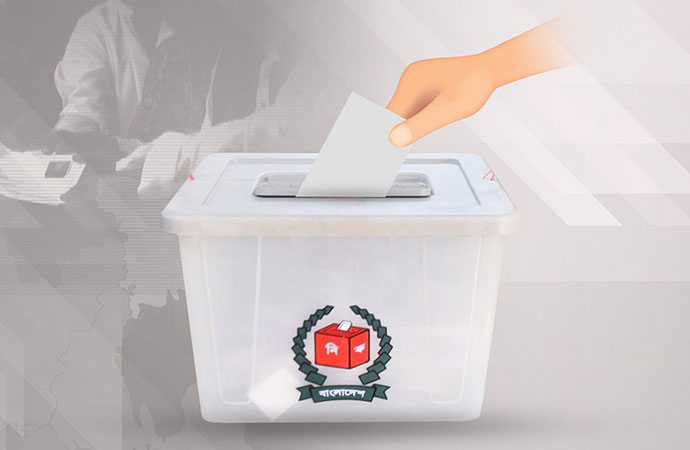
Image: Collected
I am writing this column early in the week of the general election, before the polls are held on Thursday and their results are announced. There will be victors and there will be losers in the days ahead. The most prominent loser is known already. It is the Awami League, which is barred from contesting the election. Many would consider this outcome sweet revenge for the suffocating years of its iron rule during which the national election process became something of a caged farce and turned into what cynics would call the national selection process. The result was an autocratic, "democratically"-elected quasi-dictatorship that wrecked the popular will. It produced impressive economic results, but only to have the popular share of those results gnawed away at by a conniving group of corrupt economic cannibals. It is a mercy that Bangladesh's banks have survived the collective raid on the nation's financial coffers during those morally-bankrupt times.
Hence, the Awami League's absence from the election is formally a loss for the democratic process, but only insofar as that process seeks to regain its popular legitimacy and credibility. Of course, not every Awami League supporter took part in the financial loot, or in the legal cases lodged against prominent opposition individuals, or in the enforced "disappearances" of the regime's critics. There are many honourable supporters of the party around, as there were then. However, if you supported a party that was at war with the people, you would have to pay the price when the people win the war - which they do eventually. What a pity for Bangladesh's party of independence - the party without which Bangladesh would not have emerged from Pakistan in 1971.
At the other end of the historical spectrum lies the Jamaat-e-Islami, which opposed Bangladesh's "India-backed independence from Pakistan", according to Reuters, which adds that the party "has its origins in the pan-Islamist Jamaat-e-Islami movement, which emerged in India in the early 1940s and called for a society governed by Islamic principles. Jamaat opposed Bangladesh's independence, and during Hasina's rule many of its leaders were executed or jailed in a war crimes tribunal that was criticised by international human rights groups. In 2013, it was barred from elections after a court ruled (that) its charter was in conflict with Bangladesh's secular constitution". The ban was lifted after Bangladesh's seismic shift away from Sheikh Hasina's rule caused by the mass uprising of 2024. Today, Jamaat carries the legacy of ideological longevity, an image of moral and financial cleanliness, and a record of organisational discipline unmatched in Bangladesh (or almost anywhere else, even among communist parties and their hierarchical cadre-based loyalties).
In between an electorally "disappeared" Awami League and an electorally "reappeared" Jamaat lies the Bangladesh Nationalist Party (BNP). Its presence has an interesting pedigree: Like the Awami League and unlike Jamaat, its claim to contemporary legitimacy lies in Bangladesh's split from Pakistan. But like Jamaat and unlike the Awami League, its vision of Bangladesh is not even residually India-centric. Far from it. Ideologically, the BNP's preference for "Bangladeshi nationalism" over the Awami League's "Bengali nationalism" registers an important departure from the founding principles of Sheikh Mujibur Rahman's envisioned Bangladesh. The BNP is not overtly Islamic, but its religious ideology is not incompatible with that of Jamaat although it is not aligned with it.
In my column last week, I called this an existential election for Bangladesh. It is an election for the recovery of Bangladesh's democratic soul. Who would not welcome that? However, this is also an election for the recovery of Bangladesh's religious soul. The party that comes to power will be tasked with managing the evolution of the religious identity of Bangladesh, a country of pious people belonging to different faiths. Islamic nationalism in Bangladesh - like Hindu nationalism in India or Sinhalese Buddhist nationalism in Sri Lanka - would automatically affect the national loyalties of religious minorities left on the alienated margins of national existence.
The Treaty of Westphalia in 1648 ended the Thirty Years' War over religion in Europe and established the modern nation-state system globally. For all the faults of the West, including the unmentionable brutalities that it inflicted on innocent Asians and Africans during colonialism, it has earned historical credit for having achieved the separation of church and state, a split enshrined in the idea of secularism.
Essentially, secularism means that the state is impartial towards any or all religious claims on the civic character of a nation: It does not mean that the state is anti-any religion or anti-all religions (although that occurred in the early years of the Soviet Union). Also, secularism means that while citizens can bring their religious faiths to bear on the course of public policy, they cannot do so merely because "my religion says so" but because what "my religion says" is attuned to what the nation needs, here and now, that need being determined equally by citizens from other faiths or none. Secularism is not atheist by political definition, but by the same definition, atheists, agnostics, nominal believers and others cannot be kept out of the continuous democratic discourse that determines the public contours of the state.
These are time-tested realities. They underlie how Europe, for example, has remained secular in spite of being Christian by provenance.
I say all this to place Bangladesh's "religious" election in something of a global perspective. I have no intention of denigrating any party or political formation.
This is Bangladesh's election. The choice depends on Bangladeshis, not on anyone else. The choice should be known by the time the next issue of the Courier appears.
More on this subject then.
The writer is Principal Research Fellow of the Cosmos Foundation. He may be reached at epaaropaar@gmail.com
A Independent Newsweekly
© Copyright 2026 | Designed by ARK Reepon & Developed by Cosmos Group Software Team







Leave a Comment
Recent Posts
An unaccountable process leave ...
The latest price hike of all four major petroleum products by Tk 20 pe ...
The French Connection in South ...
France Ambassador to Bangladesh Jean-Marc Séré-Charlet h ...
Ties with China enter new phase
Happy 61st birthday, Singapore!
In defiant speech, Pezeshkian calls out Trump and sa ..
The banality of evil