


Column
Reza’s Bengal

An Independent Newsweekly


Column

An article by Mohammad Habib Reza, "Reading Bengal beyond religious boundaries", appeared in The Daily Star on June 23, 2026. The writer is an architect, architectural historian and Associate Professor at the School of Architecture and Design, BRAC University. I can only say that Bangladesh, historical Bangla (which includes West Bengal), BRAC University and I are all very lucky to have him.
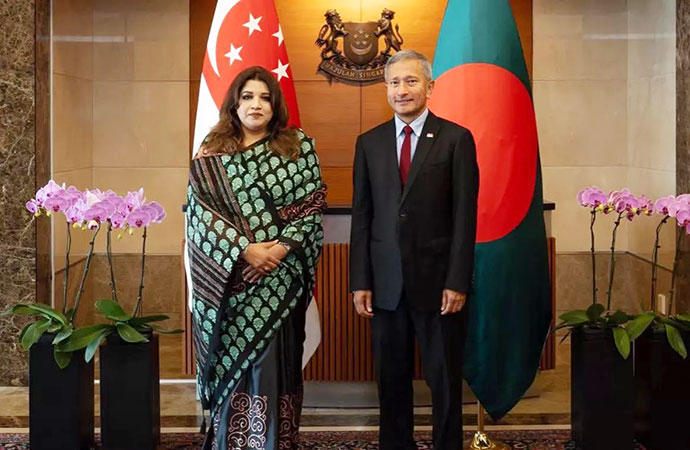
Reading the article reconfirmed my existence as a Bengali. Here I was in Singapore, a probashi Bangali from Paschim Banga, encountering the beautiful Bengali mind and exquisite English language of a philosopher of geographical history - for that is what Professor Reza is - to discover what constitutes Bengal beyond its numerous religious constructions and consequent limitations. I thank The Daily Star for having run his article, which is of considerable (and welcome) length.
Here is a key excerpt from Professor Reza's article:
"Bengal is rarely permitted to speak in its own historical voice. Instead, it is repeatedly interpreted through civilisational frameworks produced elsewhere: its Islam measured against Middle Eastern orthodoxy, its history folded into North Indian Brahmanical narratives, and its pluralism evaluated through European secular assumptions. Each of these perspectives captures part of the story. Yet none adequately explains Bengal. When a civilisation is not understood on its own terms, others will define it on its behalf, and they will do so, as we are witnessing today, with consequences that extend far beyond academic debate, reaching from the archive to the street.
"The problem is not merely historical. It is methodological, and its origins lie much deeper than most accounts are willing to acknowledge.
"For too long, Bengal has been treated either as a frontier of another civilisation or as a derivative regional culture lacking its own interpretive logic. Yet Bengal's historical formation followed a profoundly different trajectory. It evolved through deltaic ecology, vernacular adaptation, porous religiosity, linguistic hybridity, and negotiated coexistence. It was shaped as much by rivers, forests, migrations, folk traditions, and agrarian expansion as by courts, empires, or scriptural orthodoxy.
"But to understand why Bengal absorbed and transformed every incoming civilisational current, whether Brahmanical, Islamic, or colonial, one must look further back. Bengal did not begin with the arrival of Sanskrit. It did not begin with the arrival of Islam. It carried within itself, long before either, a civilisational logic of its own: rooted in the Ganges-Brahmaputra delta, in an earth-centric cosmology that venerated water, fertility, the feminine divine, and the cyclical rhythms of a great alluvial world. That deep substrate, pre-Vedic, proto-Prakrit in language, matrifocal in social organisation, tantric in spiritual sensibility, is what gave Bengal its extraordinary capacity for civilisational absorption without civilisational erasure."
Bengal today
It is a great surprise to inhabit a Bengal-of-the-mind today in which Professor Reza could be considered a heretic (Leftist, perhaps?) by the two main sides in the religious war over Bengal's contested but unquestionably single cultural identity.
On one side, a political leader in a country claimed some time ago that there is no single language called Bengali. Apparently, his remarks came on the heels of an effort by that country's police, which had used the term "Bangladeshi language" to seek translators for suspected illegal immigrants. Responding to a backlash, the politician defended the police, arguing on social media that "Bengali" denotes ethnicity and not linguistic uniformity. He claimed that variant dialects spoken in Bangladesh (like Sylheti) are distinctly different from the Bangla spoken in his country, concluding that "there is, in fact, no language called ''Bengali' that neatly covers all these variants". Of course, there is no "one and only Bengali" that covers all the dialects spoken in Bengal, but, then, there is no "one and only Hindi" that covers all the variants of Hindi spoken in the politician's country. So is there no single language called Hindi? Does Hindi connote ethnicity? Which ethnicity? Whose ethnicity? Who decides which and whose ethnicity? And, by the way, what is ethnicity without language?
On the other side, extremist attacks on recognised Bengali cultural practices and sites, such as traditional music, folk festivals and shrines, are sought to be justified on the basis that they are in conflict with orthodox religious beliefs (which are supposedly the only beliefs that true believers can possess). Rabindrasangeet was apparently composed by a Hindu, when Tagore was actually a Brahmo. Nazrul was undeniably Muslim, but, then, Nazrulgeeti's repertoire includes Shyama Sangeet, undeniably Hindu. Baul practices and shrines, which Bengalicise the Sufi understanding of the universe, have been attacked because they contradict the Arabised version of a segment of Bengali identity. Cultural institutions have been vandalised by self-constituted guardians of the faith.
The last geographical Partition of Bengal, in 1947, bifurcated the land without destroying its indigenous capacity for cultural resistance and renewal. There is a new partition of Bengal underway. It is more dangerous than the earlier split. This is an ideational partition. To believe in an undivided Bengal-of-the-heart is now to possibly be a national suspect in the eyes of those on both sides of the border who wish to secure their half Bengal free of the religious Other. In this paradigm, each half of Bengal belongs entirely to a larger entity, whether that entity is derived from North India or the Middle East. Brahminical, Islamic and colonial captures of the past - in Professor Reza's description - seek to incorporate Bengal into exclusive religious constructions of places and times.
I congratulate Professor Reza for having stepped forward to stop the repulsive march of this regressive historicity. What he has in mind, I think, and what I certainly do have in mind is the need to popularise a progressive reading of Bengal's history in which today, and tomorrow, all those calling themselves Bengalis will recognise themselves as survivors of a single but not seamless civilisation.
That civilisation is a hobbled one, of course, but which civilisation is not? The blood of innocent children, women and men cries out for revenge in our civilisation. But which civilisation has existed without devouring its young and old, its women and men, its cattle and its birds? "There is no document of civilisation which is not at the same time a document of barbarism," Walter Benjamin wrote. He is my favourite Bengali (although he was a German Jew killed by the Nazis). So for Bengal.
One day, Bengal will come into its own by proclaiming its integrity as a place transformed into time, as the nearing destination of laughing children and toothless poets, and as the final rest of the aching Bengali heart.
The writer is Principal Research Fellow of the Cosmos Foundation. He may be reached at epaaropaar@gmail.com
A Independent Newsweekly
© Copyright 2026 | Designed by ARK Reepon & Developed by Cosmos Group Software Team





Leave a Comment
Recent Posts
The right time for an apology
The publication of the posthumous memoirs of lawyer Abdur Razzaq, who ...
Human rights experts commissio ...
Human rights experts commissioned by the UN’s top human rights b ...
Teesta erosion leaves several hundred families homel ..
Housing Without Houses: The Hidden Cost of Banglades ..
The Election Commission will review the timeframe
The story behind the Arafat brothers' ‘Kolpona’