


Column
Reading a family Portrait: History at public and personal level

An Independent Newsweekly
Column
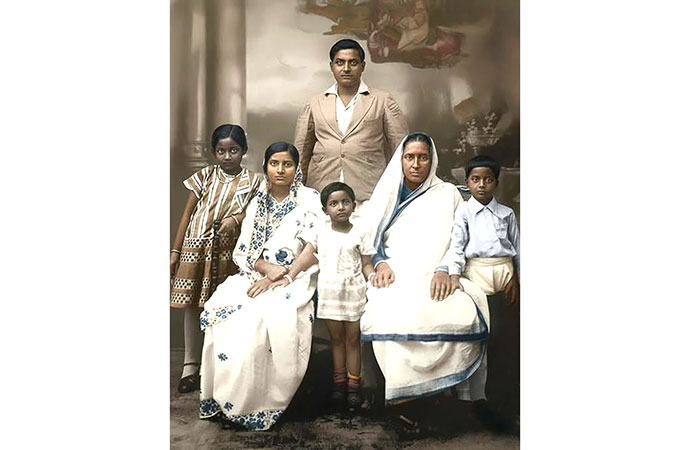
The family portrait printed above is that of my maternal grandfather's family. This family portrait was taken in Shillong but the date is a bit uncertain. The little girl to the left is my mother Mumtaz Begum who was born in 1925 and in this pic looks 6-8 years old. So early 1930s would be a fairly good guess. That would make it a plus 95 years old picture. It was a time when "Indian" politics was taking shape that would lead to 1947 which produced the states of Pakistan and India and also leading to the birth of Bangladesh in 1971. That is public history but how did history treat the people at home waiting for it to bring good news but usually arrived bearing mixed tidings.
The Man
The man is my nana -Enayet Ahmed- whose grandfather and his friend migrated from West Bengal to the Indian North East, literally by foot towards the end of the 18th century reaching Shillong via what later became Bangladesh. Their entry coincided with that of the colonial rulers now entering the furthest margins of the empire who needed suppliers of essentials and the two patriarchs turned successful traders within months of their arrival and soon had graduated into the rich category. His fellow migrant became even more rich investing in many trades and together the two became two of the richest migrant Bengalis in what is now Himachal Pradesh.
They also built mansions in their ancestral home - one in Hatpukur in Janai district and the other in Tajpur- and produced many famous progenies. And then it was inevitable. The marriage bond between these two-family streams. My nani from Tajpur was married to my nana from Hatpukur and the dual journey began.
1947 and later history
My parents were married in 1945 and family connections also played a role. My nani's brother and my father's paternal uncle were roommates at Cambridge when this pic was taken-early 30s. Both became barristers and returned home with degrees and English wives. The degrees lasted but neither marriage did but they remained friends. And one day in a conversation both mentioned about their respective eligible nephew and niece and the union took place in Kolkata in 1945. I still have pictures of that wedding, the pics taken by Ahmed Ali whose father was S. Wazed Ali, my mother's uncle and half the matchmaker. My father's uncle Lutfe Ali Chowdhury was present as the other half.
I had once asked my mother about Kolkata and she expressed great disgust and horror as she had seen the "danga"of 1946. By 1948, all the members except my khala had moved to Dhaka. Two other brothers who came after the picture was taken also joined and soon Dhaka is where it was.
My father who grew up in Kolkata though from Noakhali and had studied at the Islamia college and the fabled Baker hostel of Kolkata where all those who mattered in the making of Bangladesh through the gates of 1971 stayed as students, moved to Dhaka as part of his job as a banker- United Commercial Bank of India. In 1950 he switched to National Bank of Pakistan and left the Kolkata past behind.
This piece is about my grandfather really. He moved his family but his business was in Shillong, his property in Hatpukur. A financially distressed person, he kept commuting between Dhaka and Shillong, neither here, nor there, raising his family in Dhaka while trying to fund it from his income in India. He had a C visa, something which allowed long stays in both countries primarily meeting the needs of such migrants. Life was never the same and the family lived only a few steps above genteel poverty.
His life truly hit a disaster in 1965 when India and Pakistan went to war. He was in Shillong then and his partner accused him of being a Pakistani agent. He somehow managed to escape before the police could move or the objective was never to get him arrested just leave. He overnight became a pauper. Luckily, he had built a one storied house in Dhaka in 1957 and he landed there, a devastated man.
His final years
His sons had entered various business and trade but were only modestly successful. And he had no money, just no money at all. I remember sitting with him, the person I was closest to and hearing him chat with others. But he said one day which I still remember. "Nobody bothers about a person who has nothing." He had literally nothing. Soon undetected diabetes hit him hard and he was affected by dementia as well. His final years were without the use of his limbs, sitting on a wheelchair unable to understand what was going on or utter a word about anything.
One day in 1972 he had a massive cerebral stroke and was left limp on the bed. I remember my mother sitting on the bed, calling out repeatedly, "Baba, Baba, Baba". He never answered his daughter's calls. And when the ball in the oxygen pump stopped moving, I was there to permit the doctor to stop the flow. History had taken its toll.
We only discuss the history of State making forgetting that each time a state is created, life at the social level affects many, often cruelly. This is universal. Farewell Nana bhai.
A Independent Newsweekly
© Copyright 2026 | Designed by ARK Reepon & Developed by Cosmos Group Software Team



Leave a Comment
Recent Posts
An unaccountable process leave ...
The latest price hike of all four major petroleum products by Tk 20 pe ...
The French Connection in South ...
France Ambassador to Bangladesh Jean-Marc Séré-Charlet h ...
Ties with China enter new phase
Happy 61st birthday, Singapore!
In defiant speech, Pezeshkian calls out Trump and sa ..
The banality of evil