


Reportage
Enhancing the Capacity of Elected Women Representatives of Union Parishad


An Independent Newsweekly
Reportage
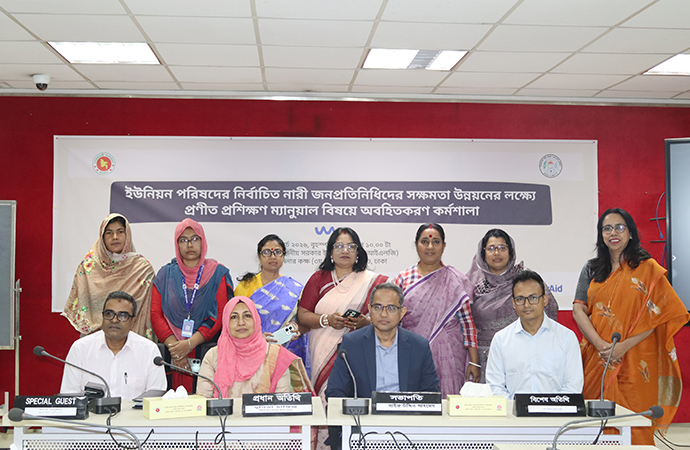
National Dissemination Workshop at NILG Unveils Training Manual to Enhance Capacity of Elected Women Representatives of Union Parishad
The Bangladesh Academy for Rural Development (BARD), Cumilla, in partnership with WaterAid Bangladesh, successfully hosted the National Dissemination Workshop on "Orientation on the Training Manual Developed for Strengthening the Capacity of Elected Women Representatives of Union Parishads" at the National Institute of Local Government (NILG), Dhaka.
The event showcased a landmark initiative under the Swiss-supported GO4IMPact programme of WaterAid-Swisscontact consortium with implementation partners Eco-Social Development Organisation (ESDO) and Rupantar, aimed at empowering women leaders in local governance.
The event featured the formal launch of a comprehensive training design and handbook developed jointly by BARD and WaterAid Bangladesh. The package emphasises practice-oriented learning and provides a systematic framework for integrating gender perspectives into local development planning.
The workshop highlighted the outcomes of a structured capacity-building initiative designed to strengthen the leadership, governance, and planning skills of elected women representatives. Key components included participatory training sessions, a practical Gender Action Plan (GAP) template for Union Parishads, and extensive field-based learning captured through Key Informant Interviews (KIIs) and feedback from 135 elected women representatives across pilot districts.
The workshop was graced by Munima Hafiz, Additional Secretary, Rural Development and Cooperative Division, Ministry of Local Government, Rural Development and Cooperatives, as Chief Guest.
Speaking on the occasion, she said, "Empowering women at the local government level is essential not only for inclusive development but also for building resilient communities. This initiative provides a practical roadmap to strengthen women's leadership in Union Parishads."
The session was chaired by Saif Uddin Ahmed, Director General, BARD, Cumilla, who highlighted the significance of the initiative:
"This training manual will serve as a cornerstone for strengthening the capacities of elected women representatives in Union Parishads. I am confident that by integrating this manual into our training curriculum, we can equip local leaders with essential tools for fostering effective, gender-responsive governance and promoting inclusive decision-making at the grassroots level."
Md. Kaesuzzaman, Director (Training and Consultancy) and Joint Secretary, National Institute of Local Government (NILG), stated: "Institutionalising the training manual at the national level is crucial for strengthening the capacity of elected women representatives. The training manual, along with the Gender Action Plan (GAP) template, will serve as important tools for promoting effective, inclusive, and gender-responsive local governance. He also emphasised that the Gender Action Plan should incorporate clear indicators to facilitate proper monitoring and evaluation of its implementation."
Azman Ahmed Chowdhury, Director, Business Development and Quality Assurance at WaterAid Bangladesh, emphasised, "This collaboration under the GO4IMPact programme demonstrates how evidence-based capacity-building and structured training can transform local governance by amplifying women's voices."
T. M. A Momin, Deputy Director, Local Government (DDLG), Naogaon, noted, "Structured capacity-building and practical tools like the training manual and GAP template are vital for empowering women representatives and ensuring inclusive decision-making in Union Parishads."
The session brought together elected women representatives from Naogaon and Satkhira districts, Deputy Directors of Local Government (DDLGs), and senior officials from various ministries, divisions, departments, and development partners.
The workshop showcased compelling evidence of the challenges and opportunities for women in local governance, while generating broad support for the newly developed training module and GAP template. Participants emphasised the importance of strengthening institutional collaboration and building government-partner alliances to embed gender-responsive practices in Union Parishad planning.
The event concluded with a unanimous commitment to institutionalise the training manual, setting the stage for inclusive and gender-responsive local governance across Bangladesh.
A Independent Newsweekly
© Copyright 2026 | Designed by ARK Reepon & Developed by Cosmos Group Software Team





Leave a Comment
Recent Posts
An unaccountable process leave ...
The latest price hike of all four major petroleum products by Tk 20 pe ...
The French Connection in South ...
France Ambassador to Bangladesh Jean-Marc Séré-Charlet h ...
Ties with China enter new phase
Happy 61st birthday, Singapore!
In defiant speech, Pezeshkian calls out Trump and sa ..
The banality of evil