


Business
Tokyo keen to strengthen strategic partnership, enhance coordination towards updated FOIP


An Independent Newsweekly


Business
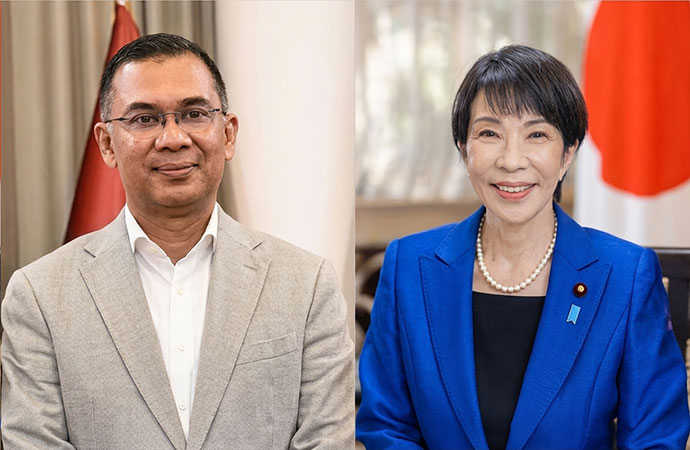
Prime Minister Tarique Rahman and Japan’s Prime Minister Sanae Takaichi. Photo: Collected
Talks between Tarique Rahman, Sanae Takaichi in Tokyo Oct 27
Prime Minister Tarique Rahman will pay an official working visit to Japan from October 26 to 29 to strengthen bilateral ties, deepen economic partnerships and attract fresh Japanese investment. Japan is likely to agree to arrange 1 trillion yen ($6.36 billion) in private-sector investments in Bangladesh over the next five years.
The Prime Minister is scheduled to hold bilateral talks with his Japanese counterpart, Sanae Takaichi, in Tokyo on October 27. Discussions are expected to cover trade, investment, development cooperation and regional and international issues.
Meanwhile, Bangladesh Ambassador to Japan Md. Daud Ali has returned to Dhaka ahead of the visit. Foreign Ministry Secretary (Bilateral-East and West) Dr Md Nazrul Islam has been sent to Tokyo to coordinate preparations. The reasons behind the unusual move remain unclear.
The Prime Minister will be accompanied by a delegation that includes Finance Minister Amir Khosru Mahmud Chowdhury, Finance and Planning Adviser Dr Rashed Al Mahmud Titumir, State Minister for Foreign Affairs Humaiun Kobir, and State Minister for Power, Energy and Mineral Resources Aninda Islam Amit.
"This visit of Prime Minister Rahman is expected to further strengthen the 'strategic partnership' between Japan and Bangladesh, a key regional partner that shares values and principles such as freedom, democracy and the rule of law, and enhance coordination towards realising the updated Free and Open Indo-Pacific (FOIP)," a spokesperson for Japan's Ministry of Foreign Affairs said.
On May 2, the Prime Minister of Japan, who was visiting Hanoi, Vietnam, delivered a foreign policy speech, announcing Japan's Updated "Free and Open Indo-Pacific (FOIP)", which launches the three priority areas of initiative for FOIP: " Building economic infrastructure for the age of AI and data including strengthening supply chain resilience for energy and critical materials", " Co-creation of economic growth opportunities through public-private collaboration and rule sharing" and "Enhancing cooperation in the field of security to ensure regional peace and stability".
"It is expected that bilateral relations between Bangladesh and Japan will be further strengthened. New doors will open in the relationship, and fresh private investment will come to Bangladesh from Japan," said Foreign Secretary Asad Alam Siam highlighting various aspects of the upcoming four-day visit.
Japanese companies are expected to use the Prime Minister's upcoming visit to announce fresh investments or plans to establish new offices in Bangladesh, a diplomatic source told UNB, adding that Japanese companies continued operating in Bangladesh even during the challenging period and had not withdrawn from the market.
Several companies are reportedly preparing to announce their commitments to Bangladesh during the visit.
Foreign Secretary Siam said both sides are discussing the signing of several MoUs during the visit. Draft MoUs on agriculture, fisheries, human resource development and skills development, domestic aviation, trade, environmental conservation, and the modernisation of local government are currently under discussion. "We hope that many of these MoUs will be signed during the visit," the Foreign Secretary said.
Earlier, Japan invited the Prime Minister to pay an official visit at a mutually convenient time, reaffirming Tokyo's commitment to further strengthening bilateral relations with Dhaka.
In April, Bangladesh welcomed a Japan-led initiative to address energy issues more efficiently across Asia, noting that countries needed to work together, as no single country could resolve the challenges alone.
Prime Minister Tarique Rahman joined an online meeting at the invitation of the Japanese Prime Minister.
Siam also said the visit would create opportunities to accelerate and complete ongoing projects. Commercial partnerships would be strengthened, the volume of economic and development assistance would increase, and security cooperation would continue, he said.
There was also potential for Japanese support in establishing factories in Bangladesh, creating employment opportunities and developing human resources. Beyond bilateral relations, the two leaders would also discuss global issues.
"It is hoped that the two countries will initiate fruitful discussions on peace and stability in the regional and international arenas, a lasting and peaceful solution to the Rohingya crisis in Bangladesh, strengthening mutual cooperation to resolve the global energy crisis, and jointly playing a role in ending international conflicts," the Foreign Secretary said.
Relations between Bangladesh and Japan were long-standing, historic and friendly. Japan was one of the first countries to recognise Bangladesh shortly after its independence and had made significant contributions to the country's socio-economic development, infrastructure construction, human resource development and capacity building, he said.
"Our relationship has expanded and broadened beyond trade, investment and development cooperation to various fields, including science and technology, connectivity, the environment, and regional and sub-regional cooperation," Siam said, describing the current relationship between the two countries as a strategic partnership.
Under this framework, various cooperative activities, including infrastructure development in Bangladesh, technological advancement, human resource development and security cooperation, are ongoing.
"We hope these activities will further increase through this visit," Siam said.
Against the backdrop of the existing strategic partnership, he said the upcoming visit offered a timely opportunity to deepen and broaden ties between the two countries.
In particular, the signing of the Economic Partnership Agreement (EPA) between Bangladesh and Japan in February 2026 had opened up new possibilities for expanding trade and investment, he said.
The Prime Minister will deliver the keynote address at the Japan-Bangladesh Economic Forum. He is also expected to visit the LNG terminal and power plant in Katsuura City, Chiba, UNIQLO Headquarters, and the Toyota plant in Nagoya, Japan.
A Independent Newsweekly
© Copyright 2026 | Designed by ARK Reepon & Developed by Cosmos Group Software Team






Leave a Comment
Recent Posts
A commendable intervention by ...
A struggle for local dominance in the Chittagong Hill Tracts, specific ...
How close is the Amazon to a ‘ ...
While Brazil’s presidential candidates have not made policy of t ...
Another shipment of highly radioactive uranium fuel
Harmony: Diplomatic community joins Durga Puja celeb ..
What to know about the Ebola outbreak that has sprea ..
Brazil election: Trump’s ‘Donroe Doctrine’ faces its ..