


Reportage
Will the centre hold?


An Independent Newsweekly





Reportage

Photo: Courtesy
At the time of writing, December is still ten days away, but the BNP-led government that came to power through last February's election is already under the cosh you feel, overwhelmed by the multi-dimensional challenge of running a country ravaged by 15 years of misrule and malgovernance.
Or perhaps there is wisdom in their approach. The main complaint against the BNP's handling of the situation pertaining to the resurgence, if one call it that, of the Awami League, hardly 2 years after they were deposed and forced to flee in one of the most stunning regime collapses of modern history, is that they (the BNP) have gone too easy on them, and that has directly allowed AL, at least what is left of it, the breathing space to regroup and plot their return, in coordination with the party's leadership that mostly fled to India.
And now they have started flexing their muscles, in anticipation of the return of their matriarch, Sheikh Hasina, who has announced her intention to come back and surrender to the courts that have pronounced a death sentence against her. More than anything else, it is this audacious announcement by Hasina that has visibly put the BNP government in a tricky situation, because clearly they never expected it. They never expected Hasina to come back on her own, and India would obviously never extradite her. That headache was over, they had thought. She may still be bluffing - it may all still be part of just a ploy to keep her party's grassroots energised. But the headache clearly isn't over.
If she does truly intend to return with a death sentence hanging over her (and the possibility that she won't be allowed to even appeal the verdict) head, it is difficult to see how the government can stop her, having made justice for the crimes committed by and during her regime one of the main planks of its electoral platform.
Pursuing justice is of course a far more difficult road than banning them, and for now, the BNP has kept in place the activities-ban imposed on the AL under the interim government of Muhammad Yunus. It prevents any AL political programme or rally from being held, with the police authorised to carry out mass arrests at any such gathering. The Awami League's most urgent concern is to get this ban lifted - something they expected from the BNP government. Awami League leaders, who are still subscribing to a fantastical reading of the events of July 2024. Till such time as they come around to a more realistic version of what happened, it is possible that they will fail to affect any positive change in their own fortunes.
So is it really fair to blame BNP for going too easy on AL?
You will hear opposition figures from the Jamaat and NCP smugly assert this is so. But this may just be part of the politicking that now prevails among the forces that united in July 2024 to bring AL down. On the face of it, the BNP has no reason to go easy on AL, having been the worst victims of their repression over the course of the 15 years they were in power. Insinuations of Indian influence or even under-the-table deals have been mostly unfounded.
When AL activists turned Gopalganj, the ancestral home district of the Sheikh family, into a virtual warzone this week (see below), the government's somewhat hands-off approach, to begin with, surprised many. And yet, when considered in light of the Uprising and the lessons it was meant to have imparted on our politicians, it actually makes perfect sense. And over time, even the government's fiercest critics will come around to this view. That is the expectation. According to sources in law enforcement and government, they have intelligence indicating that the Awami League and its president, Sheikh Hasina, want law enforcement agencies to open fire while suppressing sabotage, resulting in bloodshed.
The government's assessment is that the Awami League wants to create a situation similar to the indiscriminate killings by law enforcement agencies during the July mass uprising, thereby subjecting the BNP government to similar allegations. The government of Tarique Rahman is very keen to avoid that trap.
According to police figures, since the latest round of AL rioting began, crude bombs were exploded at 78 locations across the country during the 12 days from November 7-18. Seventy-four vehicles were set on fire. During this period, three police installations and 18 vehicles were subjected to arson and vandalism. In addition, attacks, fires and petrol bombings took place at 72 branch offices of Grameen Bank in various districts. And two BNP leaders were murdered in Natore.
That last one will not have sat well with the BNP leadership. The prime minister is sensitive to BNP grassroots leaders' concerns, and the two victims were precisely that: Sohel Rana, 45, was the general secretary of the upazila unit of JASAS, while Shahinur Islam, 40, was the general secretary of the municipal unit of Jatiyatabadi Krishak Dal.
If nothing else, this incident, which occurred on Wednesday, will have caused the BNP leadership to reassess their view. And sure enough, a combing operation rounding up almost anyone with any links to AL, commenced the very next day, under which the former education minister Nurul Islam Nahid, and actress Jyotika Jyoti, were arrested.
Gopali Republic
Gopalganj is gradually returning to a semblance of normalcy, after several days of violence, arson and crude bomb blasts perpetrated by the Awami League, which remains under an activities ban. Yet there is also a fear that this uneasy calm may not last. On more than one occasion over the last 27 months, Gopalganj has shown itself to be the last bastion of the fallen Awami League in post-Uprising Bangladesh. It may be that if AL is going to go down, it is determined to take Gopalganj with it.
No fresh violence was reported in the district after a nationwide 'lockdown' programme declared by AL passed on Thursday.
Long-distance buses resumed on the Dhaka-Khulna and Dhaka-Barishal highways at 6am Friday after about 36 hours, following the partial removal of trees that had been felled alongside the entry/exit points of the district in order to cut it off from outside, said Traffic Inspector Zahirul Islam Bhuiyan.
Train services however, remain suspended.Passengers and transport workers said fear and low demand had kept bus passenger numbers and rickshaw, van and easy-bike earnings far below normal. Some medicine, food and kitchen-market shops reopened, but most businesses remained closed.
Attackers stormed Tungipara Police Station on November 17 (Tuesday); to try and free detainees. It was later put on fire, and rendered unusable. On Thursday, Muksudpur Police Station was attacked and set on fire, destroying furniture, documents and vehicles. Homes of local lawmakers, a bank, a hospital, and a BGB vehicle were also attacked, police said.
Gopalganj Science and Technology University has suspended classes and exams from November 22 until further notice.
To help keep the peace, twenty-seven platoons of BGB and Ansar members have been deployed. The Deputy Commissioner said the situation was under control, while Inspector General of Police Ali Hossain, visiting Friday, urged residents to help restore the damaged police stations and maintain peace.
The perfect storm coming?
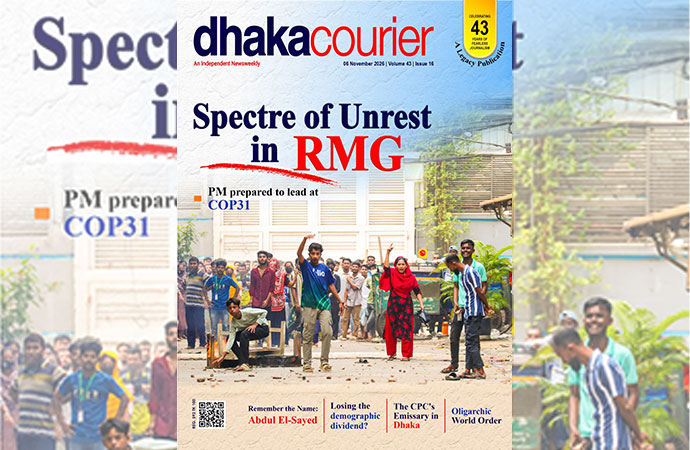
The government could frankly use a break, but unfortunately there is no scope for that when you are in office. And one place it won't be getting that from over the next month or two, is the readymade garment (RMG) industry. Despite doing better than its predecessors in every respect when it comes to the specific issue of RMG workers wages, is facing mounting operational and commercial pressures amid prolonged labour unrest, factory closures, and broader domestic political instability, prompting major international buyers to urge a swift resolution to ongoing minimum wage negotiations, as shipment schedules and upcoming work orders hang in the balance.
Factory owners and sector experts warn that the disruptions-spanning key apparel hubs including Savar, Ashulia, Jirani, Gazipur, Mymensingh, Mirpur, and Narayanganj-have already cost the sector an estimated Tk 3,000 crore to Tk 4,000 crore, with daily losses calculated at roughly Tk 200 crore to Tk 220 crore.
Meanwhile, at a meeting with leaders of the Bangladesh Garment Manufacturers and Exporters Association (BGMEA) at its Uttara office, representatives of major European and North American fashion retailers-including H and M and Inditex-expressed concern over shipment delays and production disruptions caused by protests and walkouts.
A BGMEA director, speaking on condition of anonymity, noted that while the current window is a critical period for orders ahead of the lucrative upcoming autumn and winter seasons, many overseas buyers have adopted a "wait-and-see" approach. Retailers are seeking clarity on Bangladesh's new minimum wage structure and supply reliability before committing to fresh order volumes.
Tensions have flared over wage demands amid rising living costs and inflation, alongside grievances regarding overdue wages and allowances, job security, and workplace safety. While the existing minimum monthly wage stands at Tk 12,500, some workers and worker representatives have pressed for a hike to Tk 32,000.
On November 1, the government formed a six-member minimum wage board, with a target to bring a new wage structure into effect from December 2026. The workers' side has proposed a Tk 32,000 minimum wage, while owners' representatives are scheduled to submit their proposal at a meeting on November 23.
Industry sounds alarm
Industry leaders have stressed that restoring order and factory security is essential to keep production running and protect Bangladesh's standing as the world's second-largest apparel exporter.
BGMEA President Mahmud Hasan Khan warned that ongoing protests and disruptions have severely hampered production-with an average of around 70 factories shut daily since the unrest began, and peak single-day closures hitting 679 factories across major clusters, and affecting roughly 1.68 million workers (Nov. 2). Even where factories have opened or workers have punched in, go-slows, walkouts, and clashes have disrupted output and raised costs.
"A negative message is going out to foreign buyers, and new orders are declining," Khan said, noting that many buyers are looking to alternative sourcing destinations while rising operating costs squeeze margins and threaten long-term employment.
Meanwhile, Bangladesh Garment Buying House Association (BGBA) President Md Abdul Hamid told a press conference in Dhaka on Thursday (November 19) that ongoing unrest, closures, and road blockades have already caused losses amounting to Tk 3,000 crore to Tk 4,000 crore. The daily losses amount to between Tk 200-220 crore, he also claimed.
Sector analysts and economists emphasize that the crisis goes beyond immediate shop-floor grievances, touching export earnings-where RMG accounts for over 80 percent of merchandise exports-foreign exchange inflows, backward and forward linkages, and overall investor sentiment at a time when the economy is already navigating broader political and macroeconomic headwinds.
Dr. Fahmida Khatun, Distinguished Fellow at the Centre for Policy Dialogue (CPD), cautioned that prolonged instability risks delaying export deliveries, eroding buyer confidence, diverting future orders to rival countries, and harming the wider investment climate. She stressed that fair worker demands should be addressed through dialogue while ensuring factory security to restore normal production swiftly.
Similarly, Mohiuddin Rubel, a former BGMEA director and founder and CEO of Bangladesh Apparel Voice, noted that repeated disruptions raise questions about Bangladesh's delivery reliability in global markets.
Highlighting how proactive communication and coordination helped keep production moving in Chattogram's roughly 340 factories, he urged owners and workers to build trust through ongoing engagement and realistic negotiations that balance living costs with production viability.
The International Labour Organization (ILO) is closely following developments concerning the minimum wage review in Bangladesh's ready-made garment (RMG) sector, including ongoing unrest and its impact on lives, livelihoods and enterprises.
The ILO said evidence-driven negotiations and sustained tripartite social dialogue are the path to restore industrial peace, safeguard rights, and ensure growth in Bangladesh's ready-made garment sector. It also appreciated the government's establishment of the Minimum Wage Board as a mechanism for reviewing minimum wages. This consultation with employers' and workers' representatives is fundamental to the credibility and effectiveness of the wage-fixing process.
Sustained and constructive social dialogue is critical to promoting adequate wages, decent working conditions and sustainable enterprises, and to ensuring sound industrial relations in a sector that is central to Bangladesh's economy and employs millions of workers, particularly women, it said.
According to the ILO Minimum Wage Fixing Convention (No. 131), minimum wages and their regular adjustment should be transparent and evidence-based, and informed by reliable data. It requires due consideration of the needs of workers and their families, including the cost of living and the impact of inflation on purchasing power, alongside relevant economic factors such as productivity, employment, economic development and the sustainability of enterprises.
Other factors including the general level of wages in the country, social security benefits, industrial capacity and the relative living standards of other social groups, should also be considered.
In this context, the ILO said it stands ready to continue its support to its tripartite constituents to adopt an evidence-based and gender-responsive National Wage Policy. This would enable greater predictability, transparency and fairness in wage-setting processes, while promoting sustainable enterprises and harmonious industrial relations.
On the other hand, leading domestic think-tank the Centre for Policy Dialogue (CPD) has suggested that the new minimum wage for garment workers be negotiated within a range of Tk 18,578 to Tk 24,204 a month, and urged the Minimum Wage Board to base its decision on evidence rather than pressure.
CPD Executive Director Nazneen Ahmed presented the findings of a study titled "Determining the Minimum Wage in the RMG Sector" at its Dhanmondi office. The study found that the wage board is working without an independent, recent and extensive evidence base. "There is no survey of workers and no assessment of the industry," Nazneen said while presenting the paper adding that there is also no agreed method or indicators for calculating the wage.
"Wage determination should not be a matter of pressure-induced bargaining," she said, noting that the current practice amounts to "a quick fix: wage is negotiated, not calculated."
Using available secondary data, CPD estimated the wage through three lenses.
Adjusting the entry-grade wage of Tk 12,500, set in December 2023, for a 30.8 per cent rise in urban prices, the wage would now be Tk 16,351. This only brings back the purchasing power of Tk 12,500 in November 2023 and adds nothing in real terms, the study says.
The second estimate, based on the upper poverty line for urban Dhaka, shows that keeping a four-member household above the line requires Tk 18,578 per earner.
The third, a living wage covering food, other essentials, housing and a small reserve for emergencies, comes to Tk 24,204 per earner. All estimates assume a family of four with 1.58 earners.
CPD cautioned that the figures are illustrative, as there is no large, representative survey of RMG workers, and results are sensitive to assumptions on family size and earning members. Studies report family sizes from 3.6 to 4.2 and earners per family from 1.37 to 2.1.
Workers demanded a wage covering food, housing, healthcare and education, and said they did not trust that the board would be formed on time. Both sides, CPD said, favoured annual, formula-based wage setting.
CPD put forward a seven-point path forward.
It recommended forming the wage board at least six months before each reset, meaning by June 2029 for December 2029, with the cycle spelled out in law and a permanent wage commission reviewing wages yearly.
An earlier start could have substantially reduced this year's unrest, the paper says.
It also called for defining indicators and data sources for the 11 factors listed in Section 141 of the Bangladesh Labour Act 2006, which it said remain undefined 20 years on.
Other recommendations include an RMG module in the Household Income and Expenditure Survey (HIES) and an RMG wage index, bringing buyers into wage talks, publishing anonymised survey data, and regular DIFE wage audits.
CPD warned that a living wage is becoming a market access issue. From 2029, the largest EU buyers must check for an "adequate living wage" in their supply chains, and continued duty-free access under GSP+ after 2032 will depend on meeting labour standards.
A wage that is not paid achieves nothing, the study says, stressing enforcement of whatever wage is set.
A Independent Newsweekly
© Copyright 2026 | Designed by ARK Reepon & Developed by Cosmos Group Software Team







Leave a Comment
Recent Posts
Shenzhen was no Yalta: The Lim ...
The meeting between US President Donald Trump, Russian President Vladi ...
For the first time, UN’s highe ...
In a landmark judgment, the United Nations’ top court ruled Thur ...
DFC engagement to mobilise private investment, advan ..
France to celebrate French Week in Dhaka; André Malr ..
The Roots of Macron’s Failure
The Silver Lining of a Data-Center Slowdown