


Reportage
EU outlines broad agenda for stronger strategic cooperation with Bangladesh

An Independent Newsweekly
Reportage

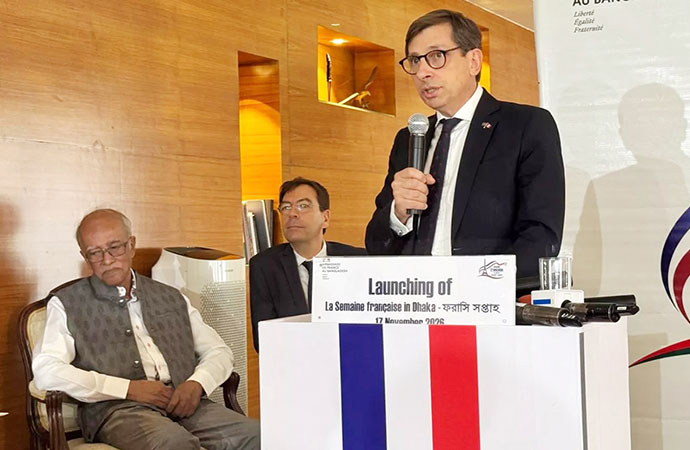
European Union (EU) Ambassador to Bangladesh Michael Miller. Photo: Courtesy
PM Tarique plans to visit Brussels in June to meet EU leaders
Bangladesh stands at a critical juncture in its relationship with the European Union (EU), as the bloc signals a clear ambition to move beyond its traditional donor-recipient engagement towards a broader, more strategic and mutually beneficial partnership.
With trade, investment, democratic governance, migration, connectivity and security emerging as key pillars of cooperation, the coming months could prove decisive in reshaping Dhaka-Brussels relations. Prime Minister Tarique Rahman's planned visit to Brussels in June next year to meet EU leaders, alongside preparations for formal discussions on a possible Free Trade Agreement (FTA), offers an important opportunity to translate this ambition into concrete outcomes.
But the prospect of a deeper partnership also brings greater responsibilities for Bangladesh, particularly as it prepares for graduation from least developed country status and a more competitive global trading environment.
European Union (EU) Ambassador to Bangladesh Michael Miller has said the EU looks forward to building ever-stronger strategic cooperation with Bangladesh, with a broad agenda for intensified engagement in the years ahead. He noted that Prime Minister Tarique Rahman had confirmed his plan to visit Brussels in June next year to meet EU leaders.
"It's an agenda that is very full. It's an agenda that reflects our ambition, which I think is a shared ambition - which is to create a partnership route to trust, fairness, and shared purpose," he told diplomatic correspondents at "DCAB Talk" at the Jatiya Press Club on November 23.
Diplomatic Correspondents Association, Bangladesh (DCAB) hosted event where DCAB President AKM Moinuddin and General Secretary Emrul Kayesh also spoke. Deputy Head of Delegation Baiba Zarina was also present.
Ambassador Miller said they have invited Bangladesh for the first in-person discussions in December on a possible Free Trade Agreement (FTA), which is broadly seen as a significant step, for deepening economic and strategic relations.
He said the EU is moving beyond its traditional donor-recipient relationship with Bangladesh towards a broader partnership encompassing trade, investment, democratic institutions, migration, connectivity and security cooperation.
"We are now scoping an FTA," Ambassador Miller said, adding that the EU is ready to match Bangladesh's ambitions for deeper commercial ties, but any future agreement must ensure balanced commitments, reciprocity, mutual benefits and enforceable obligations.
The EU envoy emphasised that labour rights, environmental protection and good governance would remain central to bilateral economic relations.
Miller urged Bangladesh to prepare urgently for changes in preferential market access following graduation from least developed country (LDC) status.
He warned that Bangladesh's competitive advantage, particularly in readymade garments, could diminish as labour costs increased and competitors benefited from FTAs with the EU.
"Six years for the European Union is almost the blink of an eye," he said, underscoring the urgency of preparing for future trade arrangements.
The Ambassador said the EU had supported extending Bangladesh's LDC graduation preparatory period to ensure a smooth transition, but expected measurable reforms and stronger private-sector engagement.
Describing the EU as Bangladesh's largest export destination, he said Bangladeshi exports to the bloc reached 23.3 billion euros in 2025.
He also highlighted Bangladesh's position as the largest beneficiary of the EU's Everything But Arms (EBA) scheme, which provides duty-free and quota-free market access.
Outlining an ambitious diplomatic calendar, Miller said the two sides had already initialled a Partnership and Cooperation Agreement (PCA), expected to be signed in the first half of 2027. Discussions on a working arrangement with the European Border and Coast Guard Agency, Frontex, are expected to begin in Dhaka in January.
The EU will organise its third Indo-Pacific Ministerial Forum in Brussels in March, focusing on economic, maritime and climate security.
A major Bangladesh-EU business and investment forum, jointly organised with the Bangladesh Investment Development Authority (BIDA), is scheduled for April 5-6 in Dhaka. The forum will explore investment opportunities in garments, leather, agribusiness, logistics and connectivity.
The Ambassador said the EU's Global Gateway initiative is expanding cooperation in Bangladesh's transport, energy, digital infrastructure and logistics sectors.
He cited the Laldia Green Container Terminal in Chattogram, railway modernisation and the country's first electrified railway project as examples of growing European investment.
Responding to allegations that the EU had pressured Bangladesh to purchase Airbus aircraft, Ambassador Miller rejected the suggestion.
"Coercion and pressure - that's not the way of doing business," he said. Welcoming Airbus's agreement to supply 10 aircraft to Biman Bangladesh Airlines, he said European companies wanted to compete on commercial merit.
He said the deal could generate further cooperation in aircraft maintenance, training, ground handling and aviation technology.
On migration, Miller said Bangladesh would be the only country discussed at an upcoming meeting of the interior ministers of all 27 EU member states in early December.
Expressing concern over irregular migration, he called for stricter regulation of recruitment agencies, stronger action against human trafficking and expanded legal migration opportunities.
Asked about recent political violence, Ambassador Miller expressed confidence that the government had the security situation under control while emphasising proportionate responses to unrest.
Regarding restrictions on Awami League (activities banned) activities, he said there is no specific EU position.
On the Rohingya crisis, Ambassador Miller reaffirmed EU support for safe, voluntary, dignified and sustainable repatriation to Myanmar. He said the EU had provided more than half a billion euros in humanitarian assistance since 2017, including 31.5 million euros in 2026, alongside 50 million euros in ongoing development cooperation in Cox's Bazar.
Referring to the recent International Court of Justice judgement, he said the EU had supported accountability efforts, including facilitating Rohingya testimony before the court.
The EU envoy said the EU looked forward to Bangladesh's new Rohingya strategy and continued international responsibility-sharing.
Describing the evolving relationship as increasingly political and strategic, the ambassador said both sides needed dependable partners amid growing global uncertainty. "The agenda reflects our ambition, which I think is a shared ambition to create a partnership rooted in trust, fairness, and shared purpose," he said.
Importance of Peaceful Personal Freedoms
Highlighting the importance of freedom of expression and freedom of peaceful assembly, Ambassador Miller said they pass the message to the authorities in Bangladesh that the response should be proportionate.
"We see that there are challenges in Bangladesh but when we speak with the authorities, we pass the message that the response should be proportionate, and it is my understanding that the response is proportionate," he said. Of course, the EU envoy said, there are many different issues that are actually converging at this point in time.
"Differences of views can be expressed in any democratic society," he said, adding that the European Union, that it is founded on the rule of law and respect for human rights, is going to say yes to freedom of assembly and freedom of expression, but no to any incitement to violence or hatred.
He said the relationship with the EU is very meaningful for a country like Bangladesh. "We will support your institutions. We will put our financing into your institutions. We will lend our political shoulder to the wheel of helping your country, its institutions be accountable and democratic."
The envoy said democracy is not just about elections, and it is not just about Parliament, it is about the institutions of state.
Asked about the Awami League's political activities, Ambassador Miller said the EU had no position on the previous regime and that his comments were personal.
He said the bloc wanted Bangladesh to be stable and prosperous, with justice, accountability for past human rights violations and respect for the rule of law.
The envoy said he is confident the government had security under control and hoped for progress in the garment sector. Ambassador Miller said political transformation was complex and could not happen overnight, requiring years and reforms. The EU had remained in close contact with the government to signal its support for reform, he said, adding that it hoped political parties in parliament would build broader consensus.
A Independent Newsweekly
© Copyright 2026 | Designed by ARK Reepon & Developed by Cosmos Group Software Team



Leave a Comment
Recent Posts
How Garment Unrest Could Rippl ...
When garment factories close, workers lose their jobs, and textile mil ...
Caught in Washington's new tar ...
The Trump administration’s latest move to impose proposed tariff ...
Between Art, Architecture and Home: Rafiq Azam trace ..
Bangladesh eyes enhanced cooperation with Singapore; ..
China-backed economic corridor could open new region ..
EU outlines broad agenda for stronger strategic coop ..