


Column
Why Study Hard? Restoring Young People’s Faith in Education and Opportunity


An Independent Newsweekly





Column
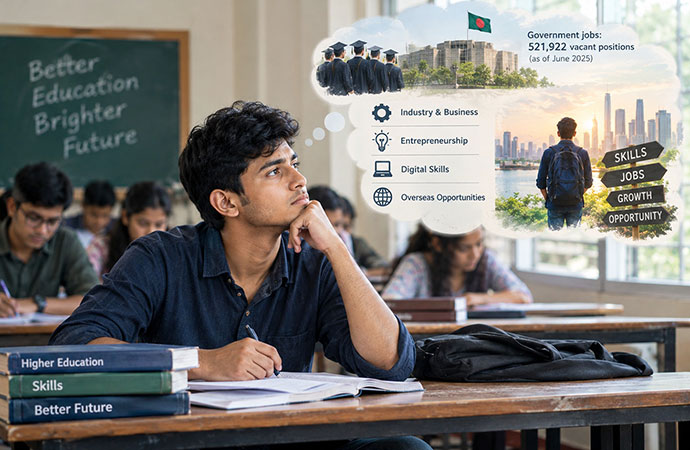
Is studying hard still worthwhile when many graduates struggle to find work? In Bangladesh, this is a fair and urgent question. Young people see qualified applicants competing for limited jobs, especially government posts, while others accept work unrelated to their degrees or consider leaving the country. Parents continue to invest heavily in education, yet many families are unsure whether a certificate will lead to a stable future. The answer is not simply to praise hard work or blame students for losing motivation. Bangladesh must also address the widening gap between education, useful skills, and employment.
The Employment Challenge
World Bank estimates for 2016-2022 suggested that about 14 million young Bangladeshis would reach working age while the economy would add only 8.7 million jobs. Manufacturing output rose, but manufacturing employment fell. Economic growth alone did not create enough opportunities for new workers. According to 2024 BBS data, Bangladesh had 2.624 million unemployed people, including 885,000 university graduates. An IMF study also reported a 36% unemployment rate among 15-24-year-olds in the labour force with post-secondary education. This figure applies to a specific group, not to all young people, but it shows how difficult the transition from education to work can be. Competition is intense. A Bangladesh Institute of Development Studies analysis of a major online employment platform found 287 applicants per vacancy before COVID-19 and 173 afterward. Online vacancies do not represent the entire labour market, but the figures reflect the pressure graduates face when seeking formal employment. They also show why sending more applications is not enough. Job seekers need clearer information, stronger preparation, and access to a wider range of opportunities beyond a small number of highly desired positions.
More Graduates Need More Pathways
Wider access to higher education is a major achievement, but graduates need ways to use what they learn. When suitable jobs do not grow as quickly as graduate numbers, young people may wait years for work, accept jobs below their qualifications, or seek opportunities abroad. The solution is not to discourage education. It is to connect education with skills, investment, and job creation. Before choosing a programme, students should have reliable information about growing industries, required skills, likely career paths, and realistic employment prospects. Career guidance should begin before university, not after graduation. Colleges and universities can publish graduate outcomes, explain the abilities employers seek, and help students compare academic, technical, and vocational routes. Better information would allow young people to make informed choices rather than follow social pressure or outdated ideas about prestige.
Government Jobs Have Limits
Government jobs remain attractive because they offer status and security. Data presented in Parliament in July 2026 indicated that 521,922 government positions were vacant as of June 2025. Not every vacancy was ready to be filled; budgets, qualifications, and recruitment procedures matter. Even so, essential vacancies should be reviewed and filled efficiently. Public service cannot employ every graduate, even if recruitment improves. Most new opportunities must come from business investment, expansion, and hiring. Reliable energy, access to finance, workable rules, improved transport and digital infrastructure, and support for small enterprises are therefore central to youth employment. Policies should make it easier for responsible firms to start, grow, and recruit. Regional development also matters: if quality jobs remain concentrated in a few cities, many capable young people elsewhere will face higher costs and fewer choices.
What Happens in the Classroom
Poor employment prospects can weaken motivation. When students repeatedly see educated adults struggling, they may question the value of serious study and focus only on passing examinations. That produces shallow learning, which can make the original problem worse. This outcome is not inevitable. Technology and artificial intelligence are changing work, making critical thinking, communication, adaptability, collaboration, and continuous learning more valuable. Students need reasons to build these abilities, and institutions must show where and how they can be used. Assessment should reward understanding and application rather than memorisation alone. A student who has completed a team project, solved a real problem, presented an idea clearly, or used digital tools responsibly may be better prepared for work than one who has only performed well in written examinations.
An Education-Opportunity Compact
Young people and institutions both have responsibilities. Students should commit to learning, discipline, and character. Society should ensure that ability and effort have a fair chance to lead to opportunity. Government should make employment a leading economic priority and improve forecasts of future skill needs. This information should be shared regularly with schools, universities, training providers, employers, and families. Universities should measure success by what graduates can do and where they progress, not only by enrolment or degree numbers. Academic study should include practical projects, internships, digital and communication skills, and problem-solving. Institutions also need stronger career services so that students can prepare applications, understand workplace expectations, and meet potential employers before graduation. Employers should help design courses and offer apprenticeships, mentoring, and entry-level experience. They cannot remain outside the education system and still expect every graduate to arrive fully prepared. Families can also broaden their idea of a respectable career to include entrepreneurship, technology, skilled trades, modern agriculture, and private-sector work as well as government service.
Give Young People a Reason to Believe
Studying hard should mean more than earning a certificate. It should mean learning to communicate ideas, solve problems, work with others, and use technology wisely. These capabilities help people recognize and take advantage of opportunities throughout their lives. Students cannot carry the burden alone. They need an education system that prepares them well and an economy that allows them to contribute. Bangladesh must reconnect learning, capability, and opportunity so that faith in education can be restored. A young person who works hard should have a reasonable chance to build a successful career at home.
Major General (Retd.) Md. Nazrul Islam is the former Executive Chairman of BEPZA and former Executive Member (Planning) of BEZA. He is a PhD researcher focusing on technology, workforce transformation, and industrial competitiveness, and the author of the Zi-DoNa Trilogy.
A Independent Newsweekly
© Copyright 2026 | Designed by ARK Reepon & Developed by Cosmos Group Software Team





Leave a Comment
Recent Posts
A Battle for the Soul of The N ...
Two disturbing incidents came to light this week, even as they went un ...
Dhaka seeks concrete measures ...
State Minister for Foreign Affairs Humaiun Kobir on Thursday urged Sou ...
Bangladesh Embassy in Ireland begins operations
Dinesh Trivedi stresses proper preparations before T ..
The Hope Deficit: Why Bangladesh’s Revolution Must M ..
Iqbal Bahar Chy: Finding freedom in the unplanned