


Column
Two Bengals?


An Independent Newsweekly




Column
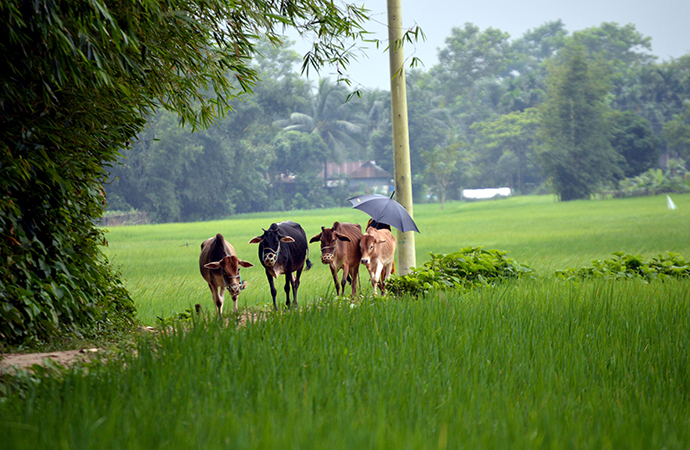
Image: Pixabay
My fellow-columnist Afsan Chowdhury asked recently: "Is there a monolithic Bengal?" His answer was essentially a "no".
He explained: "East Bengal (Bangladesh) is a 'Hinge Zone' - a frontier landscape where cultures, geographies, and even religions collided and shifted due to eco-historical trends." West Bengal is "a zone of cultural entitlement" while East Bengal exhibits "less-sophisticated survivalist tendencies" that are rooted in "a long historical process that predates colonialism by centuries".
Exploring the concepts of Settled and Hinge zones, Chowdhury wrote about the environmental and geopolitical realities of the two zones being shaped by separate ecology- based collective psyches. The ecological West Zone is the Settled Core located around the Bhagirathi-Hooghly river system. Geologically stable for more than a thousand years, it was integrated into imperial systems from the Gupta Empire and the Delhi Sultanate to the British Raj. "Culture became a currency of power, administration, and gatekeeping."
By contrast, East Bengal, currently Bangladesh, is the Hinge Frontier. "It was a wild, shifting frontier for centuries." As the great rivers - the Ganges and the Brahmaputra - migrated eastwards over centuries, "they constantly cleared forests and created new, volatile deltaic lands. This area was geographically isolated from the main imperial capitals. It was a 'hinge zone' between the Sanskritic mainland and the Tibeto-Burman/Southeast Asian frontiers. Social structures here had to be fluid to survive, because a river could wipe out an entire village overnight. Ecology ruled".
I have my doubts about ecological determinism, as I do about religious determinism, historical determinism and social determinism. I determine what determines me. I determine my relations with you. So for you.
However, let us hear Chowdhury out. He averred: "West Bengal's traditional settled cultural strategy is much more about a defensive sense of an inherited culture and institutional gatekeeping. The East is more offensive and performative as it lacks stability. Cultural components have a higher religious content as a weapon for power and survival." Thus, West Bengal is "more elitist, sophisticated but also nostalgic of its past as its capacity to negotiate with the ruling centres has declined after both zones parted ways in 1947". East Bengal is "less sophisticated, highly competitive, transactional, and prone to internal factionalism". West Bengal is sustained in status by past glories and a narrative of victimhood. East Bengal "weaponised the dominant ideology, whatever that is, including religious culture, to control economic and social terrains".
Chowdhury concluded by arguing that West Bengal sees itself as the true custodian of Bengali culture. Although economic supremacy and land was lost in 1947, West Bengal "resorts to cultural sophistication as a psychological coping mechanism". By contrast, "East Bengal will follow any trend that protects its survival chances".
West Bengal is Settled. East Bengal is a Hinge.
The question now is which way Bangladesh (the erstwhile East Bengal/ East Pakistan) will turn. West Bengal is an integral part of India - a settled region, in Chowdhury's terms. No one in West Bengal wishes to leave India to be a part of an united Bengal. Similarly, even in Chowdhury's hinge Bangladesh, no one wishes to leave a sovereign, independent nation-state to be a part of a united Bengal that would itself be a part of India. There is no question of a united, sovereign and independent Bengal today.
West Bengal, with its settled nostalgic elitism, and Bangladesh, with its almost biological penchant for shifting survival, have related but different destinies. West Bengal has found, and will continue to find, its place in a unitary India defined increasingly by the religious scope of Hindi as an Indic condition. Bangladesh will be invited in several directions: Bengali nationalism, Bangladeshi nationalism, Sanskritic revivalism across its western border, the Islamic revivalism in the borderless world, the staying power of Euro-American imperium, and the countervailing rise of China. Most immediately, the Indic and the Sinic strains of Asian history will compete for the imaginative and diplomatic attention of Bangladeshis.
There is no finishing line in this existentialist race. What I would hope for is that Bangladesh remains Bengali in its own way even as West Bengal retains a sense of its Bengali self within an India that is being recreated.
At the end of the day, nations and the world find Bengalis worth talking about only so long as they retain a genetic sense of themselves. By "genetic", I do not mean the biology of the body but the genealogy of the mind. I mean the smell of the Bengali soil after rain. I mean the taste of Bengali food.
I mean whatever makes me Bengali.
The writer is the Principal Research Fellow of the Cosmos Foundation.
A Independent Newsweekly
© Copyright 2026 | Designed by ARK Reepon & Developed by Cosmos Group Software Team





Leave a Comment
Recent Posts
A Battle for the Soul of The N ...
Two disturbing incidents came to light this week, even as they went un ...
Dhaka seeks concrete measures ...
State Minister for Foreign Affairs Humaiun Kobir on Thursday urged Sou ...
Bangladesh Embassy in Ireland begins operations
Dinesh Trivedi stresses proper preparations before T ..
The Hope Deficit: Why Bangladesh’s Revolution Must M ..
Iqbal Bahar Chy: Finding freedom in the unplanned