


Column
Runa Khan’s Bangladesh

An Independent Newsweekly

Column
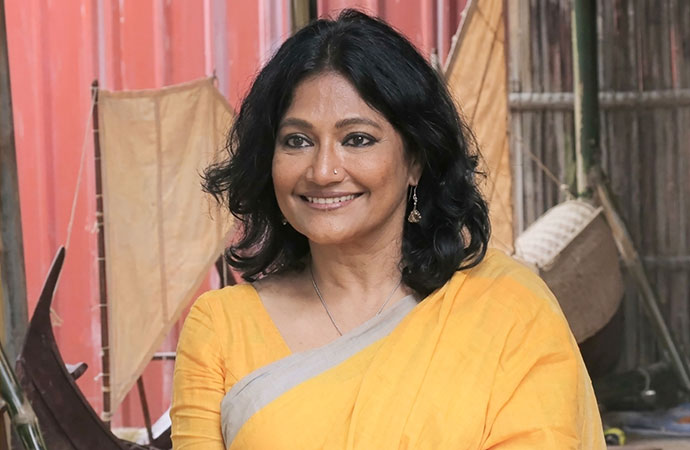
Runa Khan. Photo: Collected
Runa Khan, this year's Bangladeshi recipient of the Ramon Magsaysay Award, the Asian equivalent of the Nobel Prize, has given an interview to Nilima Jahan of The Daily Star. It contains the crux of Runa Khan's mission: "One afternoon remains etched in my memory. I saw a mother feeding her feverish child, who was not even a year old, a bowl of cold rice mixed with raw onion. I asked her, 'Why are you feeding him now, in the late afternoon, instead of at night?' She replied, 'If I feed him now, while there is still daylight, I won't have to spend money on fuel to cook tonight. His stomach will be full, he may forget his fever, and he'll fall asleep.' When you witness poverty at that level, you realise you simply can't look away."
Runa Khan certainly did not look away. She is the founder and executive director of the non-governmental organisation, Friendship, and has been awarded the Magsaysay for decades of service spent in improving lives in remote, river-eroded and climate-vulnerable areas of Bangladesh.
That is the geographical focus of this article: Khan's Bangladesh, or the Other Bangladesh, or the Invisible Bangladesh. There are problems aplenty in Mainstream Bangladesh itself - Dhaka, Chattogram and other major cities; in district towns and villages; on the highways that connect the capital arterially to outlying areas. However, these are known problems, and what is known by sight and sound and information comes under the radar of public knowledge. Thanks to Bangladesh's vibrant and competitive media, the country is united at a very high level informationally.
But the same degree of formal recognition does not apply to chars - sandbar islands - and similarly isolated areas that dot the nation's riverine reality. Such areas become but appendages of Everyday Bangladesh. It is not that the government's writ does not extend to them. It does, as does the corrective ambit of public policy. Yet, those places remain spatially detached from the public imagination.
This is where Khan's ameliorative activism makes her deserve the Magsaysay. It holds up the Other Bangladesh to national and international scrutiny. In her Alternative Bangladesh, a mother feeding her feverish child in the afternoon is not the exception. She is the norm. And that norm has to be denormalised. That is what Friendship is doing, not least through its hospital and school ships that bring medical and educational care to what she carefully calls "unaddressed communities".
According to The Daily Star, "What started with a single floating hospital has grown into a social purpose organisation serving 7.5 million people annually across healthcare, education, climate action, sustainable economic development, inclusive citizenship, and cultural preservation".
The Ramon Magsaysay Award Foundation said: "Moved by the hardships faced by Bangladesh's remote char communities, Runa Khan founded Friendship to deliver essential services to people living beyond reach of conventional development programmes. What began with a single hospital ship grew into a comprehensive development model delivering healthcare, education, climate adaptation, livelihoods, and social inclusions to millions across riverine, coastal, and refugee communities. The RMAF Board of Trustees recognises her profound empathy for the poorest of the poor in her country, and her courage, vision, and tenacity in building and leading Friendship to accomplish her mission. In her hands, privilege became not an entitlement, but a responsibility; not a family legacy to protect, but a gift to be shared so that others, too, might have the chance to live with hope, opportunity, and dignity."
Khan related to Nilima Jahan how Friendship today has around 7,500 staff members; 50 per cent to 60 per cent of them are local residents "whom we recruited from the chars and trained. We took local teachers who hadn't even passed their matric exams, trained them rigorously, and today, their students are clearing competitive exams to enter Rangpur Medical College, (the) Asian University for Women, Dhaka University, and Notre Dame College. Everyone thought it was impossible, but we proved that with proper traning and structure, everything can be achieved."
The chars of Bangladesh themselves rise in supplication to ask for blessings to shower down, like nurturing rain, on Runa Khan, her family and her supporters.
Bangladesh is a nation of possibilities. Some possibilities, such as the excellence of its intelligentsia, are predictable because Bengalis are an intensely cerebral nation. Other possibilities are created by the Runa Khans of Bangladesh, who strive to mainstream - both materially and figuratively - life in the chars into a common recognition that every inch of the country is precious geographical ground.
The writer is Principal Research Fellow of the Cosmos Foundation. He may be reached at epaaropaar@gmail.com
A Independent Newsweekly
© Copyright 2026 | Designed by ARK Reepon & Developed by Cosmos Group Software Team






Leave a Comment
Recent Posts
The government passes the test ...
One of the cornerstones of the political earthquake Bangladesh witness ...
The government hiked the price ...
The government hiked the price of a 12kg cylinder of liquefied petrole ...
Police in France stand accused of using excessive fo ..
The India-Pakistan Cold War
A week on from DNCC’s eviction drive, Mirpur-10 rema ..
Equal Service, Unequal Pensions: Time for a Fairer S ..