


Column
If Fuel Management Goes Private: Can Bangladesh Get the Model Right?


An Independent Newsweekly


Column
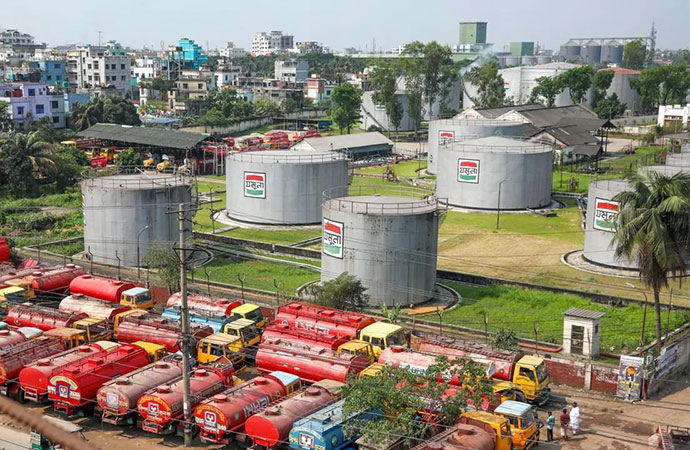
As the government considers opening fuel management to private participation, the challenge is to gain the efficiency of competition without compromising energy security. Fuel disruption affects transport, agriculture, industry, power generation and inflation, making it a strategic national concern. The recent Iran-US-Israel conflict has exposed Bangladesh's vulnerability. The country consumes nearly seven million tonnes of petroleum products annually, yet has storage capacity of only 1.36 million tonnes and refining capacity of around 1.5 million tonnes. With transport accounting for about 63 per cent of consumption, heavy dependence on imported refined fuel makes a more resilient and efficient petroleum system increasingly necessary.
A Crisis That Exposed the System
The 2026 Middle East conflict disrupted fuel supplies around the Strait of Hormuz, triggering rationing, queues and panic buying in Bangladesh. While the external shock was unavoidable, it exposed domestic weaknesses in procurement, supply diversification, storage and bureaucratic response. The lesson is clear: the real issue is not simply public versus private ownership, but preparedness, management and accountability.
Beyond a Second Refinery
The crisis reinforces my earlier argument for a second refinery, possibly in the Moheshkhali-Matarbari energy corridor. But refining capacity alone is not enough. Bangladesh also needs greater storage, diversified supply sources and well-regulated competition. Capacity and competition must move together to strengthen energy security.
Bangladesh Already Knows the Principle
Bangladesh already applies this principle elsewhere. BRTC operates alongside private buses, while selected railway services are privately managed under state ownership and supervision. Petroleum is more strategic, but the principle holds: state ownership and commercial management need not always remain in the same hands. BPC can retain its strategic role while competition is introduced in selected areas of import, storage, transportation and distribution.
What Asia Tells Us
Asia offers useful models. India combines strong state-owned petroleum companies with private participation in refining and marketing, while Pakistan allows multiple oil-marketing companies and the Philippines has liberalised its downstream sector. But private participation alone does not guarantee efficiency. The real lesson is that competition, effective management and strong regulation matter more than ownership itself.
The Greater Risk: Replacing One Monopoly with Another
Bangladesh must ensure that liberalisation does not replace a state monopoly with a private oligopoly. Since only a few large groups may initially have the capital, infrastructure and international networks to import fuel, strong safeguards must precede private participation. Transparent access to terminals, pipelines and storage, disclosure of ownership, mandatory fuel stocks and effective regulatory oversight are essential to prevent collusion and market abuse. Competition must not merely be permitted; it must be protected.
How Bangladesh Should Make the Transition
Bangladesh should not move from monopoly to competition overnight. The first task should be to separate policymaking, regulation and commercial operation. The Energy Ministry should determine policy, an independent professional regulator should supervise the market and BPC should increasingly operate as a commercial and strategic national petroleum company.
Second, government should undertake controlled market opening, initially licensing several technically and financially qualified private operators in selected segments under clear requirements covering capital, procurement capability, safety, storage and technical expertise.
Third, energy-security obligations must apply equally to private participants. Significant importers should maintain prescribed minimum stocks and alternative procurement arrangements. BPC should continue holding the national strategic reserve, retain emergency government-to-government procurement capability and remain supplier of last resort during major crises. Critical pipelines, terminals and storage facilities may remain publicly owned with transparent access for qualified operators.
Fourth, government should establish a transparent pricing and market-monitoring mechanism. Digital systems should track imports, inventories, depot stocks, retail availability, prices and market shares in near real time.
Finally, reform should be reviewed before it is expanded. After perhaps two to three years, government should evaluate procurement costs, fuel availability, pump prices, storage investment, supply reliability, service quality, market concentration and BPC's performance. The principle should be: liberalise progressively, regulate beforehand and evaluate before expanding.
BPC Plus Competition
The objective should not be to dismantle BPC, but to redefine its strategic role. BPC should focus on reserves, emergency preparedness, market stabilisation and critical infrastructure, while private operators bring competition and efficiency. Government should shift from direct operational control to strong regulation-setting the rules, ensuring quality and competition and protecting energy security. Government need not sell every litre of fuel; it must control the rules under which every litre is sold.
Capacity and Competition Must Move Together
The recent crisis should become an opportunity for reform. Bangladesh needs a second refinery, larger strategic reserves, diversified supplies and carefully regulated competition. The choice is not BPC versus private enterprise, but BPC plus competition under strong regulation. Reform must be properly sequenced: build the regulatory framework first, introduce competition gradually and protect strategic capacity. The goal should be clear-a strong state, a strong BPC and no monopoly, public or private.
Major General (Retd.) Md. Nazrul Islam is the former Executive Chairman of BEPZA and Executive Member (Planning and Development) of BEZA. He is a PhD researcher focusing on technology, workforce transformation, and industrial competitiveness, and the author of the Zi-DoNa Trilogy.
A Independent Newsweekly
© Copyright 2026 | Designed by ARK Reepon & Developed by Cosmos Group Software Team






Leave a Comment
Recent Posts
A commendable intervention by ...
A struggle for local dominance in the Chittagong Hill Tracts, specific ...
How close is the Amazon to a ‘ ...
While Brazil’s presidential candidates have not made policy of t ...
Another shipment of highly radioactive uranium fuel
Harmony: Diplomatic community joins Durga Puja celeb ..
What to know about the Ebola outbreak that has sprea ..
Brazil election: Trump’s ‘Donroe Doctrine’ faces its ..