


Column
Beyond Infrastructure: Building Bangladesh's Future Workforce Through Bangladesh–China Cooperation


An Independent Newsweekly




Column
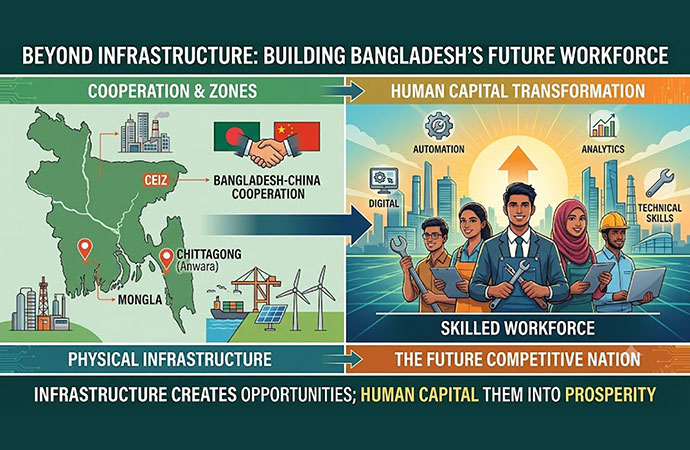
The recent visit of the Hon'ble Prime Minister to China has opened a new chapter in Bangladesh-China cooperation. Agreements on investment, industrial development and human resource development-including the Chinese Economic and Industrial Zone (CEIZ) at Anwara and the proposed Chinese Economic Zone at Mongla-have created fresh opportunities for industrial transformation. The challenge before Bangladesh is no longer attracting investment; it is preparing a workforce capable of turning that investment into productivity, competitiveness and long-term economic growth.
The Arithmetic of Graduate Unemployment and Skills Mismatch
Bangladesh is passing through a critical phase of its demographic transition. Every year, approximately 2.2 million young people enter the labour market, while universities and colleges produce nearly 700,000 graduates. Yet graduate unemployment has risen to around 13.5%, with nearly one-third of the unemployed holding university degrees. An estimated 900,000 graduates remain without suitable employment despite years of education. This is not merely an employment challenge; it is a question of national productivity. Families invest their savings, the Government invests substantial public resources and students devote years to higher education. When graduates remain unemployed or underemployed, the return on that collective investment is significantly reduced. Ironically, employers continue to report shortages of technicians, automation specialists, engineers, machine operators, logistics professionals and digital specialists. Bangladesh therefore faces a growing paradox: an expanding pool of graduates alongside a shortage of industry-ready skills. Closing this gap is no longer simply an education reform; it is an economic imperative. Bangladesh's ability to transform its demographic dividend into a skilled workforce may well determine the country's competitiveness in the era of advanced manufacturing and the Fourth Industrial Revolution.
Why the Skills Gap Matters
The Fourth Industrial Revolution is transforming global manufacturing through artificial intelligence, robotics, automation and digital technologies. In this new era, nations compete not through cheap labour alone but through skilled and adaptable human capital. During my studies in Strategic Management at the National Defence University in China, I observed that China's industrial success was built not only on infrastructure but also on sustained investment in technical education, vocational training and close collaboration between industry and academia. Human capital was treated as a strategic economic asset rather than merely a social investment. That lesson carries profound relevance for Bangladesh today.
Turning Chinese Investment into National Capability
The recent Bangladesh-China agreements present a unique opportunity to align workforce development with industrial investment. The Chinese Economic and Industrial Zone (CEIZ) at Anwara, the proposed Chinese Economic Zone at Mongla and future Chinese investments are expected to accelerate advanced manufacturing, logistics, renewable energy and other technology-driven industries. These sectors will require a new generation of skilled professionals in automation, robotics, industrial maintenance, digital technologies, cybersecurity, logistics, renewable energy and data analytics. Equally important will be communication skills, English proficiency and practical knowledge of Mandarin to facilitate technology transfer and industrial collaboration. Preparing this workforce before investment gathers momentum will enable Bangladesh not only to attract foreign investment but also to absorb technology, create higher-value employment and strengthen its long-term industrial competitiveness.
A National Strategy for Future Skills
Preparing Bangladesh's workforce requires coordinated national leadership rather than isolated training programmes.
First, the Government should establish a Bangladesh-China Future Skills Council under the Prime Minister's Office to forecast workforce demand arising from Chinese investments and coordinate policy among ministries, universities, industry associations, BEZA, BIDA, the National Skills Development Authority and Chinese enterprises.
Second, every major Chinese investment project should submit projected manpower requirements for the next five to ten years. This information should support a National Skills Mapping Programme, enabling universities, polytechnics and technical institutes to align curricula with actual industrial demand.
Third, every Economic Zone should include a dedicated Skills Development Centre as essential infrastructure, just like roads, electricity and utilities. These centres should be jointly managed by government, industry and educational institutions.
Fourth, universities and technical institutions should modernise curricula by integrating artificial intelligence, automation, industrial digitalisation, robotics, data analytics and entrepreneurship. Structured industrial internships and apprenticeships should become compulsory components of professional education.
Fifth, Bangladesh should establish a Bangladesh-China Future Skills Fund, jointly financed by the Government, Chinese enterprises and development partners, to support laboratories, instructor development, scholarships, faculty exchanges, applied research and nationwide upskilling and reskilling initiatives.
Finally, partnerships between Bangladeshi and Chinese universities should be expanded through joint research, dual-degree programmes, technology transfer and collaborative innovation centres supporting future industries.
The Economic Return on Investing in Skills
Investment in workforce development is not a social cost; it is an investment in national competitiveness. A skilled workforce attracts higher-quality investment, raises productivity, accelerates technology transfer and strengthens exports while reducing dependence on foreign expertise. In the long run, few public investments generate greater economic returns than human capital development.
Building Bangladesh's Competitive Advantage
The first phase of Bangladesh-China cooperation helped build Bangladesh's physical infrastructure. The next phase should build its human capital. The true success of the recent agreements will not be measured by the number of factories established or the volume of investment attracted, but by the number of young Bangladeshis equipped to lead the industries of the future. Infrastructure creates opportunities; human capital transforms them into prosperity. By placing workforce development at the centre of its economic strategy, Bangladesh can ensure that today's partnership with China becomes a lasting foundation for industrial competitiveness and sustainable national development.
Major General (Retd) Md Nazrul Islam is a former executive chairman of BEPZA, a retired Major General of the Bangladesh Army, and a PhD researcher on technology, workforce transformation, and industrial competitiveness.
A Independent Newsweekly
© Copyright 2026 | Designed by ARK Reepon & Developed by Cosmos Group Software Team






Leave a Comment
Recent Posts
An unaccountable process leave ...
The latest price hike of all four major petroleum products by Tk 20 pe ...
The French Connection in South ...
France Ambassador to Bangladesh Jean-Marc Séré-Charlet h ...
Ties with China enter new phase
Happy 61st birthday, Singapore!
In defiant speech, Pezeshkian calls out Trump and sa ..
The banality of evil