


Business
Why the US-China Trade Truce Matters


An Independent Newsweekly






Business
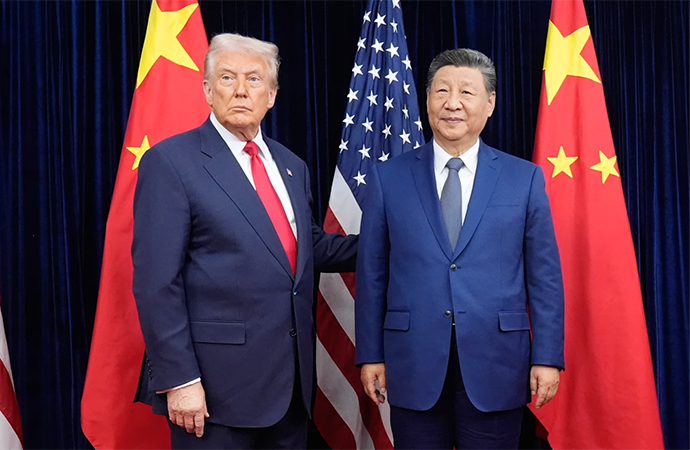
US President Donald Trump and Chinese President Xi Jinping Photo: AP/UNB
Chinese President Xi Jinping and US President Donald Trump’s agreement to extend their trade truce reflects the fact that both sides have leverage over the other. In a world where the rules-based trading system is not functioning, the current fragile equilibrium may be the best one can hope for.
Chinese President Xi Jinping's state visit to Washington in September produced no major new agreement. But it did result in an extension of the trade truce that Xi and US President Donald Trump struck in Busan, South Korea, last October. Instead of expiring on November 10, the truce will expire on January 10, 2027. Though modest, this achievement has given an unstable world economy a reprieve.
The core agreement is simple enough: China will refrain from enforcing the export controls on rare earths and related materials that it unveiled last October, and the United States will refrain from raising tariffs further, holding the overall duty on Chinese goods near the 47% level reached in Busan (down from 57% beforehand). Both sides have grumbled about compliance, but neither wants the truce to lapse before the presidents meet again, first in Shenzhen in November, then the following month in Miami.
China clearly has a great deal of leverage in dealing with Trump. It accounts for roughly 60-70% of global rare-earth mining and 85-90% of rare-earth processing (the step that turns mixed ores into the oxides used in many critical technologies). And when it comes to the heavy rare-earth elements, China's grip is even tighter. Processing of dysprosium and terbium, essential ingredients in electric-vehicle magnets, wind turbines, and missile-guidance systems, is carried out almost exclusively in China.
On a detailed element-by-element accounting, the US and its allies have meaningful non-Chinese extraction capacity for only seven or eight of the 17 rare earths, but essentially no processing capacity. That could change in the next two years, with the processing figure growing to five elements. The Australian miner Lynas and the US-based MP Materials already ship commercial volumes of lighter elements like neodymium and praseodymium, and within ten years, non-Chinese extraction could cover nearly all light elements and most heavy ones.
But even then, the processing figure may reach only nine elements, with dysprosium and terbium remaining overwhelmingly under Chinese control. While future innovations in processing, or in designing rare earths out of manufactured goods altogether, could alter the picture, such scenarios are harder to predict.
It is also useful to question the belief that "de-risking" from China would leave the US and Europe unambiguously better off. Recent geopolitical developments suggest otherwise. Now that the US no longer wants to be bound by international rules that it considers inconvenient, rare-earth leverage is one of the few remaining restraints on US protectionism and economic warfare.
Since the Trump administration seems oblivious to the cost of tariffs on US households, there is no guarantee that the next round of tariffs would stop at a level Americans can comfortably bear. In fact, by threatening to reduce, but not eliminate, the rare-earth supply, China may be saving Trump from himself, at least in the short term.
The European Union faces a similar situation. It has been more cautious than the US about raising tariffs on Chinese goods, partly because European industry is heavily reliant on Chinese inputs. Although the EU's own Critical Raw Materials Act targets 40% domestic processing by 2030, its auditors reported in February that actual capacity remains near 25%. Tellingly, although Japan has spent over a decade and roughly $1.2 billion diversifying away from China since a 2010 rare-earths dispute, its heavy rare-earth imports collapsed by 70-80% in early 2026.
Export controls were not invented by the Chinese. The US Commerce Department's Entity List has grown roughly ninefold over the past decade, to nearly 1,200 entries, while China's own retaliatory lists have grown only through the occasional addition of a few dozen entities at a time. On this measure, the US and the EU currently maintain considerably longer control lists than China does.
Although export controls are nominally aimed at military applications, the national-security rationale is not always as clean as advertised, and the civilian collateral damage often rivals the intended effect. In the case of the US and Chinese export controls, one unintended consequence has been a reduction in US exports and Chinese imports. This is probably because export controls cut off Chinese customers from US suppliers, who mostly failed to find replacement buyers and instead suffered a loss of revenue, profitability, and employment. Whereas Oxford Economics estimates that export controls cost China a cumulative 0.8% of GDP in 2024-26, a 2023 input-output study concludes that the US has, in relative terms, lost more, with Japanese, South Korean, and European firms capturing the resulting market share.
In a world where the rules-based trading system is not functioning, a fragile status quo stabilized by mutual leverage is probably better than unilateral acts of dominance or chaos. If the zero-sum wrangling ultimately inspires a return to multilateral negotiation, so much the better.
From Project Syndicate
A Independent Newsweekly
© Copyright 2026 | Designed by ARK Reepon & Developed by Cosmos Group Software Team






Leave a Comment
Recent Posts
The government passes the test ...
One of the cornerstones of the political earthquake Bangladesh witness ...
The government hiked the price ...
The government hiked the price of a 12kg cylinder of liquefied petrole ...
Police in France stand accused of using excessive fo ..
The India-Pakistan Cold War
A week on from DNCC’s eviction drive, Mirpur-10 rema ..
Equal Service, Unequal Pensions: Time for a Fairer S ..