


Reportage
Debate Over Electoral System: Leaders Urge Strengthening Conventional Polls Over PR


An Independent Newsweekly

Reportage
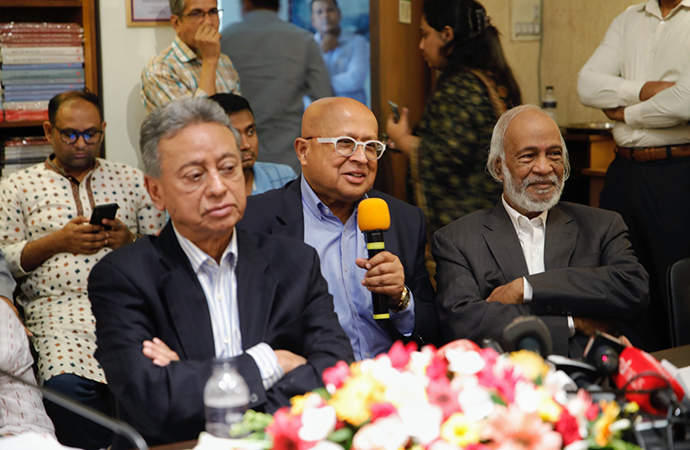
BNP leaders Amir Khosru Mahmud Chowdhury (left) and Dr Abdul Moyeen Khan (right) with UNB Editor-in-Chief Enayetullah Khan (centre) at a seminar held at the Cosmos Centre in Dhaka. Photo; UNB
As Bangladesh inches closer to the general election, political leaders and experts are still sharply divided over the idea of introducing a proportional representation (PR) system. At a seminar held in Dhaka on Saturday (11 October), the overwhelming sentiment among senior politicians leaned towards strengthening the existing First-Past-the-Post (FPTP) system, rather than opting for what many described as an 'untested and complex alternative'.
The seminar, titled 'Election 2026: A Critical Look at Proportional Representation', was organised by Cosmos Foundation, the philanthropic arm of Cosmos Group, at the Cosmos Centre in Moghbazar, with United News of Bangladesh (UNB) as media partner. The session was presided over by UNB Editor-in-Chief Enayetullah Khan.
BNP Voices: 'People Haven't Lost Faith in the Existing System'
BNP Standing Committee member Amir Khosru Mahmud Chowdhury questioned the very basis of the ongoing debate on PR, arguing that political parties have no authority to decide on holding a referendum regarding the system.
"Why should we go for a referendum on PR? First of all, who has given us that responsibility? The people didn't give us this responsibility," he said.
He stressed that only the people, not political parties, could bring change through the ballot box. "Every party has many issues where there is no consensus. So, if you go for a referendum on each of them, you'll end up doing referendums for the next two years."
Khosru also pointed out that the current interim government in Bangladesh was formed under the constitution and operates within its framework. "If we want to restore democratic order and bring about any changes later, we must first hold an election under the current constitution and return to a democratic system," he said.
Once democracy is restored, he added, discussions on electoral reforms such as PR could take place both inside and outside parliament. "You can't have a meaningful public debate when you don't have a democratic government in place," he remarked.
He also dismissed the idea of absolute consensus among all political parties. "We're not forming a one-party Baksal system. Differences in ideas and policies will always exist, and that's the beauty of democracy," he observed.
Khosru underscored the need to strengthen parliamentary committees and hearings, saying an effective parliament can solve many of the country's problems by ensuring accountability.
Another BNP leader, Dr Abdul Moyeen Khan, strongly opposed the PR model, arguing that it would weaken the direct link between voters and their representatives. "PR basically weakens the position of an individual representative and strengthens the party instead," he said.
Under PR, he noted, people would vote for a party rather than an individual candidate. "This goes against our fundamental democratic spirit, where people elect their own representatives who are directly accountable to them."
Moyeen Khan warned that empowering parties while diminishing individuals would "create a self-contradictory system". He cautioned that Bangladeshis are neither "mentally nor intellectually prepared" for such a complex electoral process, urging instead for a system that remains simple and people-centric.
Jamaat's Counterpoint: 'Every Vote Must Count'
Offering a contrasting view, Bangladesh Jamaat-e-Islami Assistant Secretary General AHM Hamidur Rahman Azad made a strong case for introducing PR to ensure fair representation and eliminate what he termed "wasted votes" under the FPTP model.
"The first and foremost benefit of implementing PR would be that every vote counts, and the voter can thus recognise that he or she is represented in parliament," he said.
Hamidur argued that the prevailing system allows the rise of local dominance, money politics, and violence. "To come out of these irregularities, PR is a suitable system. Making every vote count is number one, and number two is fair elections," he added.
Mixed Reactions: Support for PR in an 'Upper House'
Several leaders, while rejecting PR for the lower house, supported introducing it in a proposed upper chamber to ensure checks and balances.
Nagorik Oikya President Mahmudur Rahman Manna said the public had little understanding or interest in the PR system. "The people of the country do not understand PR. They have no interest in it," he said.
However, he added that PR could be discussed for an upper house. "There is a need for a check and balance between the government and other parties. The PR system can be discussed for the upper house," Manna said.
He also cautioned the BNP to remain committed to democracy, warning that any deviation could bring "dire disaster" to the country.
Similarly, Biplobi Workers Party General Secretary Saiful Haque described the campaign for PR as "motivated" and questioned claims that 78 percent of people support it. "The next election should be held under the existing system. People of Bangladesh are not yet mentally ready for such a major change," he asserted.
Haque supported the idea of PR in the upper house but opposed applying it to the lower one. He also suggested that any referendum on the proposed July Charter should coincide with the national election to save public resources and avoid confusion. "Holding the referendum before the election could bring many risks and complications if voter turnout is low," he warned.
Experts Warn Against Political Instability
Former Election Commission Secretary Dr Mohammed Jakaria said PR could produce mismatched outcomes. "A party winning the most votes under the PR system might still be unable to form the government. This could lead to a significant mismatch between the people's expectations and election outcomes," he said.
He further warned that PR might empower fringe groups and make governance unstable. "Who can guarantee that Bangladesh will not face similar problems?"
AB Party Chairman Mojibur Rahman Monju echoed similar concerns, saying, "If voting takes place at night, there will be no difference between an election under the PR system and the traditional FPTP system."
Monju favoured a mixed model on a trial basis, suggesting PR for the upper house and FPTP for the lower house. "Ensuring a free and fair election is far more important than choosing between the two systems," he emphasised.
Focus on Democratic Accountability
Presenting the keynote paper, Prof Mamun Al Mostofa of Dhaka University's Political Science Department argued that PR alone cannot ensure accountability. "Forming an upper house based on PR is not enough to institutionalise democracy. It may instead expand the class of politically privileged people," he cautioned.
Md Rashed Khan, General Secretary of Gono Odhikar Parishad, urged all parties to approach the coming national election positively. "Any division among democratic parties could pave the way for the return of a fascist Awami League," he warned.
Abul Hasan Rubel, Executive Coordinator of Ganosanghati Andolon, said PR should only be considered if people lose faith in the current system. "It's not like people have lost faith in the conventional electoral system. Rather they were denied to vote for 17 years. People want their voting rights back," he said.
He also pointed out that introducing PR could be geopolitically risky, potentially inviting instability and foreign interference. "We want to ensure proper checks and balances on the government, but weakening it through a system like PR would not be the right way," Rubel added.
The debate revealed a broad consensus among Bangladesh's political and intellectual circles. While reforming the electoral process remains necessary, the focus should first be on ensuring free, fair and credible elections under the existing constitutional framework.
A Independent Newsweekly
© Copyright 2026 | Designed by ARK Reepon & Developed by Cosmos Group Software Team





Leave a Comment
Recent Posts
A commendable intervention by ...
A struggle for local dominance in the Chittagong Hill Tracts, specific ...
How close is the Amazon to a ‘ ...
While Brazil’s presidential candidates have not made policy of t ...
Another shipment of highly radioactive uranium fuel
Harmony: Diplomatic community joins Durga Puja celeb ..
What to know about the Ebola outbreak that has sprea ..
Brazil election: Trump’s ‘Donroe Doctrine’ faces its ..