


Column
Trump has not failed

An Independent Newsweekly
Column
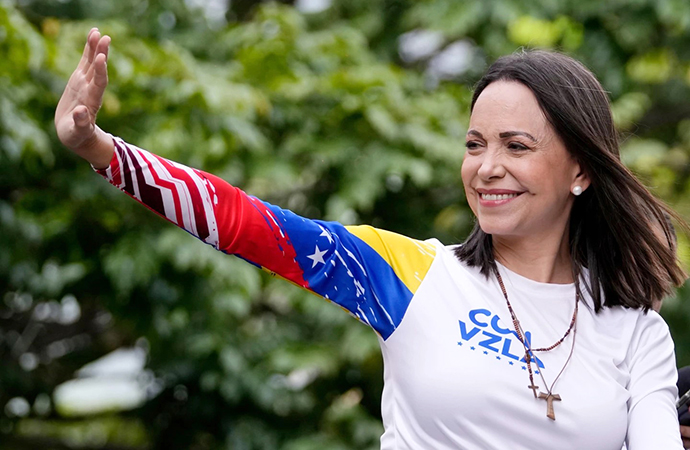
Maria Corina Machado. Photo: AP/UNB
The denial of the Nobel peace prize to American President Donald Trump, a gesture which was expected for his role in ending several wars, does not detract from his creditable effort to secure peace in the Middle East. The cessation of the medieval war between Hamas and Israel would represent Trump's biggest foreign accomplishment in his second term. His first term was marked by the Abraham Accords.
As David E. Sanger reminds us in an excellent article in the New York Times, those accords normalised relations between Israel and the United Arab Emirates and Bahrain, "the first Arab states to recognise Israel in a quarter of a century. Sudan and Morocco joined later". "It was the fear that Saudi Arabia, home to many of the holiest sites in the Muslim faith, was on the verge of joining those accords that helped drive Hamas to the horror of the October 7, 2023, attack".
Two years since that barbaric attack on the Jewish state, the war has killed 1,200 people in Israel and more than 60,000 Palestinians; destroyed 90 per cent of the homes in Gaza; and created the possibility of Israeli Prime Minister Benjamin Netanyahu keeping his troops in Gaza City and taking control of "the shattered remains of Gaza". Allowing normal life to resume in Gaza would allow Trump to claim the mantle of a global peacemaker, Nobel or not.
As for the peace prize this year, it has gone to Maria Corina Machado, whom the Norwegian Nobel Committee describes as "a brave and committed champion of peace - to a woman who keeps the flame of democracy burning amid a growing darkness". She is receiving the prize for "her tireless work promoting democratic rights for the people of Venezuela and for her struggle to achieve a just and peaceful transition from dictatorship to democracy. As the leader of the democracy movement in Venezuela, Maria Corina Machado is one of the most extraordinary examples of civilian courage in Latin America in recent times... Venezuela has evolved from a relatively democratic and prosperous country to a brutal, authoritarian state that is now suffering a humanitarian and economic crisis. Most Venezuelans live in deep poverty, even as the few at the top enrich themselves. The violent machinery of the state is directed against the country's own citizens".
These are important credentials, no doubt, but the Norwegian peace with which Nobel wishes to invest Venezuela appears to me to be less important internationally than what Trump has done. In his two terms, he has worked for global peace by contributing to the ending of hostilities between (alphabetically) Armenia and Azerbaijan, Cambodia and Thailand, the Democratic Republic of Congo and Rwanda, Egypt and Ethiopia, India and Pakistan, Israel and Iran, Israel and Hamas, Serbia and Kosovo, and the possibility of the end to the war between Russia and Ukraine.
That seems to be more than Maria Corina Machado has done, is doing, or can do for the world by democratising Venezuela, important though that would undoubtedly be. Gaza is more of an international issue.
As Sanger warns, "much could go wrong in coming days, and in West Asia it often does". In particular, the Gaza peace deal "may look more like another temporary pause in a war that started with Israel's founding in 1948, and has never ended". However, "if Hamas gives up its last 20 living hostages... and with them its negotiating leverage, that would be an extraordinary step". The first stage refers to the hostage-for-prisoner swaps and the withdrawal of Israeli troops "to a yet-to-be-described line". "Getting to the next stage, where Hamas would have to give up its arms and, even harder, its claim to run Gaza, may prove even more difficult than bringing the living and dead hostages home." Yet, there is never a second step without the first one. So, Trump has done - till now - the undoable. That is reason for hope.
The key point here is that we live in an imperfect one. A two-state solution for Palestine cannot but remain the ultimate goal for well-wishers of both Israelis and Arabs, but that solution is nowhere in sight. Hamas wants to destroy Israel; Israel has no wish to be annihilated. Israel has the power to defend itself; Hamas does not have the power to defend Gaza. Nuclear America stands behind nuclear Israel; even the world's sole Muslim nuclear nation has not opened its strategic umbrella over Palestine. In that immediate context, what the world needs is some kind of end to the suffering of innocent Gazans, who are caught in the crossfire between Israel and Hamas. If President Trump manages to achieve that "some kind of suffering", he should be given credit for his victory.
There was no Nobel for him this year. But the Nobel Peace Prize will be up for grabs again next year.
There is no harm in waiting.
The writer is Principal Research Fellow of the Cosmos Foundation. He may be reached at epaaropaar@gmail.com
A Independent Newsweekly
© Copyright 2026 | Designed by ARK Reepon & Developed by Cosmos Group Software Team



Leave a Comment
Recent Posts
A commendable intervention by ...
A struggle for local dominance in the Chittagong Hill Tracts, specific ...
How close is the Amazon to a ‘ ...
While Brazil’s presidential candidates have not made policy of t ...
Another shipment of highly radioactive uranium fuel
Harmony: Diplomatic community joins Durga Puja celeb ..
What to know about the Ebola outbreak that has sprea ..
Brazil election: Trump’s ‘Donroe Doctrine’ faces its ..