


Column
Taliban is a Menace, Bangladesh Needs No Lesson from It

An Independent Newsweekly
Column
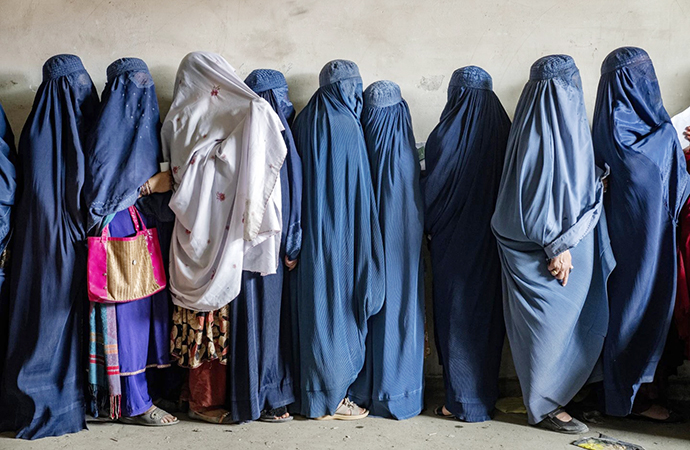
Photo: AP/UNB
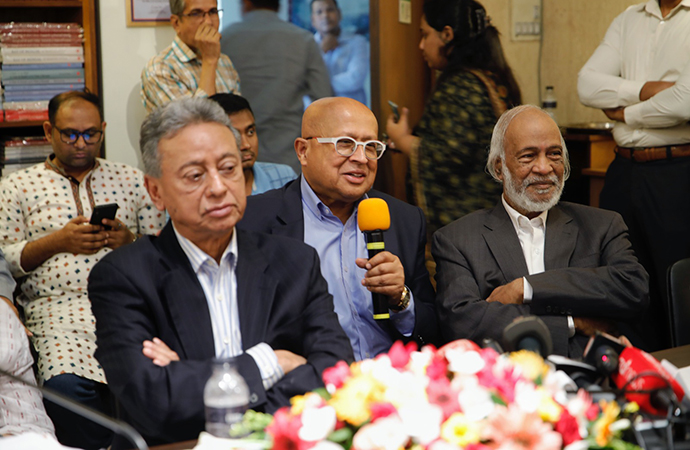
A delegation of Bangladeshi politicians, led by Mamunul Haque of the Khelafat Majlish, has just returned from Afghanistan. They expressed token concern over restrictions on women's education but also praised what they called the Taliban's achievements in "security, development, and justice."
Let's be clear: this was a state-staged tour. These men saw only what their hosts wanted them to see, and they dutifully echoed it. But because Bangladesh itself is sliding toward religion-based governance, it is essential to look beyond propaganda and confront what Taliban rule actually means.
Women as the Measure of Civilization
Half of every nation is female; the condition of women is the clearest measure of progress or decline. On this question, the Taliban stand apart not only from the modern world but from mainstream Islamic scholarship. Al-Azhar's Grand Imam has called denying education to anyone, male or female, a grave sin. Haroon Imtiaz of the Islamic Society of North America has stressed that Taliban restrictions on girls' schooling contradict both Qur'an and Sunnah.
A Law to Control Every Breath
The Taliban's flagship decree-the Law on Promoting Virtue and Preventing Vice-sounds benign. It is not. The UN warns it tramples basic human rights. The 114-page code dictates dress, speech, and movement for every Afghan.
Women must cover not just body and face but even their voices. They cannot look at unrelated men, sing, or read aloud in a way others might hear. They cannot travel without a male guardian. Men are ordered to cover from navel to ankle and grow beards of fist-length. Music is banned outright.
Enforcement lies with a Ministry of Virtue and Vice, whose morality police roam the streets, empowered to detain, fine, and jail at whim.
Education and Work: Doors Slammed Shut
Girls are barred from school beyond grade six. Universities are closed to them. Books by female authors are blacklisted; this year alone, 679 titles were banned.
Employment is virtually nonexistent. Women cannot work in NGOs, the UN, most government jobs, or television. Even nursing programs are shut. With the exception of narrow roles in health and elementary education, the public sphere has been sealed off.
"Justice" as Spectacle
Four years into Taliban rule, rights groups describe the result as cruel and inhuman. Whatever Afghan women gained over decades has been erased. Most are effectively prisoners in their own homes.
Public punishment has returned with vengeance. The Guardian reports more than a thousand women flogged recently for "immorality"-a label covering everything from walking alone to speaking to a man. One woman, Diba, a 38-year-old mother of seven, was jailed for delivering clothes to clients without a male escort, then flogged for renting a sewing machine from an unrelated man. In June 2024, 63 women were flogged in a single province. In April this year, four public executions took place.
Minorities fare no better. Shia and Hazara Afghans are vilified as "enemies of Islam," their mosques bombed, their communities expelled from Kabul as "infidels."
The Lesson for Bangladesh
This is the reality our returning politicians chose to ignore. Taliban rule is not a model of justice or order. It is a blueprint for repression. It is not only a step backward-it is, in the eyes of international law, a crime against humanity.
Bangladesh needs no lessons from the Taliban. It needs to resist, with open eyes, the lure of their darkness.
The writer is a journalist and author based in New York.
A Independent Newsweekly
© Copyright 2026 | Designed by ARK Reepon & Developed by Cosmos Group Software Team





Leave a Comment
Recent Posts
Art, Love and Resistance: A Co ...
The exhibition Braids and Threads: Connecting Legacies by artists Mo ...
VTRT rescues 10-foot python fr ...
The Village Tiger Response Team (VTRT), trained and supported by WildT ...
The Hormuz Crisis and the Fate of the Global South
The Great Hungarian Reset
Dr Yanan Wu
The fate of the bhadralok