


Column
The Other Lenin


An Independent Newsweekly







Column
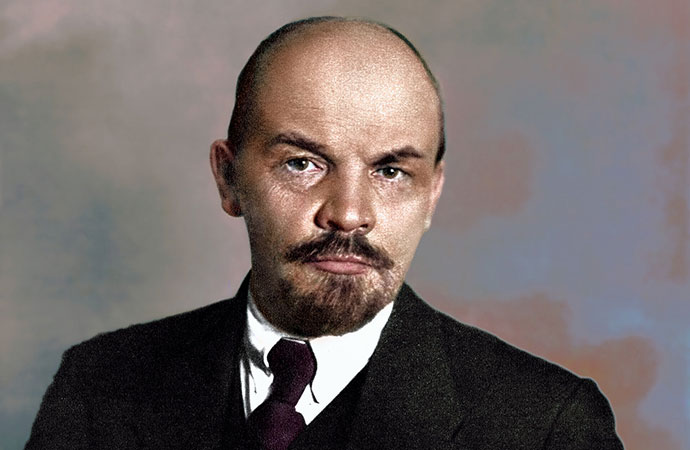
Vladimir Lenin. Photo: Collected
The British philosopher Bertrand Russell (1872-1970) remains an intellectual lodestar for many progressive intellectuals around the world because of his interventions in contemporary public affairs. His premise was: "Men are born ignorant, not stupid. They are made stupid by education. It is not what the man of science believes that distinguishes him but how and why he believes it." That line of thinking brought him into conflict with established religion, including Marxism, the greatest of the secular religions.
One of his critical public interventions revolved around Vladimir Lenin (1870-1924), the leader of the Bolshevik Revolution who was the first head of government of Soviet Russia from 1917 and of the Soviet Union from 1922. Among leftists, Lenin is celebrated for having established the world's first communist state, winning the Russian Civil War and creating a one-party state that imploded ultimately only in 1991. In his "Third Hymn to Lenin", the Scottish poet Hugh MacDiarmid presents Lenin as the greatest turning point in human history since Christ, and praises the Russian icon for his capacity to merge thought and reality. Russell, too, was a self-declared communist but his encounters with actually-existing socialism in Russia/the Soviet Union disabused him, a man of science, of his utopian belief in revolutionary emancipation centred on an exceptional individual.
Russell met Lenin for an hour in 1920. The philosopher recalled in a 1961 interview: "I was less impressed by Lenin than I expected to be. He was of course a great man. He seemed to me a reincarnation of Oliver Cromwell, with exactly the same limitations that Cromwell had. Absolute orthodoxy. He thought a proposition could be proved by quoting a text in Marx, and he was quite incapable of supposing that there could be anything in Marx that wasn't right, and that struck me as rather limited.
"I disliked one other thing about him which was his great readiness to stir up hatred. I put certain questions to him to see what his answer would be, and one of them was 'You profess to be establishing socialism, but as far as the countryside is concerned you seem to me to be establishing peasant proprietorship which is a very different thing from agricultural socialism.' And he said, 'Oh dear me no, we're not establishing peasant proprietorship. You see there are poor peasants and rich peasants, and we stirred up the poor peasants against the rich peasants, and they soon hanged them to the nearest tree, ah hah hah HAH HAH.' I didn't much like that."
Russell wrote elsewhere: "Lenin and his early colleagues were actuated by a wish to benefit mankind, but from errors in psychology and political theory they created a Hell instead of a Heaven."
No wonder that Russell's time in Soviet Russia was one of "continually increasing nightmare": "Cruelty, poverty, suspicion, persecution, formed the very air we breathed. Our conversations were continually spied upon. In the middle of the night one would hear shots, and know that idealists were being killed in prison. There was a hypocritical pretence of equality, and everybody was called 'tovarisch' [comrade], but it was amazing how differently this word could be pronounced according as the person who was addressed was Lenin or a lazy servant."
Russell's words foretold the famous slogan from George Orwell's 1945 allegorical novel, Animal Farm: "All animals are equal, but some animals are more equal than others." That paradoxical statement reflects the betrayal of the socialist revolution by the pigs (one of the animals on the communist farm), who use this reasoning to rationalise their elite position, corrupt behaviour and oppression of other animals. This is how the quest for Heaven leads instead to unintended Hell.
Russell's impressions of Lenin are relevant to this day. Totalitarianism appeals to citizens when the apparatus of democracy - free and fair elections, political and religious freedom, gender equality, an active civil society, a free press, and so on - appear to have failed to produce the basic public goods for which every citizen craves: freedom from hunger, want and fear of arbitrary power. Also, an economic disaster such as the Great Depression of the 1930s can propel a people as civilised as the Germans towards an ideology as sub-human as Nazism.
Totalitarianism is at home both on the Right and on the Left, in Nazism and Fascism as much as in Communism. What these failed ideologies possess in common is their basis in the theft of human agency. Fascism forces citizens to repose existential faith in the Leader and not in themselves. Nazism makes that Leader the protector of an imagined Race. Communism makes the Leader the embodiment of the Party, which itself is the past, present and future of the Revolution.
The international intellectual audience that includes Bangladesh needs to ponder on all this.
The writer is Principal Research Fellow of the Cosmos Foundation. He may be reached at epaaropaar@gmail.com
A Independent Newsweekly
© Copyright 2026 | Designed by ARK Reepon & Developed by Cosmos Group Software Team







Leave a Comment
Recent Posts
The right time for an apology
The publication of the posthumous memoirs of lawyer Abdur Razzaq, who ...
Human rights experts commissio ...
Human rights experts commissioned by the UN’s top human rights b ...
Teesta erosion leaves several hundred families homel ..
Housing Without Houses: The Hidden Cost of Banglades ..
The Election Commission will review the timeframe
The story behind the Arafat brothers' ‘Kolpona’