


Politics
Oligarchic World Order


An Independent Newsweekly
Politics
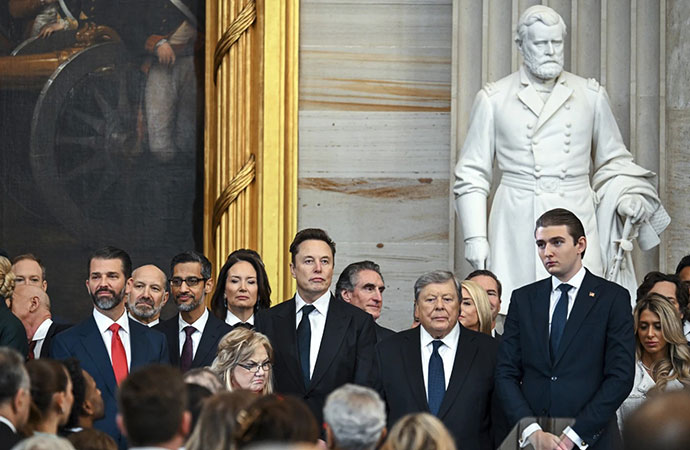
Photo: AP/UNB
Today, some 64 heads of state or government are oligarchs, leading countries that together account for some 60% of global GDP. The question is thus no longer whether oligarchs will rule the world, but rather what kind of world they are building.
For most people, the word "oligarch" conjures images of Russian elites who amassed huge fortunes in the wake of the Soviet Union's collapse or, more recently, the tech billionaires who filled the front row at US President Donald Trump's second inauguration. But oligarchs are global, systemic, and increasingly entrenched. They are a defining feature of the emerging world order.
We define oligarchs as actors who accumulate and fuse substantial wealth and consequential power (a criterion that, unlike Aristotle's, does not require rule for the rich as a class). Today, some oligarchs, like Trump, start with wealth, which they use to acquire power (and yet more wealth). Others use power to accumulate immense wealth, as Russian President Vladimir Putin has done over the last quarter-century. Still others, like Saudi Arabia's Crown Prince Mohammed bin Salman (MBS) and Morocco's King Mohammed VI, possess both from the start.
One need not be a billionaire to be an oligarch. We believe a net worth of $20 million, alongside evidence of wealth-power fusion, provides enough financial independence for an actor to build and exercise power without relying on others for the resources to do so. Applying this wealth threshold together with our wealth-power fusion criterion, we estimate that 59 heads of state or government today are oligarchs. Among them are leaders of eight of the world's 20 largest economies (at purchasing-power parity, according to International Monetary Fund estimates for 2026).
Aside from Trump, Putin, and MBS, these oligarchs include Chinese President Xi Jinping, Indonesian President Prabowo Subianto, Turkish President Recep Tayyip Erdoğan, and Nigerian President Bola Ahmed Tinubu. Together, the countries with at least one oligarch-leader represent roughly 54% of global PPP-adjusted GDP. Such leaders can be found in every region, with the largest concentrations in the Middle East and North Africa, and Sub-Saharan Africa, followed by East Asia and the Pacific, and Europe and Central Asia. These leaders fuse wealth and power, not just hold substantial wealth or significant power.
About one-fifth of these 59 oligarch-leaders began with wealth; two-fifths started with power; and the rest accumulated the two jointly. Few-just 7%-are self-made; the remaining 93% inherited their wealth or acquired it through political and other connections. For example, South African President Cyril Ramaphosa's African National Congress connections directly enabled him to accumulate private wealth. By contrast, Czech Prime Minister Andrej Babiš built his own fortune by acquiring and developing one of his country's leading conglomerates, then leveraged it to gain political power.
But oligarchs need not fill top roles in government to exercise influence. While heads of state and government embody one form of power-decision-making authority-oligarchs can also wield two other types of power: agenda-setting and thought-shaping. These are less visible and more difficult to measure, but just as important to understanding the emerging oligarchic world order.
Established American oligarchs include Charles Koch, whose fortune has long supported the Republican Party, and Rupert Murdoch, who has harnessed his media empire to shape public opinion in the United States and beyond. Under the Trump administration, however, tech billionaires-such as OpenAI's Sam Altman, Elon Musk of Tesla and SpaceX, and Google's Larry Page-have been stealing the spotlight, as their growing political engagement has coincided with lucrative public contracts, deregulation, and other benefits.
Such agenda-setting activities are matched by a deeper and more consequential power. These tech oligarchs control or influence technologies, from ChatGPT to Musk's X to Google Search, that shape the way people think and act. We believe that the impact of these activities rivals and, in some instances, exceeds (or will come to exceed) the decision-making power of heads of state and government. Billions now use search and social media daily, while hundreds of millions increasingly rely on AI to find, interpret, and generate information. The capacity to influence what people see, know, and ultimately believe is an extraordinary form of power.
Yet few recognise the true scale of the threat, partly because oligarchs can be a diverse lot. They can exist in both democracies and autocracies. An oligarch is an attribute of an actor, not necessarily of the political regime in which that actor operates or the ideology they espouse. They might espouse political views of the left or the right, promoting socialism, capitalism, or something else. This is apparent in the long list of oligarch-leaders, which includes communist state-socialists (Xi), revolutionary leftists (Nicaragua's Daniel Ortega and Rosario Murillo), centrist populists (Babiš), conservative nationalists (Erdoğan), religious conservatives (Iranian Supreme Leader Mojtaba Khamenei), and hard-right figures (Trump).
Ultimately, what matters is not ideological categories, but rather that wealth and power become fused and mutually reinforcing, instead of being kept institutionally separated. (An autocrat is an oligarch only if substantial wealth is fused with their power, just as a billionaire is one only when their money is fused with power.) Classification of someone as an oligarch depends on the fusion of wealth and power; policies, purposes, and beneficiaries of that fusion are separate empirical questions. This means that the emerging oligarchic world order will not be defined by any particular ideology; on the contrary, it will probably be ideologically diverse. It will thus cut across the categories normally used to understand global politics.
Another key characteristic of the emerging world order is that different types of oligarchs will become increasingly dominant. Heads of state and government will remain important, given their coercive power, but tech oligarchs will wield new forms of thought-shaping and agenda-setting power that states cannot control. Musk's surging wealth and influence during Trump's second presidency is probably not an anomaly, but a harbinger of a future trend.
Finally, this oligarchic world order is likely to be more unstable and transactional than the order it is displacing. Oligarchs thrive on manipulating, circumventing, and co-opting the rules of the game. They treat institutional boundaries as negotiable and agreements as renegotiable. They keep their options plentiful and open, and they view uncertainty as opportunity. Trump's capricious deal-making illustrates this mindset, though he is hardly a trailblazer in this sense. Putin has been honing this approach since 2014.
The question is no longer whether oligarchs will rule the world. They already do, and this will probably remain true for decades. What we must now contend with is what kind of world they are creating.
From Project Syndicate
A Independent Newsweekly
© Copyright 2026 | Designed by ARK Reepon & Developed by Cosmos Group Software Team
Leave a Comment
Recent Posts
A political earthquake in Amer ...
The American midterm elections have delivered a resounding political r ...
‘A beautifully American story’ ...
Campaigning relentlessly across Michigan, Abdul El-Sayed didn’t ...
Consumers fear paying Tk 2500 for 12-kg LPG cylinder ..
UNB Chief Editor mourns death of Bogura corresponden ..
Enayetullah Khan attends FICAC 2026 North America Re ..
Democrats won control of both chambers of Congress i ..