


World this week
Democrats won control of both chambers of Congress in the United States


An Independent Newsweekly







World this week
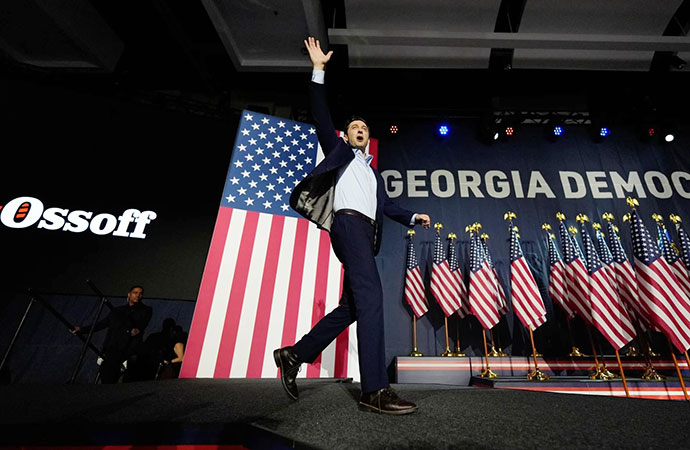
Photo: AP/UNB
Democrats won control of both chambers of Congress in the United States, delivering a decisive rebuke of Republican governance in Washington and ushering in a new era of congressional resistance to President Donald Trump. Tuesday's midterm elections laid bare voters' deep frustrations over high prices, the Iran war and concerns over government corruption. Democrats routed their rivals across the map, flipping states that have voted Republican for decades and that Trump won by double digits just two years ago.
That includes James Talarico's stunning Senate victory in Texas, where no Democrat had won statewide office in more than 30 years, and Annie Andrews' upset victory over Sen. Darline Graham in South Carolina. Trump had thrown his full weight behind both losing candidates. In Michigan, progressive Abdul El-Sayed - one of a crop of left-wing candidates who prevailed in Democratic primaries - topped Republican Mike Rogers. Even Republican Sen. Susan Collins of Maine, a battle-tested survivor of difficult elections, lost to Democrat Troy Jackson.
Protests took place across France after five unions launched a national day of strike action, joining high school students and demonstrators criticising the rising cost of living. More than 250,000 people had taken to the streets in almost 70 towns and cities by 13:00 (12:00 GMT) on Thursday (Nov. 5), and that was "just the start", said Sophie Binet of the CGT union. The unions have vowed to take the wave of protests that began in September over poor conditions and resources at lycées (high schools) "to the next level".
They have since spread to include workers and the so-called "yellow-vest" movement against high prices. Interior Minister Laurent Nuñez said 70,000 police were being deployed, vowing "an extremely firm response" to any potential outbreaks of violence. Some unrest has been reported in the cities of Lyon and Rennes. The five unions have combined forces across the public and private sector, announcing more than 250 separate actions.
The Hong Kong activist Joshua Wong was sentenced to 10 years in prison after earlier pleading guilty to "foreign collusion", his second conviction under a national security law critics say has been used to silence political opposition in the city. Wong, who rose to prominence as the teenage face of Hong Kong's 2014 pro-democracy demonstrations, submitted his guilty plea in September. He had been accused of working with the exiled Hong Kong activist Nathan Law to urge foreign powers to impose sanctions, blockades or other hostile measures against China.
In his ruling, high court judge William Tam described Wong's actions as "grave in nature". He said Wong had visited the US to seek foreign interference before the national security law's introduction in 2020, and continued to share posts on social media by Law calling for sanctions after it was enacted.
Debt owed by developing countries rose to a record $9.4tn (£7tn) last year, with the poorest paying the highest interest rates since the late 1980s, World Bank data shows. The UK government is preparing to champion a "new drive on debt" as part of its presidency of the G20 next year - a move the prime minister, Andy Burnham, has linked to confronting the legacy of slavery. In its annual International Debt Report, the World Bank said the rising cost of servicing external debt was preventing some governments from investing for the future.
The increase in developing country debt last year, of 5.5%, was the fastest in four years, the report found - driven by a rapid rise in private sector lending. The World Bank's chief statistician, Haishan Fu, said: "Access to international finance has improved, but the price of that finance has not. Low- and middle-income countries are borrowing more, paying more, and, in many cases, leaving less for long-term development."
A Independent Newsweekly
© Copyright 2026 | Designed by ARK Reepon & Developed by Cosmos Group Software Team









Leave a Comment
Recent Posts
A political earthquake in Amer ...
The American midterm elections have delivered a resounding political r ...
‘A beautifully American story’ ...
Campaigning relentlessly across Michigan, Abdul El-Sayed didn’t ...
Consumers fear paying Tk 2500 for 12-kg LPG cylinder ..
UNB Chief Editor mourns death of Bogura corresponden ..
Enayetullah Khan attends FICAC 2026 North America Re ..
Democrats won control of both chambers of Congress i ..