


Column
Remembering Tapanbabu

An Independent Newsweekly


Column
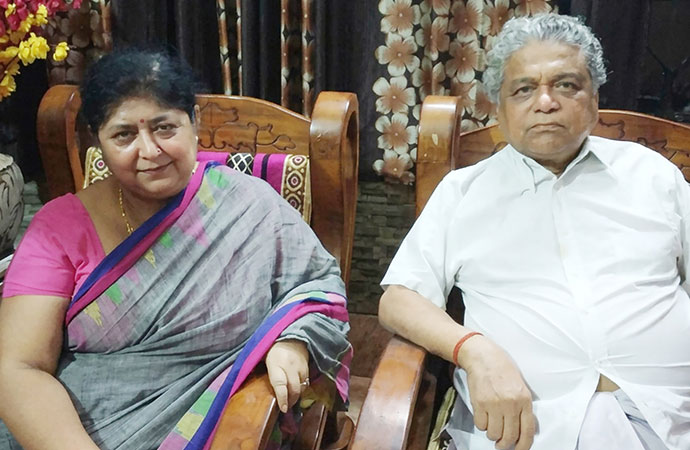
Advocate Tapan Lahiri on the right and his wife on the left. Photo: Collected
Advocate Tapan Lahiri is not a familiar name in Bangladesh. But he was well-known in Adra, in West Bengal's Purulia district, where he died of Covid in November 2020. This is the sixth anniversary of his passing.
I never met him. I came to know of him several years ago through his daughter Sangbida, three decades my junior at Presidency College, Kolkata. She told me his story.
Tapanbabu's family had migrated from Surulia, lying next to the Kapataksha river in Khulna, to West Bengal in the early 1950s, having found it impossible to survive the demographic pressures of the Partition of Bengal any longer. Even amidst the communal tensions of the time, though, a Muslim family had escorted the majority of the Lahiri clan to the outskirts of the district and had promised to look after the remaining members.
Tapanbabu studied Law in Kolkata and began his practice. He moved to Adra, a prominent railway town lying close to Bihar, where he settled eventually.
Meanwhile, he fell in love twice: once with Karl Marx, and then with Enakshi Bhattacharya.
Tapanbabu joined the Left, which had played an exemplary role in resisting the communalisation of Partition in West Bengal. Partition had resulted there in economic dislocation, food shortages and recurrent waves of Hindu refugees arriving from East Bengal.
Left parties championed refugees' interests, organised squatters' movements, and tried to bring marginalised populations into the shifting mainstream of Bengali political history.
Even I, who have never belonged to a leftist party, understand that West Bengal's Muslims benefited existentially from the absence of avenging religious riots carried out by displaced Hindus from East Bengal. I thank Tapanbabu from the Muslim bottom of my Bengali heart. He gave me the legacy of his history: I received it gratefully as the beginning of mine.
Enakshidebi's trajectory was different. Her family had lived close to the Lahiri home in Sagardari. Her uncle and Tapanbabu's father had formed a theatre group which was famous for playing the Sitaharan Parba, which enacts Raban's abduction of Sita and constitutes a pivotal chapter in the Ramayan. Tapanbabu's father acted as Raban, and Enakshidebi's uncle played Sita because he was very fair-skinned. A Brahmin playing the "demon" Raban and a man playing Sita: Such were the possibilities of those unsettling times.
Both Tapanbabu and Enakshidebi were members of the Brahmin crème de la crème, and both were descendants of zamindar families. However, Karl Marx was not. The Tapan-Enakshi love affair invited her family's opposition to his ideology, which he refused to abjure because it was nothing less than an ideational family to him.
Those tensions were resolved when they married defiantly at the great Kalighat temple in Kolkata. It is not known whether Marx, a German-Jewish atheist long dead by then, was present to bless them in spirit. Who knows? He could have been there. Men in beards (including Rabindranath and Marx) are a fixture of Bengal's imaginative life. In fact, there is nothing more spiritual than white beards and white hair, but sported only when their owners are dead and invisible and therefore incapable of speaking up.
Silent spirit turned into ear-splitting flesh with the birth of Sangbida. Rebelling in her genes, she arrived to join a running battle with priests, purists, pedants, professors, poetasters, politicos, pretenders and anyone else whose pasty faces recalled the twin horrors of caste and patriarchy. Her father egged her on: He would not have preferred any other kind of daughter. Her mother recognised her once-runaway self in recalcitrant Sangbida, and let her be.
Then came Samanwaya, her maternal cousin. She brought him up as a younger brother. He is more feminist than many women are. History always finds its own.
History was on the lookout for Tapanbabu as well. He rose through his party's district ranks at the expense of his legal career - till he fell out with certain hierarchs and was demoted. The party all but left him. But he never left the party. There were such people then.
Sangbida grew up to be herself. She entered Presidency, and promptly fell in love with Debajyoti Mondal, who brought the future within grasp with his scathing intelligence and piercing eyes. After prolonged fears of capitulation to bourgeois practices, a civil marriage followed - and lasts.
Tapanbabu's life was thus not a one-off encounter with time. His longing for social meaning replicated itself in the next generation.
The reason for this longevity was rooted in his experience of Partition. It had cost the Lahiri family its wealth and power in East Bengal. But it did not cost Tapanbabu his identity as a Bengali. Sangbida and Samanwaya - both named by him - called their grandmother "ammi", a word that Tapanbabu had taught them to utter. It is a Muslim-sounding Urdu/Hindi word. Why on confounded earth would a Bengali Brahmin, exiled from East Bengal, carry with him the linguistic legacy of sub-continental Islam to West Bengal, where Hindus (including him) were reeling from the residual economic violence of Partition? Why?
It was because Tapanbabu's Brahmin birth was only a part of his identity as a Bengali: It did not form the whole. A Bengali is never born to prove or disprove the agency of religion, region or nation: A Bengali captures in his thoughts, feelings and actions the everyday tremors of history, whether they are felt in the silence of the hungry next-door, or are screaming, screeching war-seismic - all this and more in the mother tongue that he calls Bengali.
To speak Bengali is to be Bengali, and to be Bengali is to understand that Bengal can be scarred by war or earthquake or famine or riots but that it remains Bengal even in its ruins. The ruins lie scattered in parts: What survives is the human ability to reimagine a whole.
What survived in Tapan Lahiri to the end was a Bengal that had refused to partition itself.
Tapanbabu, salaam. I mean, nomoshkar!
The writer is Principal Research Fellow of the Cosmos Foundation. He may be reached at epaaropaar@gmail.com
A Independent Newsweekly
© Copyright 2026 | Designed by ARK Reepon & Developed by Cosmos Group Software Team









Leave a Comment
Recent Posts
A political earthquake in Amer ...
The American midterm elections have delivered a resounding political r ...
‘A beautifully American story’ ...
Campaigning relentlessly across Michigan, Abdul El-Sayed didn’t ...
Consumers fear paying Tk 2500 for 12-kg LPG cylinder ..
UNB Chief Editor mourns death of Bogura corresponden ..
Enayetullah Khan attends FICAC 2026 North America Re ..
Democrats won control of both chambers of Congress i ..