


Column
Remember the Thieves

An Independent Newsweekly
Column
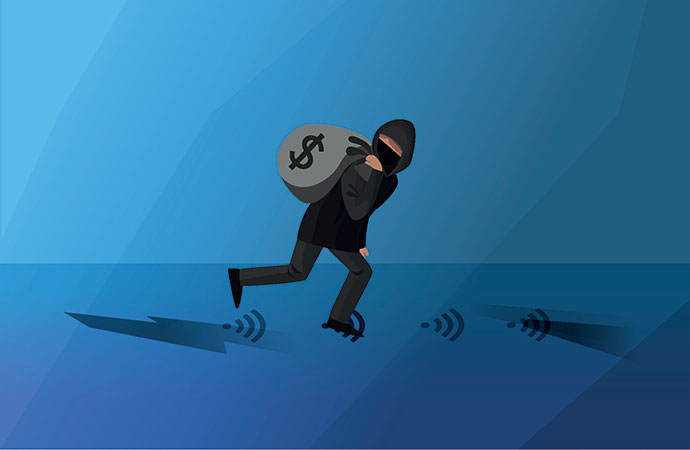
Freepik
A democratic state rests on an unwritten contract between citizens and their government. Citizens surrender a measure of power in exchange for security, justice and the rule of law. But sometimes the guardian becomes the predator.
Consider three recent examples.
In Bangladesh's infamous Rooppur "Pillow Scandal," pillows worth a few hundred taka were purchased for nearly 100,000 taka each, while moving them into apartments reportedly cost thousands more. The theft was extraordinary not because it violated the rules, but because it followed them. The project was approved, tenders were issued, accounts were audited and officials signed off at every stage.
In Pakistan's Kohistan scandal, billions of rupees allocated for development projects allegedly vanished through fake companies and fictitious contractors. One garbage truck driver was listed as receiving more than $1.6 million. Investigators found evidence of fraud stretching across multiple levels of government.
And in the United States, President Donald Trump's proposed $1.8 billion compensation fund raised questions of a different kind. Critics argued that public money could be used to reward political allies and settle grievances involving the president himself. Even some Republicans balked.
Different countries. Different systems. Same pattern.
The looting of public resources no longer requires suitcases stuffed with cash. It can be accomplished through spreadsheets, accountants, lawyers and electronic transfers. What matters is not the method but the enabling environment. Corruption on this scale cannot occur without the participation, acquiescence or silence of people entrusted with safeguarding the public interest.
Think of the state as a public bus. It belongs to everyone. Anyone who pays the fare has the right to ride. Corruption begins when those in charge decide the bus belongs only to them and their friends. The public still pays for the fuel, but the benefits are reserved for a privileged few.
The German political philosopher Hannah Arendt warned that the greatest danger is not simply theft or abuse of power. The greater danger is when citizens come to regard such behaviour as normal. When people assume that presidents, ministers and officials are expected to steal, moral collapse follows.
A nation can recover from financial loss. Recovering from moral decay is much harder.
Likewise, Amartya Sen argued that democracy weakens when citizens stop speaking out against injustice. And George Orwell reminded us that authoritarian leaders never rule alone. They depend on an ecosystem of loyalists, beneficiaries and silent bystanders willing to exchange principle for patronage.
History offers a simple lesson. No system of corruption survives on fear alone. It also depends on public resignation.
That is why memory matters.
Corrupt rulers want yesterday's scandals buried beneath today's headlines. They want citizens to believe that theft is normal, dishonesty inevitable and resistance futile.
History suggests otherwise. When the people rise, the force of their anger sweeps away even the most powerful dictators. For almost every autocrat, the ending is remarkably similar: a hurried departure in the dark, a waiting aircraft on the runway, and a few hastily packed suitcases.
Marcos learned this. Mobutu learned this. Abacha learned this. Sheikh Hasina learned this. They all were forced into exile after nationwide protests. They hurried into their planes, each carrying multiple suitcases loaded with cash. They lost the country they once ruled and gained an infamy that would live long after they are dead.
Individually, citizens may appear powerless. Collectively, they remain the only force capable of holding power accountable.
The first duty of citizenship, therefore, is neither heroism nor sacrifice. It is memory.
Remember who stole. Remember who looked away. Remember who justified the theft. Remember who defended the indefensible.
And when the time comes, act accordingly.
Hasan Ferdous is a journalist and author, based in New York
A Independent Newsweekly
© Copyright 2026 | Designed by ARK Reepon & Developed by Cosmos Group Software Team



Leave a Comment
Recent Posts
UNGA presidency: A significant ...
No matter how you look at it, Dr Khalilur Rahman's election as pre ...
On the trail of the Asian Wild ...
The conflict between humans and elephants has reached an extreme level ...
Electricity prices were hiked
Bishwajit Goswami’s work travels to Brooklyn, New Yo ..
The Intelligence That AI Is Missing
The One Man Who Could Give Trump Middle East Peace