


Reportage
Trust deficits weaken partnerships

An Independent Newsweekly

Reportage
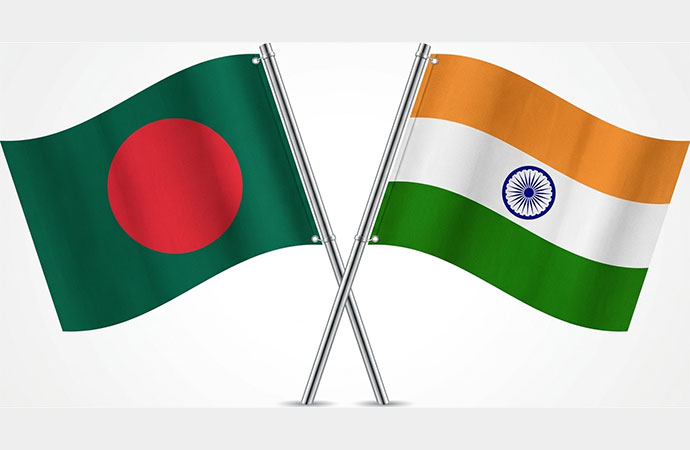
Temporary "clouds or storms" cannot erase long-standing Dhaka-Delhi ties
Rebuilding trust among states is essential for effective international cooperation. Without trust, partnerships weaken. Without trust, institutions lose credibility. Without trust, diplomacy becomes more difficult and challenging.
At the Bay of Bengal Conversation 2026, Bangladesh-India relations emerged as a relationship that needs to be managed through continuous dialogue, mutual respect and trust, rather than allowing differences to accumulate.
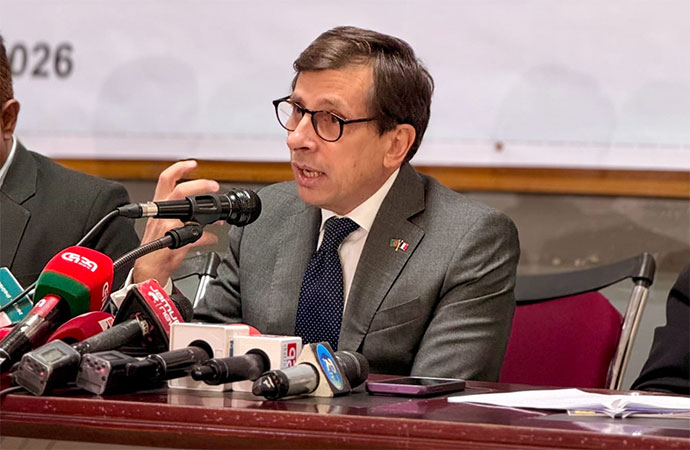
"We must address the challenge of trust," said State Minister for Foreign Affairs Humaiun Kobir, noting that Bangladesh believes in dialogue, international law, and peaceful settlement of disputes.
Prime Minister Tarique Rahman inaugurated the three-day international conference on Saturday which ended on Monday.
Bangladesh believes in a rules-based international order that respects the sovereignty and dignity of every state. Bangladesh also called for democratic institutions to adapt to emerging technologies and new forms of global competition.
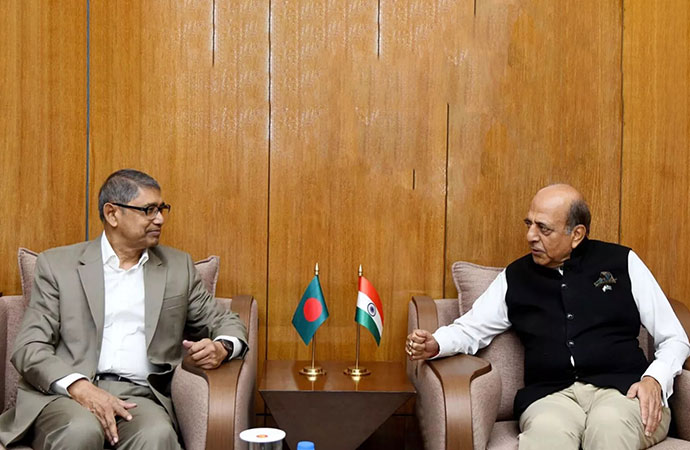
Indian High Commissioner to Bangladesh Dinesh Trivedi said all outstanding issues, including water, trade, connectivity, transportation, culture and sports, should be discussed through appropriate forums, stressing that the engagement process between Dhaka and New Delhi has not stopped. He also acknowledged Bangladesh's sovereign right to make its own decisions and protect its national interests, while saying India likewise has the right to protect its interests.
The broader discussion also underscored the deep historical, cultural and people-to-people bonds between the two neighbours as an important foundation for the relationship.
Former Indian Minister of State for External Affairs MJ Akbar said temporary "clouds or storms" cannot erase the long-standing ties between Bangladesh and India, while Trivedi described the relationship as much deeper than a transactional partnership.
Peace, security, progress and prosperity of the two countries are interlinked, with trade, transport, energy and people-to-people connectivity providing avenues for mutually beneficial cooperation.
Taken together, the discussions at BoBC suggest that differences are inevitable between two neighbouring democracies, but sustained engagement, trust, equality and respect for sovereignty can provide the basis for a stable and constructive relationship.
Strategic Autonomy
State Minister Humaiun Kobir expressed optimism that Prime Minister Tarique Rahman will pay a bilateral visit to India at a convenient time, stressing that the Prime Minister has never ruled out visiting the country through a proper bilateral framework.
"To maintain relations with another country, bilateral engagement is required. We will do it directly. The visit will be bilateral, and we will talk," Kobir told reporters after delivering his speech at the Bay of Bengal Conversation in Dhaka.
Kobir said there were challenges in Bangladesh-India relations but expressed optimism that they could be addressed through dialogue. "There are challenges, but we believe those can be overcome through dialogue," he said.
Asked about the possibility of the Prime Minister's visit to India this year, Kobir said Dhaka wants the visit to take place in a conducive environment and through a proper bilateral framework, but he did not give any specific timeframe.
"Nothing gets resolved just over a phone call. We are having discussions, and things are positive," the State Minister said.
He praised Indian High Commissioner to Bangladesh Dinesh Trivedi for trying to understand Bangladesh's current context and said Dhaka hoped New Delhi would give due importance to his assessments.
"The Indian High Commissioner here is doing a good job; he is trying," Kobir said. "Hopefully, Delhi will be receptive to him and the opinions and analysis he provides regarding the context in Bangladesh."
Bangladesh wants to pursue a foreign policy based on strategic autonomy, national interest and balanced engagement with all countries, he said, stressing that Dhaka will not compromise its national interests while maintaining open channels with its partners.
"Every country wants strategic autonomy. Bangladesh also wants it," Kobir said while speaking to journalists on the sidelines of the programme.
Ganga Treaty and National Interests
On the renewal of the Ganges Water Sharing Treaty, which is due to expire in December 2026, Kobir said Bangladesh would seek an outcome that serves its national interests.
The treaty's expiry in December 2026 has also emerged as a major issue for the two countries.
Asked whether the existing treaty would be renewed or replaced with a new agreement, he said, "Whatever is best for Bangladesh's interest will be done."
Asked about a possible guarantee clause, Kobir said Bangladesh would work to safeguard its national interests and security.
"Whatever is best for Bangladesh's national interest and security, we will work to ensure that," he said.
Kobir said discussions are already underway and that Bangladesh is waiting for a response from its Indian counterparts.
"Our committee is ready. We are just waiting for the final response from our Indian counterparts. So yes, we are hopeful," he said.
Kobir said Bangladesh would engage positively with the international community while protecting its national interests.
"We want to engage in a positive way that does not compromise our national interest, yet we embrace the diversity on offer to achieve success politically, economically, and in terms of overall security," he said.
Dhaka Seeks Reciprocity
The State Minister said Bangladesh expected India to prevent individuals based in India from using its territory to make political statements or engage in activities aimed at destabilising Bangladesh.
"Restraining a terrorist or extremist in their land is not too much to ask," he said.
"Why should that happen? So, if that is restrained, there won't be any issues with our relationship, and a normal working relationship can be maintained, which is essential for both countries."
He said Bangladesh also would not allow anyone from India to use Bangladeshi territory to make statements against the Indian government.
"We don't allow any terrorist coming from India to sit here and speak against the Indian government. So, it sends a bad message. We hope India will do that as well," Kobir said, noting that such restraint would help create a more stable environment for bilateral relations.
Kobir stressed that India remained an important partner for Bangladesh despite existing differences.
"Regional cooperation is required, and India will be an important partner for Bangladesh," he said.
"As we said, we never close the door to dialogue in diplomacy. It is always open," Kobir said.
Kobir also linked the government's foreign policy approach to its broader vision of strategic autonomy, saying Bangladesh would seek engagement with countries across the world without compromising its own interests. "We will engage across the board," he said.
He said Bangladesh would continue to approach its relationship with India with openness and candidness while seeking solutions to outstanding issues through dialogue.
"We are having positive discussions, and I am hopeful we will reach satisfactory conclusions," Kobir said.
He also expressed hope that the Prime Minister's visit to India would eventually take place once the necessary conditions were in place.
"The Prime Minister never said no to visiting," Kobir said. "Certain things need to be addressed. We will reach a positive resolution through talks, and I am hopeful the visit will happen."
Mutual Respect, Trust
Indian High Commissioner Dinesh Trivedi on Saturday highlighted the need for continuous dialogue, mutual respect and trust between the two countries to address bilateral issues, saying every issue between the two neighbours has a solution.
"There's no point hiding the issues, and there's no point not talking about the issues," he said while speaking at a discussion titled "Power and Prudence: Managing Great-Power Competition without Conflict" as part of the Bay of Bengal Conversation in Dhaka.
Trivedi, who faced a couple of questions, said the two countries need to discuss all outstanding issues, including water, trade, culture, sports, communication and transportation, through appropriate forums.
"In a democracy, the dialogue has to be there at the proper forum. And the dialogue has to be a continuous dialogue," he said, noting that the process of engagement between the two countries may be slow, but it has not stopped.
"I can guarantee you, there is no stoppage of process. The process is ongoing," Trivedi said. "Believe me, there has to be a solution, and there will be a solution," the Indian diplomat added.
The High Commissioner said Bangladesh as an independent and sovereign country, understands its own security interests and has the right to make its own decisions.
"Bangladesh is an absolutely independent country and people have elected democratically. So whatever decision Bangladesh takes is the decision of the Bangladesh government," he said, adding that "Nobody should tell Bangladesh what they should do."
Trivedi also said India's relationship with Bangladesh does not depend on Dhaka's relations with other countries.
"As far as we are concerned in India, the relationship doesn't depend on what relation Bangladesh has with other countries," he said. He stressed that both countries have the right to protect their respective national interests.
"They are absolutely, and they're very much right to protect their very interest of the people. So are we," Trivedi said.
Describing Bangladesh-India ties as distinct from a merely transactional relationship, he said the two countries share deep cultural and historical bonds.
"We go through not only a transactional relationship, it is much beyond, which is cultural. And that cultural bond is very, very foundationally solid," he said.
Trivedi, who said he comes from India's eastern state of West Bengal, said he understands the historical and cultural connections between the people of the two countries.
"This relationship is very difficult for the outside world to understand, which is culturally deep-rooted," he said.
He said the two countries' relationship has a unique cultural foundation, referring to the shared legacy of Bengali cultural icons.
"Can you imagine that one person, Rabindranath Tagore, has written the national anthem for both the countries?" the envoy said.
The High Commissioner also said good neighbours should support each other when faced with calamities or security challenges, while respecting each other's sovereignty and domestic policies. "At the same time, no neighbour has any reason to interfere in each other's policies," he said.
Trivedi acknowledged that disagreements are inevitable between neighbouring democracies.
"In a family, there are hiccups, and if I say that no, there are no issues. If there are no issues, there is no democracy. In democracies, you are bound to have issues," he said.
He said such issues can only be addressed through dialogue and consultation, with trust serving as their foundation.
"Issues can only and only be settled through dialogue, through consultation. And the basis of that dialogue is trust," he said.
"Without dialogue, it is not possible to sort out relationships remotely. And that is what we feel is work in progress all the time," he added.
Trivedi expressed confidence that the strong people-to-people ties between the two countries would continue to underpin bilateral relations. "I have full confidence that it's here to stay," he said.
Passing Clouds, Storms
Former Indian Minister of State for External Affairs MJ Akbar said temporary "clouds or storms" cannot erase the long-standing ties between Bangladesh and India, describing the two countries as civilisational states with deep historical and cultural links.
"I never think that passing clouds or passing storms can ever remove the sunshine of Indo-Bangladesh ties," said the eminent writer, journalist and politician while addressing the Bay of Bengal Conversation 2026 in Dhaka.
Akbar said there would be ups and downs in the relationship between the two countries, but the issues between them should be approached by looking beyond what is considered immediately possible.
"I urge that the questions that are addressed by the two sides, we always think of or look at it from what is possible. Change the pivot from what is possible to why is it impossible? And suddenly, many, many more avenues will open up," he said.
Akbar, an author of several internationally acclaimed books, said both Bangladesh and India are civilisational states and Bangladesh's identity is deeply rooted in language and culture. "It is based on language, the power of language," he said.
Akbar also congratulated Bangladesh on the election of its Foreign Minister Dr Khalilur Rahman as President of the United Nations General Assembly, describing it as recognition of the country's credibility on the international stage.
"This is a recognition of Bangladesh's credibility on the international stage and, in my view, a very long overdue recognition of the credibility," said the veteran politician.
However, Akbar said the United Nations is facing the biggest challenge in its history, with the future of the institution depending on how the international community responds to growing threats to sovereignty.
He said the UN was built around the principles of sovereign equality, territorial integrity and political independence, which became the foundation of global stability after the Second World War.
Akbar warned that wars are increasingly being initiated or imposed without formal declarations of war, saying failure to respect sovereignty could lead to "a period of intensifying chaos."
He described the conflicts of the 21st century as a new form of "worldwide war", arguing that they are not necessarily one continuous global conflict but a series of conflicts that continue or recur across different regions.
Akbar said many of the current conflicts are also linked to competition for control of strategic waterways, including the Mediterranean, Black, Red, Caspian and Arabian seas. "What we are witnessing is actually wars for the control of the seas," he said.
He also warned about the consequences of unresolved territorial and strategic disputes, describing many countries as "unfinished states".
"What is an unfinished state? It's a state whose geography does not synchronise with its strategic requirements by its own estimation or by its cultural definition," he said.
"If the wars of the unfinished states and the wars of the seas meet, as they are threatening to, then we are looking at a very major conflagration," he said.
On India's foreign and security policy, Akbar said national security cannot be purchased or outsourced and must instead be built on internal strength."Security can only be achieved by internal strength. It cannot be purchased. There is nothing in the world for checkbook security."
The Bay of Bengal Conversation is an international strategic dialogue platform hosted annually by the Centre for Governance Studies (CGS) in Dhaka, Bangladesh.
Bringing together political leaders, policymakers, diplomats, business executives, scholars, journalists and emerging voices from around the world, it explores the ideas, challenges and opportunities shaping the Bay of Bengal, the Indo-Pacific and the wider international order.
A Independent Newsweekly
© Copyright 2026 | Designed by ARK Reepon & Developed by Cosmos Group Software Team






Leave a Comment
Recent Posts
The government passes the test ...
One of the cornerstones of the political earthquake Bangladesh witness ...
The government hiked the price ...
The government hiked the price of a 12kg cylinder of liquefied petrole ...
Police in France stand accused of using excessive fo ..
The India-Pakistan Cold War
A week on from DNCC’s eviction drive, Mirpur-10 rema ..
Equal Service, Unequal Pensions: Time for a Fairer S ..