


Culture
Metamorphosis: Bishwajit Goswami on Art, Nature and the Journey of Transformation


An Independent Newsweekly


Culture
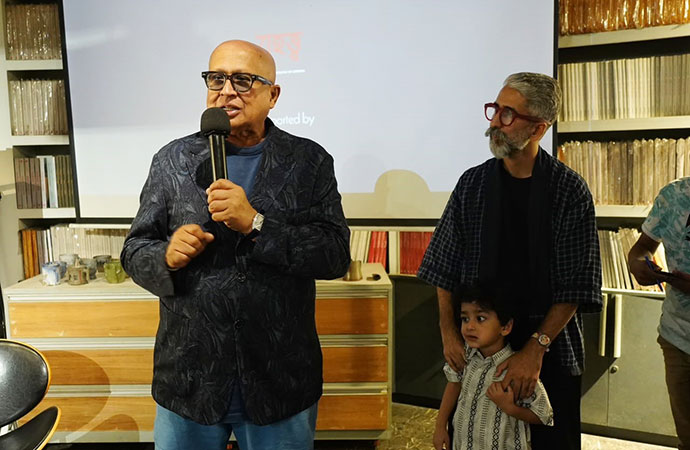
The eleventh session of Cosmos Art Echo, the artist talk series organised by Gallery Cosmos and Cosmos Atelier71, brought together artists, students, teachers and art enthusiasts for an inspiring evening of conversation. Held at the Cosmos Atelier71 Studio in Malibagh, the session featured renowned Bangladeshi artist, art educator, curator and researcher Bishwajit Goswami, who spoke on the theme "Metamorphosis."
The title itself suggested change and transformation, but as the discussion unfolded, it became clear that the talk was about much more than artistic development. It was about how our surroundings, memories, people and experiences quietly shape who we become. Rather than giving a formal lecture, Bishwajit shared stories from his own life, making the session feel personal, thoughtful and deeply connected to the realities that influence an artist over time.
Throughout his artistic practice, Bishwajit Goswami returns to six key ideas-Ma (Mother), Mati (Earth), Manush (People), Bhasha (Language), Swadesh (Motherland) and Prokriti (Nature). These are not simply recurring themes in his work; they are the foundation of his way of thinking. Through painting, installation, community-based projects and curatorial practice, he explores how these elements shape our collective identity. His work often grows through collaboration with artisans and local communities, bringing traditional knowledge into contemporary art through dialogue and shared experience.
During our conversation after the talk, Bishwajit reflected on where this way of thinking began. A significant part of his childhood was spent among the haor wetlands, rivers and vast agricultural fields. Those landscapes, he said, taught him to observe the world with patience. The open skies, endless water and changing seasons became his first classroom.
One memory that continues to stay with him is the arrival of migratory birds. Every year they travel great distances, settle into a new environment, adapt to the local climate and become part of the landscape before moving on again. For him, this is much more than migration. It is a process of exchange-of experiences, environments and ways of living. Listening to him, it became clear why he chose the title Metamorphosis. The movement of those birds became a metaphor for the way human lives also evolve through different places, cultures and experiences.
He described his own life in much the same way. Growing up in a rural landscape and later moving into the city introduced him to completely different realities. Alongside this shift came his engagement with art, which opened new ways of thinking and seeing the world. Every new experience, every conversation and every environment became part of his artistic journey. According to him, transformation is not something that happens once. It is continuous, and it shapes both the artist and the artwork.
Nature remains one of the strongest influences in his practice. He spoke about the rhythm of the tides, the sound of the sea and the quiet moment when the first light enters his studio each morning. These everyday experiences may appear simple, but they continue to inspire new ideas and remind him of his connection to the natural world.
As an Assistant Professor at the Faculty of Fine Art, University of Dhaka, Bishwajit also reflected on his role as a teacher. He believes teaching is never a one-way process. Every class becomes an opportunity to learn from students as much as to guide them. Watching young artists experiment freely, paint on large canvases and discover their own visual language keeps his own curiosity alive. Their energy, he said, is one of the greatest motivations behind his own practice.
One of the most memorable moments of the discussion came when he spoke about public art. He believes art should not belong only inside galleries or museums. It should speak equally to a rickshaw puller, a schoolchild or someone who has never visited an exhibition. Recalling the July movement, he shared how local people protected several of his wall paintings because they felt those artworks belonged to them. For him, that was one of the strongest examples of how art can create genuine connections with communities.
His thoughts naturally extended to curatorial practice as well. Over the years, Bishwajit has worked on projects that explore memory, history and cultural identity through collaborative approaches. His curatorial projects, Roots (2020) and দ্বৈধ | Dyoidho (A Duality) (2023), presented at the Dhaka Art Summit, focused on intergenerational knowledge, archival memory and layered cultural narratives. Speaking about his collaborations with international institutions, including the Victoria and Albert Museum, he explained that one of his goals has always been to present the richness of Bangladeshi culture to global audiences while encouraging meaningful cultural exchange.
Today, Bishwajit Goswami is recognised as one of the leading voices in contemporary Bangladeshi art. Alongside his teaching responsibilities, he is the co-founder of Brihatta Art Foundation, where he continues to engage in research, critical pedagogy and community-based artistic initiatives. His work has been presented internationally at CONDUCTOR in Brooklyn, Asia NOW in Paris, Paris Internationale, the London Design Show, the 58th Venice Biennale, multiple editions of the Dhaka Art Summit, the Asian Art Biennale Bangladesh, the Beijing International Art Biennale, the Setouchi Triennale in Japan and the Kunming International Art Biennale.
Speaking at the event, Enayetullah Khan, Chairman of Cosmos Foundation and Editor Emeritus of United News of Bangladesh (UNB), reflected on the idea of transformation from a broader human perspective. He observed that every day brings new challenges and new possibilities, and that growth comes from accepting those challenges with a positive mindset. He also emphasised that creativity belongs to everyone. In his words, every child is born an artist, and artistic expression exists not only in paintings but also in the way we communicate, think and interact with the world around us. Human imagination, he said, has no boundaries, and neither does the potential for human progress.
The evening concluded with an engaging question-and-answer session, where participants continued the discussion on art, education and cultural identity. Long after the formal programme had ended, small groups of artists and students remained in conversation with Bishwajit, reflecting the open and interactive spirit that Cosmos Art Echo has encouraged since its beginning.
The programme also paid tribute to the late legendary artist Mustafa Monwar, who passed away on 29 June. A one-minute silence was observed in his memory, followed by the screening of a documentary celebrating his remarkable life and artistic achievements. During the programme, Enayetullah Khan announced that the Cosmos Foundation will publish a research-based book dedicated to documenting Mustafa Monwar's life and his invaluable contribution to the art and culture of Bangladesh.
Among those present was Dr. Iftekhar Ahmed Chowdhury, President of Cosmos Foundation, along with artists, educators, students and cultural enthusiasts from different institutions.
Since its launch under the Atelier71 Membership Programme, Cosmos Art Echo has grown into an important platform for conversations around contemporary art. Alongside artist talks, the initiative regularly organises workshops, art camps, film screenings, outdoor art events and auctions, creating opportunities for artists and audiences to learn from one another. The session with Bishwajit Goswami perfectly reflected this vision. His thoughts on metamorphosis reminded everyone present that transformation is not simply about changing direction-it is about remaining open to new experiences, carrying memories forward and continuing to grow through every stage of life and artistic practice.
Sourav Chowdhury, Artistic Director, Gallery Cosmos and Cosmos Atelier71
A Independent Newsweekly
© Copyright 2026 | Designed by ARK Reepon & Developed by Cosmos Group Software Team






Leave a Comment
Recent Posts
The right time for an apology
The publication of the posthumous memoirs of lawyer Abdur Razzaq, who ...
Human rights experts commissio ...
Human rights experts commissioned by the UN’s top human rights b ...
Teesta erosion leaves several hundred families homel ..
Housing Without Houses: The Hidden Cost of Banglades ..
The Election Commission will review the timeframe
The story behind the Arafat brothers' ‘Kolpona’