


Culture
Iqbal Bahar Chy: Finding freedom in the unplanned

An Independent Newsweekly
Culture
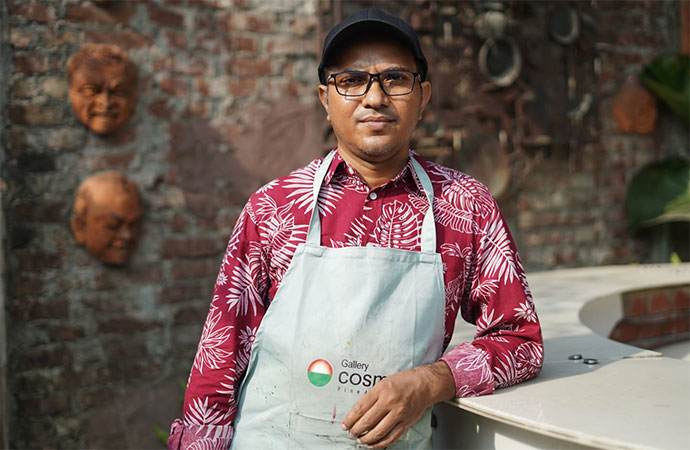
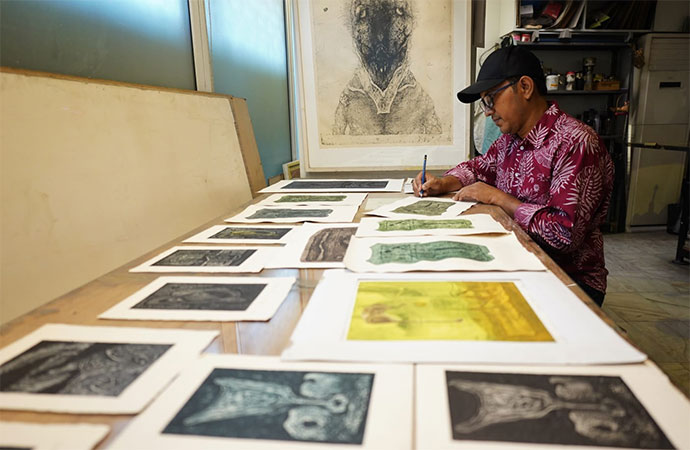
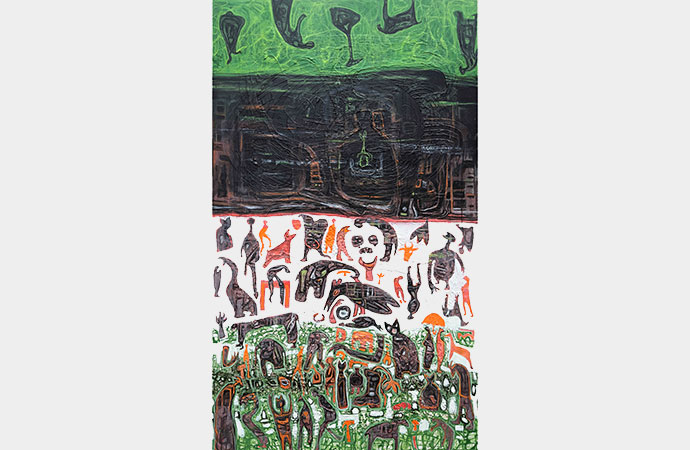
Before an artist learns how to draw, he simply draws. There are no rules about composition, no concern about whether an image is original, and little anxiety about what another person might think. Iqbal Bahar Chy often thinks about that freedom when he works.
Years of formal training have taught him technique, discipline and the language of art. Yet he continues to search for something that existed before all those lessons: the instinct to begin without knowing exactly where the work will go.
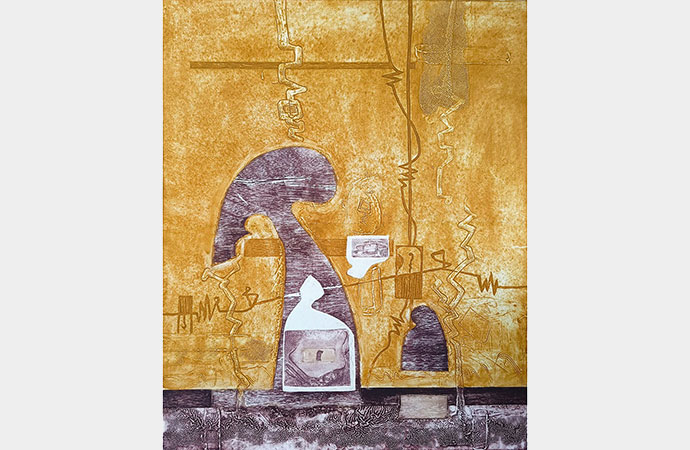
That instinct has shaped much of Chy's practice. Primarily a printmaker, although increasingly engaged with painting, he often begins with a small form, an object, a feeling or something familiar from everyday life. He does not always know what the work will become.
"I do not plan a work too much before I begin," he says. "I start working and then play with the forms. There may not be one particular story behind a work. It is more about moving with time and life."
For him, making art is less about illustrating a predetermined idea and more about allowing something to emerge through the process.
Chy believes formal training can sometimes impose too many rules on an artist. He tries to retain the spontaneity of childhood, when a child draws without worrying about whether the work will be praised or whether it resembles something that has already been done.
He does not want to choose a subject simply because it is easy for a viewer to connect with. The work, first of all, has to satisfy his own artistic need.
Iqbal Bahar Chy considers making art almost a form of devotion, something inseparable from living. That belief allows him to leave space for instinct and for elements of the creative process that cannot always be explained beforehand.
Born and raised in Cox's Bazar, Chy grew up with hills and the sea around him. As a child, they were simply part of everyday life. Only later did he begin to wonder whether those surroundings had quietly entered his work.
Standing beside the sea or a mountain can make a person conscious of their own smallness, he says. Yet he has never wanted to simply reproduce nature. What interests him is observing it and responding to it in his own way.
Artist Kibria has influenced his attention to details in nature, particularly earth, sky and landscape. But Chy does not want to imitate another artist's vision. He sees himself as part of nature and wants to leave room for instinct in his work.
The scarecrow is one of the recurring forms in Chy's practice.
Made by people to protect crops by frightening birds away, it has no life of its own. Yet standing alone in a field, it develops a distinct presence. That contradiction interests him.
The form also connects with his understanding of creation as play. He recalls Kazi Nazrul Islam's line, 'Khelichho A Bishwo Loye, Birat Shishu Anmone', and sees something of that spirit in the creative process.
A piece of clothing can become part of a print; a discarded object can acquire another form; a simple shape can develop into something unexpected. The work does not necessarily begin with a fixed narrative.
Chy's relationship with Gallery Cosmos began in 2012, when he participated in a joint workshop organised by the Samdani Art Foundation and Gallery Cosmos.
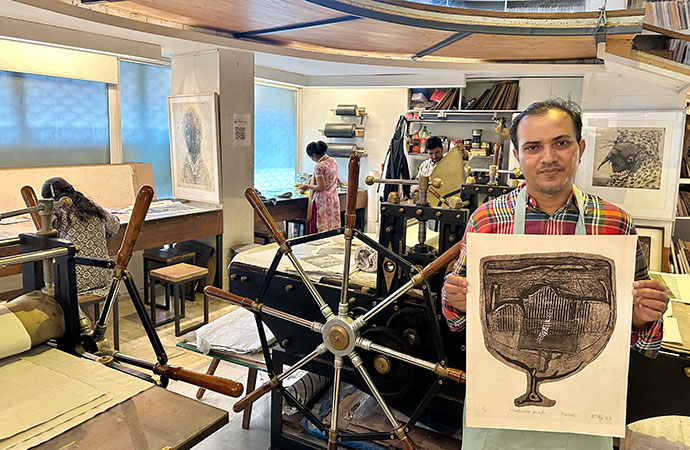
After completing his master's from the University of Development Alternative (UODA), in 2013, he returned to Cosmos to make prints. By then, Sourav Chowdhury, the current Artistic Director of Gallery Cosmos, had joined the gallery, and the connection became an important part of his artistic journey.
He made several large prints at Cosmos. Some later helped take his work beyond Bangladesh, including an invitation to Japan, where he exhibited and also showed work at the Bangladesh Embassy.
Works from around 2013 to 2015 later appeared in the Asian Art Biennale, while one of his works was acquired by the National Museum of Bangladesh.
For Chy, however, the significance of Gallery Cosmos and its printmaking studio, Cosmos Atelier-71, lies equally in the opportunity to keep working with printmaking. After completing his Master's, he continued seeking studios where he could pursue the medium, including Cosmos and Kala Kendra, to name a few.
Iqbal Bahar Chy's influences extend beyond fine art. Poet Jibanananda Das, filmmaker Tareque Masud and artist Kibria have all shaped his way of looking at the world. He believes inspiration can come from almost anyone.
Today, Iqbal Bahar Chy works on painting extensively, while continuing to work with printmaking. He is developing several bodies of work, including 'Essence of Time', which he began earlier and returned to after a long gap.
Regarding his recent works, he told Dhaka Courier that around 30 to 40 plates are currently in progress. He does not want to name the series yet.
"I will know what they are when I sit with all the plates together," he says.
That uncertainty is characteristic of his practice. He accepts that his visual language may change, that old ideas may return in new forms and that the work may lead him somewhere he did not initially expect.
Artist Iqbal Bahar Chy has exhibited in China, taken part in an artist residency in India and received a young artist award at Kala Kendra's printmaking festival, which gave him an opportunity to work at a studio in India. In 2018, he also participated in an art camp in Uttar Pradesh.
Now he is working towards a possible solo exhibition next year.
For an artist who has spent much of his life resisting the need to decide everything before beginning, perhaps the destination matters less than the act of moving towards it.
Iqbal Bahar Chy keeps looking, experimenting and making. The instinct he remembers from childhood remains intact: to begin first, and discover where the work leads along the way.
A Independent Newsweekly
© Copyright 2026 | Designed by ARK Reepon & Developed by Cosmos Group Software Team


Leave a Comment
Recent Posts
A Battle for the Soul of The N ...
Two disturbing incidents came to light this week, even as they went un ...
Dhaka seeks concrete measures ...
State Minister for Foreign Affairs Humaiun Kobir on Thursday urged Sou ...
Bangladesh Embassy in Ireland begins operations
Dinesh Trivedi stresses proper preparations before T ..
The Hope Deficit: Why Bangladesh’s Revolution Must M ..
Iqbal Bahar Chy: Finding freedom in the unplanned