


Culture
‘Stories bring us together’: Laetitia Troussel-Luber on art and community

An Independent Newsweekly

Culture
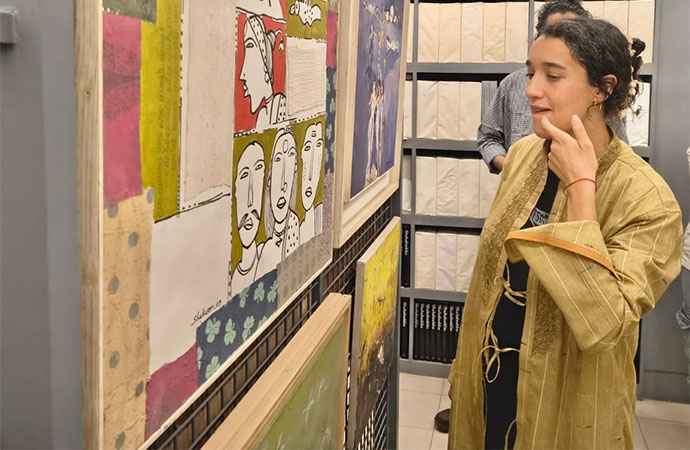
French artist Laetitia Troussel-Luber
Some stories are spoken aloud, others remain in memory, and still others take shape through hands that touch the earth. For French artist and storyteller Laetitia Troussel-Luber, these are not separate worlds but threads that bind people, places and generations. Brought to Bangladesh through an artistic residency with Alliance Française de Dhaka (AFD), with support from the French Embassy, she explored how stories travel through lives and landscapes, eventually taking shape in 'Pohal Neya', an interactive exhibition where river clay, personal memories and oral traditions came together.
On Thursday afternoon, after exploring Gallery Cosmos's collection of prominent Bangladeshi artists with its Artistic Director Sourav Chowdhury, she spoke to Dhaka Courier at the rooftop café of Cosmos Centre about what makes art meaningful: its ability to connect with people beyond the gallery walls.
For Laetitia Troussel-Luber, whose artistic practice revolves around storytelling and oral traditions, preserving art is only part of the picture. Equally important is creating spaces where art can connect with people beyond the gallery walls.
"I'm also very interested in how they create a space that connects with the community and welcomes people," she said. "For me, this is the most important thing, because it's nice to make art, but if you only make art for yourself, it's useless."
The observation offers a glimpse into the thinking behind her own work. A French artist who describes herself as a storyteller, Laetitia Troussel-Luber, focuses on tales and orality, working in France and internationally. Her recent projects have taken her to Senegal and Quebec, where storytelling has continued to shape her exploration of how people communicate experiences, preserve memories and pass cultural knowledge between generations.
Her month-long residency in Bangladesh, undertaken with an invitation from Alliance Française de Dhaka, grew from a similar curiosity. She wanted to understand the place stories occupy in contemporary life, from intimate family circles to public spaces and exchanges between generations. "I was so happy to accept," she recalled the invitation.
During her stay, she travelled to different parts of Bangladesh, including Dhaka and Rajshahi, collecting mythical narratives alongside personal stories. Her research also took her along riverways in Dhaka, Munshiganj, Narail, Rajshahi and Kushtia, where she listened to local residents, workers, boatmen, artists, scholars and others whose lives and work intersect with the country's waterways.
The river became a recurring presence in these encounters, embodying both sustenance and loss. "I was very interested in the importance of the river being a source of life, and of course, a source of death and loss," she said.
She collected different kinds of clay from river valleys and brought them back to Dhaka. Rather than treating these materials as objects to be displayed behind glass, she used them to create an environment in which visitors could participate directly in her artistic process.
The result was 'Pohal Neya', an interactive exhibition presented at La Galerie, Alliance Française de Dhaka, from October 23 to 26. Drawing on Bengali water mythologies and contemporary environmental concerns, the project brought together the symbolic world of traditional narratives and the lived experiences of people affected by the changing relationship between communities and rivers.
Laetitia Troussel-Luber transformed the gallery into what she called a "shared house", hanging saris around the space to evoke a small hut where people could gather and exchange stories. Visitors were invited to touch the river clay, bring personal belongings and share memories, songs and experiences.
"I am not a traditional physical artist; I don't produce paintings and things like that," she said. "For me, the idea is always about participation."
That approach allowed the exhibition to develop through collective experience rather than follow a predetermined form. People began sharing memories of childhood, happiness, loss and dreams. Together, they shaped clay into landscapes, characters and animals, while evenings brought opportunities to tell stories, sing and dance.
The participation was deeply moving for the artist. Some visitors returned throughout the four-day exhibition, while the number of participants grew with each passing day. "We built a beautiful trust because we could really connect to the stories and the messages we wanted to share," she said.
By the final day, the group had developed three tales addressing challenges faced by women and the consequences of losing touch with cultural traditions, including singing and storytelling. For Laetitia Troussel-Luber, the process demonstrated how personal experiences could become part of a shared narrative, allowing people to recognise connections between their own lives and those of others.
Her work also reflects a wider interest in the relationship between traditional beliefs and present-day realities. In Bangladesh, stories about water offered a way to explore questions of environmental vulnerability, cultural memory and the changing lives of river communities.
At Cosmos Centre, her response to Gallery Cosmos returned to the same principle that shaped 'Pohal Neya': art gains meaning through the connections it creates. Having viewed the works in the collection, she described the experience as impressive, while praising the gallery's commitment to supporting Bangladeshi artists and making their work accessible.
"I think it's a beautiful initiative," she said of Gallery Cosmos. "I really like the fact that the gallery cares so much about arts and artists in Bangladesh and try to preserve and publish their work."
For Laetitia Troussel-Luber, storytelling is not simply a way to preserve what people remember. It can also create a space where individual experiences meet, cultural traditions find new life and strangers discover what they share. In Bangladesh, that process unfolded through river clay, songs, memories and the stories people chose to tell. Her encounter with Gallery Cosmos offered another perspective on the same idea: whether art takes the form of a preserved painting or a collective act of creation, its possibilities grow when it reaches beyond the artist and becomes part of a wider human experience.
A Independent Newsweekly
© Copyright 2026 | Designed by ARK Reepon & Developed by Cosmos Group Software Team







Leave a Comment
Recent Posts
Resting in Peace in Pirojpur
I never had the privilege of meeting freedom fighter Manik Pashari, wh ...
An impending disaster in the h ...
There has been a fresh spike in both dengue and measles cases, hospita ...
‘Stories bring us together’: Laetitia Troussel-Luber ..
A high-speed train slammed into another that had sto ..
Bangladesh and Malaysia concluded the first round of ..
CPC's international department head Liu Haixing to v ..