


Column
Sukanta: The poet of his own perilous history

An Independent Newsweekly

Column
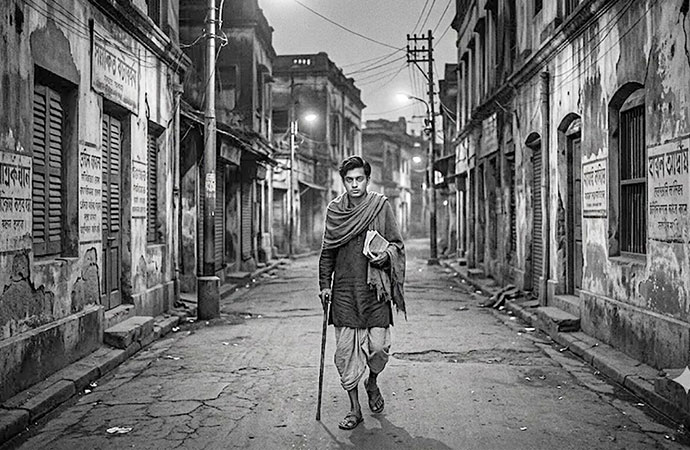
There are few poets in our literary world who are as widely discussed yet remain so unknown. We have made him great, made him a revolutionary and forbidden him from stepping outside the bounds of politics. We believe that the entire Bengali political reality was captured in the mirror of a scorched bread in his poetry.
This happens to many poets and writers, where the individual is lost in the shadow of the public perceptions of their own. They no longer remain who they were; we reconstruct them in our own mirror according to our needs. To me, Sukanta seems to be the most painful example of this trend.
Our imaginations of the poets
We turned Rabindranath into a superhuman, causing him to be lost behind a magical curtain, but at least we know a great deal about him. Rabindranath studies is a massive sector with many active players so we at least know something about his joys, sorrows, and life. Nazrul lags a bit behind, about whom we know some though there are things we do not know and do not wish to know. Nazrul's life came to a standstill when he developed Pick's disease, a type of early-onset dementia. After that, he became a silent legend.
Lately, we are learning more about Jibanananda, particularly his romantic life and its complexities. However, he is rarely allowed to step outside the realm of romance. He is the poet of love and the verdant splendour of Barisal, the poet of Ruposhi Bangla, the ultimate poet of Bengali nostalgia.
These are our three major poets-there might be one or two others, but broadly speaking, these three dominate. And then there is Sukanta, the reflection of all our good intentions, the symbol of the collective promise to change society and establish the rule of the masses, the architect-poet of the Bengalis' favourite slogan "A Country for Everyone," which reflects revolutionary Left politics.
This was strongest in the 1960-70s or during our youthful decades. It was almost a duty of all political and cultural workers to like him. Besides, how many people die of TB at the age of 20 or 22 after writing such poetry? The Sukanta built into our psyche is actually a reflection of ourselves, not Sukanta's reality. This is why we know so little, or care to know so little, about his actual life.
Nowadays, the various factions of the Leftists are so weak that we need to consider whether there is any urgency or need to do anything concerning him. For this reason, while other poets remain more intact, we have scorched Sukanta to some extent to alleviate the dimness of our own political dreams and their failures.
A scorched life?
Reading Sukanta's poetry will not reveal how his ill health and sickness were practically inevitable given the environment and conditions in which he was born, raised, and lived. He was born into an impoverished family, to his father's second wife. But he lost his mother when he was only six years old, meaning he grew up deprived of affection.
The person with whom he shared the closest bond was Ranidi, his cousin, who named him "Sukanta" after a character in a story by Monilal Gangopadhyay. It was she who introduced Sukanta to poetry. Ranidi was a devout admirer of Rabindranath and would read his poems aloud to Sukanta. His love for poetry was born from that. Yet, his mother and Ranidi-the two people in his life who genuinely loved him-passed away during his childhood. There were very few people in the world who loved him. This reality and pain surface repeatedly in the letters he wrote to his friend Anirban Basu.
His relationship with his father was never good and worsened as he grew older. His father was an unfortunate man whose both wives passed away after only brief marriages. His book business never succeeded, and middle-class poverty pursued them throughout their lives. Consequently, when Sukanta did poorly in his exams, their relationship deteriorated further. A futureless, unemployed Sukanta was, to his father, a failure just like himself.
The pain of poverty
Sukanta's poverty held no poetic glory; he paid for it with his entire life. The Communist Party paid him a meager monthly allowance to edit the party's anti-fascist magazine and run the youth organisation. This was highly inadequate. Sukanta would frequently skip meals because he had no money or had given it to others even less fortunate than him.
The party lacked the means to provide sufficient funds required to survive as a full-time worker. Consequently, the party did not keep track of how ordinary workers and petty leaders like Sukanta survived, or even if they did, there was nothing they could do. This can be viewed through an ideological lens, but we must question whether this strategy was correct. Can it be said that the party gained anything from this limitation of theirs?
Letters written to Anirban Basu reveal that this image of a full-time revolutionary left him exhausted and helpless, but who could he tell? To speak out would mean betraying the party, the ideology, and himself, exposing a cowardly weakness. Therefore, Sukanta never thought of complaining. He accepted the sacrifice for the ideology; only a few close to him knew of his suffering.
Ill health
Over the years, this family estrangement, lack of livelihood, and poverty brought on by his work took a heavy toll on his body and health. Sukanta suffered from malnutrition for a long time. Sleeping on the floor might carry an aura of ideological romanticism, but the damage this lifestyle inflicted on his young yet already decaying body became evident when he contracted malaria in 1944.
Though it seemed like a minor illness, it dealt a severe blow to his already weakened body. Prolonged starvation, unhygienic environments, restlessness, and mental agony combined to inflict an even greater blow to his body next. By then, Sukanta was a full-time party member, and it was during this period that he was diagnosed with tuberculosis. This was not a tragedy, nor was it a random twist of fate. It was inevitable. A young man barely 20 began his hospital-bound life on his deathbed.
If his diet, health, and mental state are scrutinised, it becomes clear that his body had become a factory for this wasting disease long before. His final stay at Jadavpur Hospital was painful. Tuberculosis is contagious, so few came to visit him. The man who spent his whole life alone was even lonelier on his deathbed.
Does the death of a man whose life was so cruel bring relief? Thus, the individual who lacked affection since childhood lived a similarly affectionless, youth-less life. He vanished after gifting the romantic Bengali a few poems and the favourite romantic legend of a poet's death from a wasting disease.
The political dimension
But Sukanta was the soldier-poet of socialism. What happened to the politics for which he sacrificed his life? This is perhaps the most depressing chapter and outcome of his life. During World War II, the Soviet Union joined forces with the British for its own self-interest, but we ignore how this news was received by Indians especially the Left.
Suddenly, the primary enemy of India had become the main friend of the revolutionaries. For the leftists who grew up with a simple, one-dimensional worldview, this was a massive crisis. The ideological image they presented to the public suffered a severe blow.
At the same time, it proved that nationalist politics based on class struggle was far stronger than the linear, party-based communist politics they claimed was superior. Along with this, two new states were created, neither of which was a product of communism ideals, Sukanta's politics. This was a melancholy surprise for him and many other leftists.
Looking at the state of leftist politics today only deepens that pain. His purported final poem should be read within the context of this background. Beyond the romantic, sorrow-tinged joy with which we read about the "scorched bread" or cry saying "alas, poor soul," lies the true imagery of this poem. It is an imagery of his own autobiography rather than a poem of politics.
His last poem: An autobiography?
We might find it difficult to accept, or due to our conditioned reading, we may think that when the poet declares poetry that "no more poetry," it is merely a poetic metaphor. But poetry was everything to him, and the adversary of that poetry was prose.
Compared to a beautiful, fluid, poetic world, prose is a "hard axe." This feels like the defining experience of Sukanta's entire life because poetry was not just literature to him; it was the foundation of the bridge of affection with his beloved Ranidi, who gave him his name and read him his first poems in childhood. In other words, this declaration extends far beyond the measure of a life stricken by poverty and disease.
Those who have read Sukanta's complete works know he was cautious in constructing imagery and never took liberties of imagination, but the full moon as a scorched bread is a highly radical image. There are few lines like it in Bengali literature, perhaps none. Although the poetry of the 1940s was politically driven, it remained polite, as seen in the works of Nazrul or Subhash Mukhopadhyay. But close to death in that diseased body, he no longer felt the need to remain a party worker, a failed and jobless son, or a follower of a political ideology that failed to keep pace with history.
Bengali readers, especially leftists, may call "He Mahajibon" a political poem, but he himself gave poetry a leave of absence. When he dismisses his primary reality, is it politics, or is it the personal utterance of a young man standing on the final step of life with no future ahead and nothing happy to recall? Let the reader judge.
A Independent Newsweekly
© Copyright 2026 | Designed by ARK Reepon & Developed by Cosmos Group Software Team






Leave a Comment
Recent Posts
Bangladesh to purchase additio ...
Ruling out any US pressure behind Bangladesh’s decision to purch ...
Hormuz Strait’s reopening does ...
State Minister for Foreign Affairs Humaiun Kobir has said keeping the ...
Climate change has won - now it’s climate catastroph ..
Runa Khan’s Bangladesh
The United States struck targets in Iran
After 14 years, a lead finally emerged in the 2012 m ..