


Politics
The Irresistible Temptation of Chile’s Polarized Politics


An Independent Newsweekly


Politics
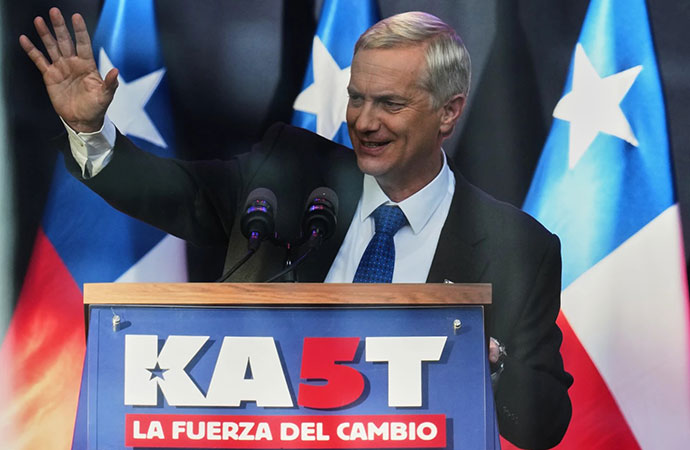
Photo: AP/UNB
Four years ago, Chileans were tempted by the promise of a progressive “refoundation” of the country under Gabriel Boric, a former student leader, and elected him president. Now they have swung in the opposite direction, electing the far-right José Antonio Kast – and are likely to be equally disappointed.
"The only way to get rid of a temptation is to yield to it," exclaims Lord Henry Wotton in Oscar Wilde's novel The Picture of Dorian Gray. Chileans have taken his advice to heart.
Four years ago, they were tempted by the promise of a progressive "refoundation" of Chile under Gabriel Boric, a former student leader. Chileans yielded to that temptation and made him the youngest and most left-wing president since the country's return to democracy in 1990.
Illegal migration, rising crime, and a sluggish economy under Boric pushed voters toward another temptation: that of far-right former congressman José Antonio Kast, whose promises to kick out migrants and cut taxes echo US President Donald Trump's. Chileans have now yielded to temptation once again, electing Kast president with a record number of votes.
Boric's administration was disappointing even to its own supporters. His plan for a new constitution produced a draft so wildly "woke" that nearly two-thirds of voters rejected it in a referendum. When the youthful ministers from Boric's own Frente Amplio (Broad Front) proved mostly incompetent, Chile's Social Democrats rode to the rescue, supplying a team of safe hands. Still, with the exception of an early 2025 pension reform, the administration can claim few accomplishments.
Little wonder, then, that voters punished Boric's coalition at the polls. Jeannette Jara, its candidate and a communist former minister in Boric's cabinet, obtained a paltry 41.8% of the vote. Kast won by more than 16 percentage points - the worst electoral showing for the left since 1990.
Will Kast also disappoint? Chances are that he will. We know from other countries that right-wing populists derive their support more from identitarian posturing than from policy achievements, and Kast's campaign promises mostly look far-fetched.
While Kast studiously avoids using the word deportation, his vow is to remove most or all of Chile's 337,000 undocumented migrants. Trump has not delivered on a similar vow, and neither will Kast. The Chilean state (including the judiciary, which in most cases must authorize deportations) does not have the capacity to identify, apprehend, hold, judge, and then deport such large numbers of people. Conservative former President Sebastián Piñera deported fewer than 7,000 people when he was in office between 2018 and 2022; the total under Boric is even smaller.
Kast's other big promise is to cut $6 billion, or 7% of the total, from Chile's budget. This is also unlikely to happen. As in most countries, the lion's share of expenditure goes to entitlements such as pensions and educational subsidies that no one - not even Kast - wants to cut. And to pass any laws in Congress, he will need the votes of center-right politicians who in theory favor less spending, but in practice tend to scream whenever cuts affect their constituencies.
If Kast does not cut spending, he won't have the fiscal headroom to cut corporate taxes, as he has promised to do and his supporters in business expect. His foolish vow to abolish property taxes on primary residences could make the fiscal situation even tighter.
The big, all-important, question is whether a frustrated Kast will try to cut corners and weaken the checks and balances of liberal democracy - as have other far-right leaders, from Jair Bolsonaro in Brazil to Nayib Bukele in El Salvador to Viktor Orbán in Hungary to Trump.
For all the shortcomings of his administration, Boric has been scrupulously democratic. When the new constitution he advocated was defeated at the polls, Boric graciously accepted the result. Unlike other far-left Latin American leaders, he has not hesitated to call Venezuela's Nicolás Maduro a dictator or to denounce Vladimir Putin's criminal invasion of Ukraine.
Will Kast be as scrupulously democratic? His claim that General Augusto Pinochet, Chile's dictator from 1973 to 1990, would vote for him if he were alive is not a good omen. Nor are the comments Kast made during the campaign suggesting that he did not need Congress to achieve his goals, and that issuing decrees would be enough (he later walked back those remarks).
But the center-right parties on which he will have to rely will be a moderating force. He struck a conciliatory tone in his victory speech, promising a government of broad-based agreements. Will he keep his word? Will he be like Trump or like Italy's more measured Giorgia Meloni? No one can be sure.
One way or the other, Kast's victory will have lasting consequences. This election was a perfect illustration of Yeats' dictum that "the center cannot hold." The center-left candidate in the race, the highly qualified Carolina Tohá, lost to Jara by a wide margin in the primary of the pro-government bloc. And the center-right candidate, the highly qualified Evelyn Matthei, did make it to the general election but ended in fifth place.
Like Argentines, Americans, Britons, and so many others, Chileans are in no mood to back the quietly competent when fang-bearing, belligerent populists are on offer.
The political center is likely to shrink further. By joining Boric in office, the Social-Democrats saved his administration but eroded their own political capital. As Britain's Liberal Democrats learned when they joined the Conservatives in a coalition, the junior partner gets no credit for the government's achievements while getting all the blame for its failures.
The same will happen now to Chile's center-right forces. The offer to join Kast's cabinet will prove too enticing to turn down. If he begins to play fast and loose with democratic rules, they will have to grin and bear it at first. But if he perseveres, they will have to push back, with the consequent ugly political infighting. Neither outcome will earn the center-right much love from voters.
With Chile's traditional centrist parties much diminished, the new congressional king-maker will be the People's Party of Franco Parisi, an uber-demagogue who placed third in the first-round presidential vote. Having yielded to populist temptations in two successive election cycles, voters will yield to his own allure four years from now, Parisi hopes.
Or, having learned the hard way that yielding to temptation only produces hangovers, Chileans may decide to vote for a quietly competent reformer. That is the hope that springs eternal.
From Project Syndicate
A Independent Newsweekly
© Copyright 2026 | Designed by ARK Reepon & Developed by Cosmos Group Software Team





Leave a Comment
Recent Posts
Is the international community ...
A spate of downgraded economic projections, from Bretton Woods to Mani ...
A Childhood Lesson in Arithmet ...
As children, we learned a simple mathematical rule: if we know the pri ...
Indian authorities launched a major security crackdo ..
Police dispersed garment workers from the Azampur ro ..
Why Saudi Arabia has struggled to defend itself agai ..
Iran-backed Houthis strike Saudi oil company Aramco’ ..