


Column
Knowledge and freedom


An Independent Newsweekly





Column
Freepik
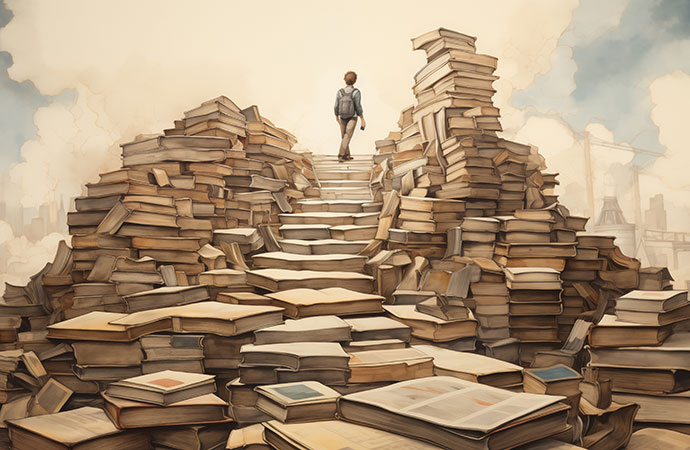
For some time now, I have been tormented by the thought of why humans wish to know anything at all. Why is knowledge intrinsically important? The only reason of which I can think is freedom. The point of gaining knowledge is to obtain freedom.
That quest is underlined in the founding mythos of Adam's and Eve's departure from the Garden of Eden. The lucky couple had it all: No work, all play, all love, but no sex. They did not miss sex because they did not know that it existed. Like everlasting children, they had no need to grow up. Yet, something very nasty happened. Eve, tempted by the Devil in the form of a snake, ate and shared with Adam the apple from the forbidden Tree of Knowledge of Good and Evil. They became shamefully aware of their nakedness (read "sexuality"), drew divine wrath upon themselves, and invited their expulsion from Paradise. Marking humanity's separation from God, the exiled couple suffered the penalties of toil, pain and death on Earth.
But look at where the Tree of Knowledge led them. It led them to the Soil of Freedom. The First Man was free to love the First Woman without the coercive protectiveness of Eden. Here on Earth, Adam and Eve produced two sons, the Evil Cain and the Good Abel. Cain killed his brother, proving the binary presence of good and evil inherited from Heaven. However, here, too, on Earth, there appeared a third category of Being as well: Imagination. The Tree of Imagination freed the human mind from the either/or choice between Good and Evil. It is not that Good and Evil ceased to exist but that the relationship between them turned from being closed and teleological to being open and dialectical.
That turning came to fruition in Shakespeare. His characters straddle the opposites of Good and Evil but within a single, unifying stage created by Imagination where every reader and every audience past, present and future was, is and will be judge and jury. In a 1951 essay on Shakespeare that appeared later in the prized journal Granta, the playwright Harold Pinter paid tribute to the greatest of dramatic masters in these unforgettable words: "In attempting to approach Shakespeare's work in its entirety, you are called upon to grapple with a perspective in which the horizon alternately collapses and reforms behind you, in which the mind's participation is subject to an intense diversity of atmospheric. Once the investigation has begun, however, there is no other way but to him."
Indeed so. Likening Shakespeare's works to a wound, Pinter observed: "He amputates, deadens, aggravates at will, within the limits of a particular piece, but he will not pronounce judgement or cure. Such comment as there is is so variously split up between characters and so contradictory in itself that no central point of opinion or inclining can be determined."
Shakespeare creates new words of the mind but he does not judge their inhabitants. That is why his infectious genius has visited every age almost everywhere since his own times in Elizabethan England. Do you think Shakespeare could have composed his troubled agnostic masterpieces in the beatific certainties of Heaven? If Eve and Adam had not partaken of the explicitly prohibited fruit of the Tree of Knowledge, would there have been a Newton on whom an apple fell from a Cambridge tree or an Einstein who united space and time? Would there have been a Plato or a Kant? Would there have been a Tagore or a Nazrul, a Neruda or a Marquez? A Picasso or a Mozart? A you or a me?
No. It is only the restlessness of the human imagination that produced them and us. Those figures represent different ways to pursue knowledge on the single way to freedom.
The problem today
The chief intellectual problem today, as I see it, is a distinct turning away from free enquiry as the precondition of human existence. In country after country, universities are being subjected to restrictions on what scholars can produce and thus on what they can imagine publicly. Ideas are being censored to suit the demands of power. Faculties and departments are being polarised not only along partisan lines - that, they have always been - but along ideational lines as well that reflect the presumptions and pretensions of passing power over ceaseless knowledge. Imagination is being curbed to fit into the borders of states, whether national or civilisational. To think is becoming a crime: To imagine is becoming, metaphorically, a capital offence.
America's attack on "woke culture" in universities is being accompanied globally by efforts to reinstate Indic, Islamic and Sinic knowledge systems in Asia. There is nothing intrinsically wrong with a return to indigenous knowledge systems, but they very unfortunately are a part of egregious infringements of intellectual freedom globally. Knowledge now is supposed to belong within national/civilizational frontiers and imagination to the state. Ironically, this incursion serves merely to confirm the unruly nature of human existence and will ultimately be a futile attempt to contain it within the fragile frontiers of a single ideational hegemony.
Ideational fascism is reappearing, leaving the path open to outright cognitive Nazism, which compels a supposedly chosen people to exterminate other humans when and where they can in order to preserve their own racial or religious sense of superiority. No thinking human can be a fascist and certainly not a Nazi. One can be those under compulsion but not in freedom.
And it is freedom that is the true destination of the journey of knowledge.
Edward Said said it well: "Inside the academy we should be able to discover and travel among other selves, other identities ... we should regard knowledge as something for which to risk identity and we should think of academic freedom as an invitation to give up on identity in the hope of understanding and perhaps even assuming more than one."
Outside the academy as well, I must add. Adam and Eve did not go to university. Nor for that matter did Shakespeare.
The writer is Principal Research Fellow of the Cosmos Foundation. He may be reached at epaaropaar@gmail.com
A Independent Newsweekly
© Copyright 2026 | Designed by ARK Reepon & Developed by Cosmos Group Software Team






Leave a Comment
Recent Posts
Is the international community ...
A spate of downgraded economic projections, from Bretton Woods to Mani ...
A Childhood Lesson in Arithmet ...
As children, we learned a simple mathematical rule: if we know the pri ...
Indian authorities launched a major security crackdo ..
Police dispersed garment workers from the Azampur ro ..
Why Saudi Arabia has struggled to defend itself agai ..
Iran-backed Houthis strike Saudi oil company Aramco’ ..