


Nation this week
More than 156,000 expatriate Bangladeshis residing in different countries


An Independent Newsweekly




Nation this week
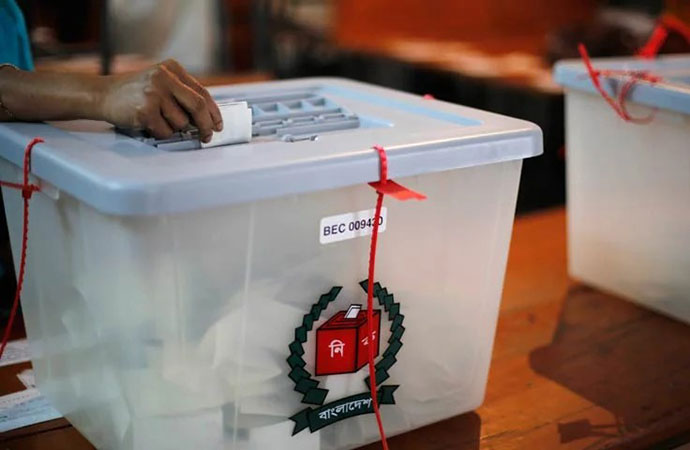
More than 156,000 expatriate Bangladeshis residing in different countries around the world had registered to vote through the 'Postal Vote Bd' mobile app by Wednesday (Dec. 3). The Election Commission launched the 'Postal Vote Bd' app on November 18 to bring expatriate voters living in 143 countries under the postal balloting system, to allow them to participate in the upcoming national election and referendum to be held in a single day in early February 2026.
The overwhelming majority of the 156,712 expatriates who have so far registered are male (139,107 or 89%), and females jut making up 11% (17,605). Among the registrants, the highest number came from Saudi Arabia (22,176), followed by the USA (18,713), Singapore (9,878), South Korea (9,421), the UK (8,973), Canada (8,915), Malaysia (8,013), Australia (7,646), Japan (6,855), the UAE (6,599), Italy (5,952), Qatar (5,478), Oman (4,838), South Africa (4,744) and Maldives (3,478).
The Council of Advisers to the Interim Government approved a number of ordinances, including the Police Commission Ordinance 2025, at its weekly meeting at the Chief Adviser's Office on Thursday. Chief Adviser Professor Muhammad Yunus chaired the meeting. "The government has approved the Police Commission Ordinance 2025, establishing a five-member Police Commission with the mandate to modernise the police, ensure accountability, and make the force more people friendly," Environment Adviser Syeda Rizwana Hasan told reporters following the meeting.
Rizwana said the Police Commission envisioned in the ordinance, which is a much watered-down version of one presented last month by law and parliamentary affairs adviser Asif Nazrul, will include a retired Supreme Court judge (as Chair), a retired government officer who served as district magistrate (not below Grade-1), a retired police officer with the rank of Additional Inspector General of Police (not below Grade-1), a university professor (retired or in service) and one expert with at least 15 years' experience in human rights and good governance.
Several UK universities have suspended recruitment of students from Bangladesh and Pakistan, it was revealed, citing tougher visa rules and concerns over potential abuse of the system. At least nine higher education institutions, vowing to enrol "genuine" students, have stopped receiving applications from "high-risk" countries, according to an article published in the Financial Times. The University of Wolverhampton has stopped accepting undergraduate applicants from both countries, while Sunderland and Coventry have also suspended recruitment.
London Metropolitan University confirmed it had halted admissions from Bangladesh, noting the country accounted for 60 percent of its visa refusals. The University of Hertfordshire has paused recruitment from both Bangladesh and Pakistan until 2026, blaming "long visa processing times." The crackdown follows changes to the Basic Compliance Assessment thresholds that universities must meet to retain their student sponsor licence. Institutions must ensure that no more than 5 percent of visa applications are rejected, down from 10 percent, according to the new rules coming into effect in September this year.
A Dhaka court convicted and sentenced ousted prime minister Sheikh Hasina to five years' imprisonment, her sister Sheikh Rehana to seven years, and Rehana's daughter Tulip Siddiq to two years in the Purbachal plot allocation scam. Judge Robiul Alam of the Dhaka Special Judge Court-4 pronounced the judgment. The case was lodged against a total of 17 people over irregularities in the allocation of a 10-katha plot in the RAJUK Purbachal New Town Project. The court also convicted and sentenced all 14 of the other co-accused, including a former state minister for housing and public works.
Tulip's conviction raised eyebrows, as no plot was actually allocated to her. However, the chargesheet states that she used her influence as a British MP to "force and influence her aunt to secure [a plot of land] for her mother Rehana Siddiq, sister Azmina Siddiq and brother Radwan Siddiq". The ACC said Siddiq was tried as a Bangladeshi citizen as authorities had obtained her Bangladeshi passport, ID and tax number.
A Independent Newsweekly
© Copyright 2026 | Designed by ARK Reepon & Developed by Cosmos Group Software Team






Leave a Comment
Recent Posts
Is the international community ...
A spate of downgraded economic projections, from Bretton Woods to Mani ...
A Childhood Lesson in Arithmet ...
As children, we learned a simple mathematical rule: if we know the pri ...
Indian authorities launched a major security crackdo ..
Police dispersed garment workers from the Azampur ro ..
Why Saudi Arabia has struggled to defend itself agai ..
Iran-backed Houthis strike Saudi oil company Aramco’ ..