


Featured 2
‘Rising from the Dust’ Dalit Stories from Bengal


An Independent Newsweekly




Featured 2
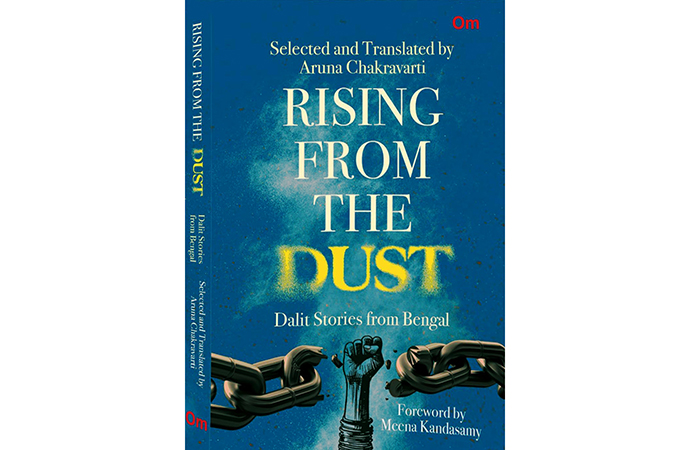
Selected and Translated by Aruna Chakravarti Book Review by Raana Haider Part 2
'Illegal Immigrant' is an entry written by Nakul Mallik. 'Notes on Contributors' inform us that Mallik was born in 1946 "into a low-wage farming family of the Namasudra caste in Gajendra village of Khulna in Bangladesh...He was expected to carry on in the footsteps of his forefathers. But with his father's support he managed to get an education. He studied first in the village school, then moved to Kolkata for higher education. While still in school, his community's untouchable status started haunting him and the inhumanity displayed by the upper castes towards his people in Kolkata, took hold of his consciousness in a big way. The tragedy of Dalit existence moved him to write poems and stories in protest. He lives in Kolkata."
"Once inside the train, there was no time for anything other than moving from compartment to compartment jingling the brass bells around his wrist. A sound that invited passengers to buy Madhab's famous spiced jhal muri...Reaching home, he ate the rice and dal his wife had cooked at dusk. Though ice cold by the time he sat down to his meal, he ate with relish and got ready for bed just as Shefali had risen from it...Husband and wife saw each other for a few minutes with just enough time to exchange a few pleasantries."
Cross border reference. "Madhab's father had taken refuge in India while the war of liberation was being fought. After Bangladesh became independent, he had answered the call of his roots and gone back to his native village...They had struggled for a few years, then, like so many others, were forced to return ...drawing a blank everywhere, he built a small leaf hut in a refugee slum at the edge of the Bongaon line, and started selling jhal muri. This was nearly ten years ago."
Shefali was not Bangladeshi. She was born in India. "Her family belonged to the farming community though they owned no land. Her father had made a precarious living by working in other people's field and could rarely give his family two square meals a day...she was forced to think of ways to augment her father's meager income." Her neighbor 'Boudi' "used to catch the first train to Kolkata every morning with a basket of flowers, garlands, bel and tulsi leaves which she sold in the city markets. Shefali decided to follow her example." Madhab and Shefali met on the train. Marriage followed.
"Shefali came to Madhab's hut and made it her home. She had seen poverty and struggle, had known hunger and privation, but what she saw around her, now, was too bitter for words. The ceiling of their hut was so low, she couldn't stand straight without hitting her head...The door was so flimsy, it served no purpose...No welcoming ululation or blowing of conch-shells greeted the new bride...Even the mandatory phoolsajja ceremony, the ritual that entitled bride and bridegroom to sleep together, was not performed...For the first time she realized what it was to be a refugee in another country...All will be well dear," Madhab would say lovingly, taking her in his arms. "This is the way people in this slum have lived for years. We are all refugees; all in the same boat. It is a matter of habit. You'll get used to it in time. But don't despair. You won't have to stay here forever." Madhab had plans. "It will take us about a year to buy the land and build our own hut."
"The government had decided that all encroachments by Bangladeshis, including slums that had stood for years, would be razed to the ground and the inmates forcibly deported to their own country. He heard a radio blaring...armed police had forcibly evicted some Bangladeshis from their home and carried them away in trucks across the border...He formed a band with a few chosen men from the slum and went to meet the members of the local party in power. ..The problem is that you are divided...Get everyone in the slum together and start working for us. Only a strong political party can raise your issues in parliament...Disheartened, Madhab and his compatriots went to the chief of the other party. But what they heard was a parrot-like repetition. The ruling party was corrupt...Depending on those guys would be useless. The members of the opposition, on the other hand, were committed to the welfare of ordinary people...They wanted people like Madhab and other slum dwellers to work for them...Madhab had stopped going out with his barrel of jhal muri. But Shefali went about her business as usual. She had no fears...'Madhab said to Shefali more than once. 'Let's go to some place where no one knows I am a Bangladeshi. The police will pick me up, sooner or later, if I stay on here. Nonsense' Shefali snapped at him. 'So many people live in this slum. How many can they carry off to Bangladesh?" Defiant Shefali, a month later was terror-stricken.
"The empty room and eerie silence struck her heart with a deathly chill..."They were illegal immigrants. They're being sent back to Bangladesh...Shefali threw herself on the ground weeping. Knocking her head against it, over and over again, she screamed and hurled curses at the police. Then...she pulled herself together. Do you know where they've been taken? To Petropole border..." Shefali reaches Petrapole border. "A man in the uniform of a customs inspector walked towards her and asked in a threatening tone; 'What is your business here? I'm looking for my husband...You took him away at dead of night, Shefali shouted, and you have the gall to ask me who he is...How do you know we took your husband away? The neighbours saw you. You dragged everyone from our slum while they lay sleeping, pushed them into lorries and are keeping them here as prisoners..."
"You say your husband was in the lorry? he muttered in a puzzled voice. But they were all Bangladeshi immigrants. They've been sent to Benapole. Where is Benapole? Right there. On the other bank...Shefali started walking purposefully in the direction of the pointing finger...What passport? Shefali cried out angrily. I'm going to my husband. How dare you try to stop me?...That's not possible, Didi...Your husband was an illegal immigrant from Bangladesh. We have sent him back from where he came. We've acted strictly on the orders of the government...Suddenly a shriek tore out of Shefali's lungs, so loud that sky, land and river reverberated with the sound. 'What about me? What am I? I carry his child in my womb...And now...what is to become of me and my child? O go, Ma go! Ki hobe, Ma!' Bursting into tears Shefali dashed head, over and over again on the bamboo barricade...Constable, customs inspector and police officer stood frozen in their places. They glanced at one another. No one had an answer"
*A traumatic tale of tortured hearts. Reviewer.*
'The Fortress' is a short story written by Manoranjan Byapari. He was born in 1951 in a Namasudra family in Bangladesh. The Dalit family moved to India when he was three and lived in various refugee camps before finding permanent sanctuary in Kolkata. Hindered by financial constraints, Manoranjan did not receive a formal education and had to work as a rickshaw puller at one time. Yet, with extraordinary dynamism, he became a celebrated author, politician and activist with twelve novels, a hundred short stories and a number of essays to his credit. He is hailed as a pioneering author of Dalit literature of Bengal....His literary corpus documents the oppression and marginalization Dalits have suffered for generations in Bengal. He is the recipient of many awards and lives in Kolkata at present" is his Contributor background.
"Sarama had been turned into a widow in a single night. The night her sack of sindoor sank into the fetid, festering waters of the canal...From that day Sarama became everyone's concern...'It isn't right. Panchanan Koyal's considered opinion. Eight kotahs of land at the crossroads! Prime property! Owned by a single woman! Why?' He counsels, 'you have this fine healthy body. Why waste it in selling dung cakes? Go to the town. You will live like a queen. What about my land? 'I'll give you something for it. It's ancestral land. My husband's forefathers." Getting official backing, "This Panchanan was not the old Panchanan...He was a strong man now. Behind him were a hundred men with lathis...Your presence is damaging the purity of the village. Our young men are losing their characters. You are Nakul's widow. He was a criminal....I won't go...Is that your last word? Yes. She has to be taught a lesson..."
"Sarama's life is unbearable these days. Thousands of eyes lick her form with slavering tongues...Drunken leers. She runs away from the light and buries her face in the dark. But the dark is cruel too. Her world is torn from her body in tiny shreds...collecting cow dung, she sees eyes. Naked eyes graze her neck. Lust at her limbs. Her body streams with sweat. She is like a muniya bird caught in a trap. She flutters her wings. Struggles to free herself...Panchanan is a contented man these days. His worry over the eight kotahs of land has been laid to rest. His gang of toadies are ecstatic. Sarama has become a public woman. Acknowledged. Undisputed. Anyone can enjoy her now."
Sarama meets Parul whose husband (Ratan) is a rickshaw driver. "My husband can't work anymore. He's suffering from a disease that even the gods can't cure...A shameful one, Didi...Poison women! Haven't you seen them...Under the paint and glitter their skins ooze deadly venom. To touch them is to die. My fool husband courted death. He's dying...Bitter rage contorts Parul's face as she utters these words..."I've run away and come to my parents. Why should I share his shame and die with him?"
"Sarama comes home. Bathes for a long time. Twines her hair into a knot high on her head. Lines her eyes with kajal. Wears a red-and green striped sari. Tucks the folds neatly into her petticoat. Shrugging off all shame she steps on to the road..." "Ratan's emaciated form is barely visible on the bed...Will you do me a favour? Give me one night...I want one night from you. Only one....Ratan's soul is shaken to its foundations. What are you?...Sarama looks at him with feral eyes. She has metamorphosed. From woman to predatory beast. She is a tigress...ruthless in her revenge. Suddenly the mask cracks into shards. Falls to her feet. 'Save me,' she cries out piteously and bursts into tears."
"The old adulterous blood leaps up in Ratan's veins. His passion for female flesh long spent and forgotten, bursts into flame. He sits up. Leans towards her. She strokes his neck. Places her lips on his. Sucks the venom out of him with a long, stinging, shuddering kiss. She comes home late at night. She is a pot brimming over with poison. She leaves her door open. Locks and latches are redundant now. She doesn't need protection. Her body has become a fortress.
The God of Death resides within its walls...Sarama's mind and body glow like a furnace. Venom has driven out fear. She will welcome every touch. Invite them. She waits outside her door in delicious anticipation..."
*Following its first reading, 'The Fortress' continues to linger long in my mind. Reviewer.*
In an emblem of her suffering, I recall the following words of Frida Kahlo, the renowned Mexican artist. "I never painted dreams. I painted my own reality...Few artists had the audacity to picture their own departure from this world, but then few faced death on so regular a basis...Death is an enormous and very silent exit."
Raana Haider has an MA. in Sociology from the American University of Beirut, Lebanon. She has taught 'Women and Development' at the Cairo Center for Development. Her publications in the have been on Environment and Gender issues; publishers being The American University in Cairo Press and The University Press Limited (UPL), Dhaka. She resides in Dhaka.
A Independent Newsweekly
© Copyright 2026 | Designed by ARK Reepon & Developed by Cosmos Group Software Team





Leave a Comment
Recent Posts
Is the international community ...
A spate of downgraded economic projections, from Bretton Woods to Mani ...
A Childhood Lesson in Arithmet ...
As children, we learned a simple mathematical rule: if we know the pri ...
Indian authorities launched a major security crackdo ..
Police dispersed garment workers from the Azampur ro ..
Why Saudi Arabia has struggled to defend itself agai ..
Iran-backed Houthis strike Saudi oil company Aramco’ ..