


Reportage
Falling on Her Own Sword


An Independent Newsweekly


Reportage
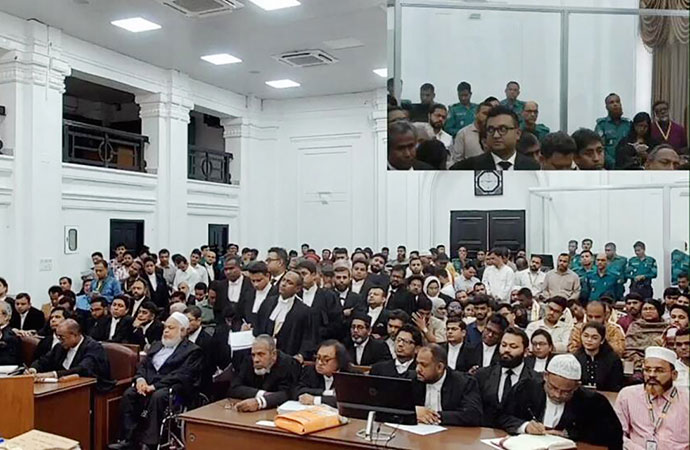
Photo: AP/UNB
There were essentially two things to watch out for among Bangladeshi political observers and stakeholders, as the date set by the International Crimes Tribunal for its verdict in the case against deposed prime minister Sheikh Hasina - Monday, November 17 - approached this week. The verdict itself would form the centrepiece of course, drawing a mixture of anticipation and apprehension among the public, even though a guilty verdict was the overwhelming expectation. The forces that led the Uprising that ousted her, certainly made it known that they would accept nothing less. There was little to counter them.
Hasina was being accused of having exercised command responsibility over the brutal crackdown on the students-led movement, that started out as one to abolish an unfair and unworkable quota system in government jobs but later evolved mostly under state pressure into something much bigger, in July-August 2024. Eventually it resulted in Sheikh Hasina, the prime minister and daughter of the nation's independence hero, who once boasted she would never escape, doing exactly that and finding refuge in India.
By the time the house of cards came down in the summer of 2024, she had served as the country's prime minister for 20 years, longer than anyone else, with fifteen of those on the trot. During that 15-year run in particular, it was generally agreed that she had run the country's democratic institutions into the ground, and secured almost absolute power for herself and her family in particular. But this does not mean she was short of supporters. The Awami League had a long history as a big party in Bangladesh, in fact preceding its birth and stretching into its short existence as East Pakistan. And so as the vanguard of Awami League for over four decades (since 1981), Hasina could claim to always have a substantive political constituency, that was not only relevant but also influential within society.
So as the date set for her verdict approached, it was also going to be interesting to watch out for the reaction to it within this segment. In fact, to the extent that the verdict was probably not going to throw up any surprises, the reaction would draw even more interest, since it was still quite unpredictable. There was an anticipation of violent, disruptive protests on the streets, Hasina herself had made clear what she wanted on numerous occasions in her conversations with party activists from exile in Delhi's outskirts, but the extent of it remained uncertain.
In the event, what we saw was that the country's capital and major cities remained calm on Tuesday, the day after the verdict was announced, despite a call for a 'nationwide shutdown' by the former ruling party, after she was sentenced to death over her crackdown on the student uprising last year.
The International Crimes Tribunal handed down death sentences in absentia to Hasina and former Home Minister Asaduzzaman Khan on Monday for their involvement in deadly force used against protesters last year.
The Awami League rejected the court proceedings Monday, calling it "a kangaroo court" and called for a nationwide shutdown the next day.
Hasina's opponents clashed with police and soldiers until late Monday and attempted to use excavators to demolish the home of her father, Bangladesh independence leader Sheikh Mujibur Rahman, to coincide with the verdict - a symbolic burial 'for good' of the AL's allegedly fascist ideology and political conduct. But that was not to be either. The interim administration of Muhammad Yunus, thus signaled its seriousness as an administration with a three-pronged mandate: justice for the killings during the Uprising, reforms to state institutions, and elections that now stand less than three months away. It has now become fairly established that Hasina's Awami League will not be part of that election. Apart from the ban on its activities pending trial for its sins in power, the muted response it was able to muster against its leader's death penalty would also seem to signal a loss of organisational capability, that would take a small miracle to stand back up again so soon, from the monumental defeat it suffered on August 5, 2024.
On Tuesday, there was no closure of services or shops and schools, although some people expressed tension and confusion over what lies ahead for the nation and its 170 million people.
As you reap
Hasina, 78, was convicted Monday on five charges of crimes against humanity. She also was sentenced to prison until natural death for making inflammatory remarks and ordering the extermination of student protesters with helicopters, drones and lethal weapons. Her home minister over two terms in office, Asaduzzaman Khan, also received the death penalty. Her police chief during the Uprising, Chowdhury Al Mamun, was sentenced to five years' imprisonment after pleading guilty and becoming a state witness against Hasina.
Hasina cannot appeal unless she surrenders or is arrested within 30 days of the sentencing. She and Khan did not designate defense lawyers and rejected a state-appointed defense attorney for the tribunal.
Hasina and Khan were sentenced in absentia. India has so far declined to extradite them, making it unlikely that they would ever be executed or imprisoned.
More than 800 people were killed and about 14,000 were injured in the student-led uprising in July and August of 2024, according to the health adviser to Bangladesh's interim government. However, the United Nations in February estimated as many as 1,400 people were killed.
Hasina said the charges were unjustified, arguing that she and Khan "acted in good faith and were trying to minimize the loss of life."
"We lost control of the situation, but to characterize what happened as a premeditated assault on citizens is simply to misread the facts," she said Monday in a statement denouncing a verdict she called "biased and politically motivated."
A three-member tribunal, headed by Justice Golam Mortuza Mozumder, announced the ruling in a live broadcast that lasted for several hours.
Some of those in the packed courtroom cheered when Mazumder said Hasina was sentenced to death. He admonished them, telling them to express their feelings outside the courtroom.
Families of some of those killed or injured during the uprising waited for hours outside.
In a media statement Monday, Bangladesh's Ministry of Home Affairs urged India to send both Hasina and Khan back soon, something New Delhi has so far refused to do.
Separately, Bangladesh's Foreign Ministry in a statement said it would be extremely unfriendly and demeaning to justice for any other country to grant asylum to these individuals convicted of crimes against humanity.
"We urge the Indian government to immediately hand over these two convicts to the Bangladeshi authorities. It is also a legal obligation for India as per the existing extradition treaty between the two countries," it said.
India's foreign ministry in a statement acknowledged the verdict but did not say whether it would hand the pair over to Dhaka.
"As a close neighbor, India remains committed to the best interests of people of Bangladesh, including in peace, democracy, inclusion and stability in that country. We will always engage constructively with all stakeholders to that end," it said.
India's failure to extradite the pair has created some tensions between the neighboring nations.
Opponents rejoice
In a statement, Chief Adviser Yunus said the verdict offered justice to the thousands who were harmed in the uprising: "No one, regardless of power, is above the law."
Ordering the use of lethal force against young people and children, whose only weapons were their voices, violated laws and the basic bond between government and citizens, he added.
The Bangladesh Nationalist Party, or BNP, headed by Hasina's longtime archrival, former Prime Minister Khaleda Zia, hailed the verdict.
BNP Secretary General Mirza Fakhrul Islam Alamgir said in a Facebook post that it wasn't just a judgment on Sheikh Hasina's crimes, but a "burial of all forms of dictatorship on this country's soil."
Authorities at the Supreme Court, in a letter to army headquarters on Sunday, requested the deployment of soldiers around the tribunal premises ahead of the ruling. Paramilitary border guards and police were deployed in Dhaka and many other parts of the country.
Even as judges were still reading out the verdict, police elsewhere in Dhaka charged with batons and used stun grenades to disperse crowds.
Her son Sajeeb Wazed, currently in the United States, said in a message to The Associated Press that the "verdict is a joke and meaningless. My mother is safe in India. The trials were so legally flawed they won't survive any challenge once rule of law returns to Bangladesh."
A few kilometres away from the tribunal, Hasina's opponents gathered outside the storied home of her father, Bangabandhu Sheikh Mujibur Rahman, that is now a museum. Or was, till the Uprising triumphed. The mostly young crowd, corresponding with the image of the leaders of last year's protests, brought two excavators to finish the demolition of the building, which was looted and damaged, including with fire, during earlier protests. But this time, even after they waited till the next day, there was no way through.
Flawed Justice, or Fair Enough?
The tribunal's judgment is anchored in extensive evidence from the UN and international human rights organisations. In a report published in February 2025, the UN Office of the High Commissioner for Human Rights estimated that up to 1,400 people were killed during the three weeks of unrest. A further 11,700 people were detained, it said.
The report found that "the vast majority of those killed and injured were shot by Bangladesh's security forces", and determined that security agencies "systematically engaged in rights violations that could amount to crimes against humanity". UN data suggests that up to 180 children were killed in the security crackdown.
During the unrest, Human Rights Watch (HRW) noted that the Bangladeshi government had "deployed the army against student protesters, imposed shoot-on-sight curfew orders, and shut down mobile data and internet services."
The UN report concluded that the violence against protesters in Bangladesh "was carried out in a coordinated manner by security and intelligence services". It documented instances where "security forces engaged in summary executions by deliberately shooting unarmed protesters at point-blank range."
HRW documented similar patterns. In a January 2025 briefing, HRW stated that "over 1,000 people were killed and many thousands injured due to excessive and indiscriminate use of ammunition." These findings were repeated by Amnesty International, which recorded the use of live ammunition on protesters and mistreatment of detainees.
The court's verdict accepts evidence that multiple branches of the security apparatus acted in concert, and that senior officials did not intervene even as human rights violations escalated. Judges stated that those in positions of authority were expected to prevent such abuses, yet the violence continued despite their ability to stop it.
For many families, the court's ruling marks the first official acknowledgement of their loss. Testimonies collected by UN investigators describe parents spending days searching hospitals and police stations for their children, often being told that records were missing. The UN reported that hospital staff were pressured by security forces to alter or remove death records.
According to Shahzad Uddin, Director of the Centre for Accountability and Global Development at the University of Essex, the court's verdict establishes "an official record that lethal force was used in ways inconsistent with international law, the violations were widespread, and the state bears responsibility."
So you will sow...
In 1973, shortly after Bangladesh became independent, the new government enacted the International Crimes (Tribunal) Act to allow it to prosecute Pakistani military officers who had allegedly committed international crimes during the country's nine month war of independence. These trials never took place, but the Awami League, after it came to power in 2009, used the 1973 law to establish a court, the International Crimes Tribunal of Bangladesh (ICT), to prosecute Bangladeshis, mostly the leaders of the opposition party Jamaat-e-Islami, who had allegedly committed crimes during the 1971 war in support of the Pakistan military. The trials, which resulted in six men being executed, were widely criticised for their lack of due process.
After Hasina's government fell, and most senior leaders fled, more and more of the atrocities committed by the regime in the final weeks came to the fore, intensifying calls for justice for the victims of 'July'. Asif Nazrul, a Dhaka University law professor who was now adviser to Yunus's interim government on the Law Ministry, came up with the idea that the Awami League and its affiliates who had committed egregious crimes to prop up the regime, were now going to be tried at the very same tribunal that they had allegedly used to further their own political ends. Nazrul even appointed a new Chief Prosecutor, Muhammad Tajul Islam, who had been a senior defence lawyer for the Jamaat-e-Islami's accused leaders in the previous trials at the tribunal.
Tajul Islam has always insisted he would carry out his work independently, but is that something the public will ever believe, having been privy to his disappointment as a defence lawyer at the same Tribunal where he now commands the respect of all he surveys?
In November 2024, the government appointed the international lawyer Toby Cadman as a special prosecutorial advisor and also made some significant amendments to the 1973 Act to bring the country's legislation closer to international standards. Although some improvements were made, critics will say they could've gone further. What we may say is that the tribunal is a better functioning body today than it was during the trial of the Jamat leaders. But it is far from perfect. And perhaps it is just as well that its sentence, although possibly enough to ensure she never steps foot in the nation again with a conviction hanging over her, can never actually be implemented.
Breakdown of Verdict
The special International Crimes Tribunal 1 (ICT) in Dhaka found Hasina guilty of crimes against humanity and sentenced her to death.
The independent ICT was originally set up by Hasina herself in 2010 to investigate crimes against humanity committed during the 1971 war that resulted in Bangladesh's independence from Pakistan. However, it has been criticised in the past by human rights organisations and her opponents who have accused her of using it for politically motivated purposes while she was in power.
The tribunal issued three categories of punishment against Hasina across five charges. Two counts resulted in the death penalty, and one count led to imprisonment until natural death.
Hasina faced the following charges:
1. Orchestrating mass killings of protesters
2. Ordering or authorising lethal force from the air and ground
3. Murdering specific individuals
4. Incinerating and disposing of bodies to hide evidence
5. Coordinating the killings and persecution of demonstrators in specific areas
Hasina was sentenced to imprisonment until natural death after being found guilty on three counts under the first charge: incitement, ordering killings, and inaction to prevent the atrocities and failing to take punitive actions against the perpetrators.
For charge two, Hasina was found guilty of crimes against humanity by her order to use drones, helicopters and lethal weapons. She was handed the death sentence.
Hasina was also found guilty of the remaining three charges, but since she was handed the death sentence for her second charge, the court did not announce a punishment for the remaining charges.
A Independent Newsweekly
© Copyright 2026 | Designed by ARK Reepon & Developed by Cosmos Group Software Team





Leave a Comment
Recent Posts
Is the international community ...
A spate of downgraded economic projections, from Bretton Woods to Mani ...
A Childhood Lesson in Arithmet ...
As children, we learned a simple mathematical rule: if we know the pri ...
Indian authorities launched a major security crackdo ..
Police dispersed garment workers from the Azampur ro ..
Why Saudi Arabia has struggled to defend itself agai ..
Iran-backed Houthis strike Saudi oil company Aramco’ ..