


Featured 2
Ashraful Hasan – a pioneer in groundbreaking innovations

An Independent Newsweekly

Featured 2
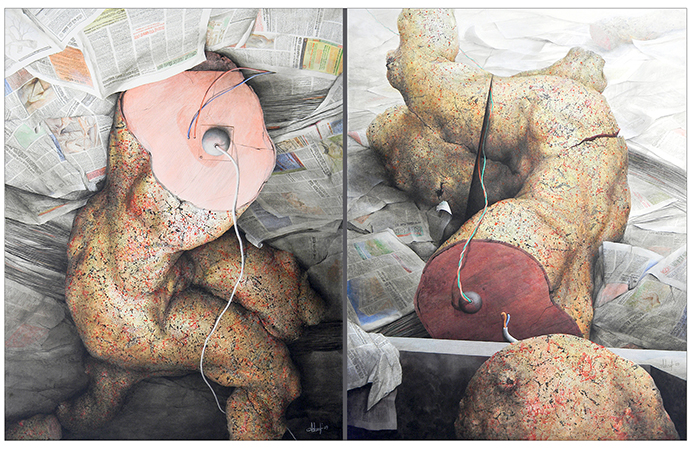
Ashraful Hasan is undoubtedly one of the most groundbreaking artists of our time, having overcome systematic barriers through artistry and a mindset that inspired creative works. Deep philosophical ideas and concepts have profoundly influenced him for years, until they found fruition through his artistic presentations. For him, art is too sacred to be corrupted by materialistic desires.
Ashraful's paintings provoke us to contemplate innovative ideas. His creations, which utilise acrylic, charcoal, and pastel mediums, exhibit exceptional detail through striking illustrations, showcasing his profound ability to articulate and compose semi-figurative representations. He has applied his finely honed understanding of craftsmanship and skill to depict images that frequently address themes of deforestation and the inhumane aspects of humanity. He prefers to delve into the intricacies of his subjects, selecting to construct his narrative by focusing primarily on the significant details present on the surfaces of the depicted objects.
Asraful began his experimentation in 2002. Before this, he engaged in still-life, academic works, and nature-themed subjects. He has persistently continued his experimentation up to the present day, with his artworks being conceptually driven. His themes consistently address socio-economic challenges, political turmoil, unplanned urban development and industrialization, deforestation, the harsh realities of capitalist society, inhumanity, societal brutality, societal violence, and the destruction of natural greenery.
A notable aspect of the years 2002 to 2025 is that many works by the artist address a range of social, cultural, and environmental concerns, including the discrimination faced by human beings, deforestation, communalism, and social intolerance, among others. The artist expressed his creative vision through various styles such as surrealism, semi-realism, figurative, symbolism, abstraction, semi-abstraction, and conceptual. Some of his pieces delve deeply into narrative and absurdist themes. He is regarded as a socially conscious painter, with his primary focus on diverse social issues, and his voice resonates with anti-establishment sentiments. His paintings convey his personal insights, experiences, and profound reflections on societal anomalies. The canvases highlight human regrets, needs, despair, and frustration. His works are populated with protesting and tormented figures that illustrate the common and unfortunate aspects of life. He addresses a wide array of topics, including corruption, misplaced idealism, and religious intolerance.
Ashraful expresses significant concern regarding the harmful effects on nature. Uncontrolled urban development leads to deforestation and a shortage of cultivable land. The artist is also worried about the harm caused by urbanisation and industrialisation. Some of these damages affect individuals directly, while others occur through natural processes. Additionally, he emphasises the increasingly pressing global issue of wildfires. The decline in the health of plants and trees is a significant concern. Therefore, he showcased the importance of this interdependence in his remarkable artwork, where the tree and human figure are seamlessly integrated to create a single entity.
Ashraf is engaged in work, demonstrating a strong awareness and negotiating matters such as identity and tradition with a more objective perspective. He is striving to tackle significant national and international concerns, including globalization, communalism, environmental issues, and economic and social discrimination, using a language that is both current and distinctly unique. Many works by Ashraf tackled issues such as superstition, and both political and social discrimination. In his art, he has emerged as a voice opposing various forms of malevolent actions. His language is different from the so-called mandatory approaches like "Art is Beauty". He is regarded as an anti-establishment figure.
The series titled "The Roots", and "Nature"-created in 2002 and 2003-serves as a continuation of Ashraf's exploration of the relationship between humanity and trees. Many pieces within this collection depict trees that take on human-like forms, emerging from the confines imposed by a wall. The red wall serves as a symbol of challenging times, while the figure embodies a being yearning for freedom from societal limitations. Indeed, the overarching theme is consistent across all works in the series.
In 2007, Ashraf mainly did three series of works titled "Bondage", "Paper Man", and "Tree Man and Wall". At first glance, "Bondage" presents a geometric structure divided into segments of muted colours - earthy greens, reds, and greys. Emerging from the intersection of these angular planes is a textured, organic form resembling twisted, restrained flesh or a contorted mass. The use of dark space around the form enhances a sense of confinement or compression, while the small red specks scattered across the white form add emotional tension and perhaps suggest pain or struggle.
Between 2016 and 2020, Asraf created many paintings of different sizes throughout these five years. His notable series includes works titled "Nature", "The Newspaper", "The Roots", and "Pyre of Green".
The series of paintings "The Newspaper" - is a powerful and thought-provoking works executed in acrylic on canvas. It portrays a human-like figure made entirely of folded and layered newspapers, suspended by two red strings against a dark, almost void-like background. The figure resembles a mannequin or puppet, devoid of distinct facial or bodily features. The newspapers form its body and head, suggesting fragility and artificiality. The red strings, attached from above, create the sense that the figure is being controlled or manipulated - like a marionette or a person hanging in helplessness. The newspapers are printed in Bangla, grounding the artwork in a specific socio-political context. The series of paintings explores the relationship between media, truth, and humanity. It raises questions about how individuals are shaped, controlled, or even silenced by the information they consume. The use of newspapers as the material for the human form symbolizes how modern identity and perception are constructed through media narratives.
The series of paintings titled "The Roots" represents the profound relationship between life, nature, and identity. The depiction of roots illustrates the hidden foundation of existence - robust, intertwined, and essential. The roots extend across the canvas akin to veins, symbolising development, resilience, and the link between the visible and the concealed realms. They delve deep into the soil, signifying stability, heritage, and the origin of sustenance. Concurrently, the interwoven shapes of the roots imply human emotions or connections - how individuals are linked, how their histories influence them, and how all living beings rely on the same earth. The artwork inspires a sense of depth and contemplation, reminding observers that the elements that support life often reside beneath the surface, unseen yet crucial.
The series of paintings titled "Pyre of Green" - created using charcoal and acrylic on canvas - represents a profoundly stirring piece that merges human and natural elements to convey themes of devastation, metamorphosis, and the delicate relationship between humanity and the environment. Upon initial observation, the primary figure seems to resemble a tree; however, its outlines mimic the torso and arms of a human figure, symbolizing the inseparability of humans from the natural realm. The gray and black shades of the charcoal impart a feeling of lifelessness and desolation, while the vibrant orange and red tones in the backdrop imply a forest consumed by fire - potentially serving as a metaphor for ecological destruction, climate change, or spiritual decline. From a stylistic perspective, the artist's application of charcoal accentuates texture and contrast, endowing the tree-body with a sense of both strength and fragility. The acrylic flames contrast sharply against the monochromatic forest, heightening the tension between life and annihilation.
Between 2021 and 2025, Ashraf has created multiple series of paintings. Notable among them are "Reincarnation" and "Spring."
"Reincarnation," a painting centered on the theme of reincarnation, is rich in symbolism - it frequently delves into the cycle of life, death, and rebirth, illustrating how the soul evolves and persists in its journey across various forms or realms. This series of paintings depicts the perpetual rhythm of existence - birth, death, and rebirth - through a vortex of interconnected shapes. At its core, a radiant human silhouette disintegrates into a spiral of energy that harmonises with nature: blossoming flowers, meandering rivers, and blazing suns. Rising from the remnants of a former existence, a new figure starts to ascend, representing the soul's infinite journey through time. Furthermore, this series of paintings encourages contemplation on continuity, aura, and spiritual growth - serving as a reminder that every conclusion is simultaneously a new beginning.
The soft-spoken Ashraful possesses a scholarly demeanour and profound insights into his subject matter. Preserving individuality feels essential to him. This is because beauty is found in uniqueness. For him, art is an ongoing journey. Consequently, he consistently upholds his personal language, which he strives to develop. An artist must cultivate a distinct language that aids in understanding his creations. While his themes may vary over time, his style remains consistently unique and unmatched.
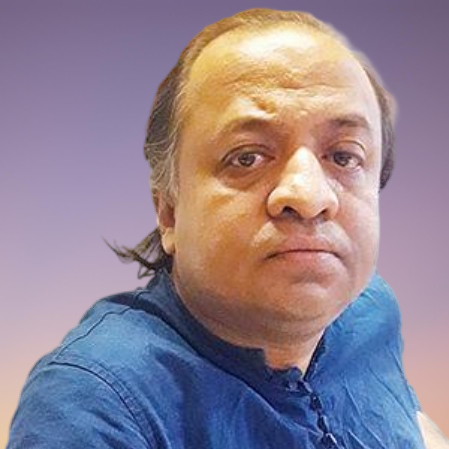
The writer is an art critic and cultural curator.
A Independent Newsweekly
© Copyright 2026 | Designed by ARK Reepon & Developed by Cosmos Group Software Team



Leave a Comment
Recent Posts
Is the international community ...
A spate of downgraded economic projections, from Bretton Woods to Mani ...
A Childhood Lesson in Arithmet ...
As children, we learned a simple mathematical rule: if we know the pri ...
Indian authorities launched a major security crackdo ..
Police dispersed garment workers from the Azampur ro ..
Why Saudi Arabia has struggled to defend itself agai ..
Iran-backed Houthis strike Saudi oil company Aramco’ ..