


Column
Powering Bangladesh’s Industrial Future: Bridging the Gas Gap for Investment and Jobs


An Independent Newsweekly







Column
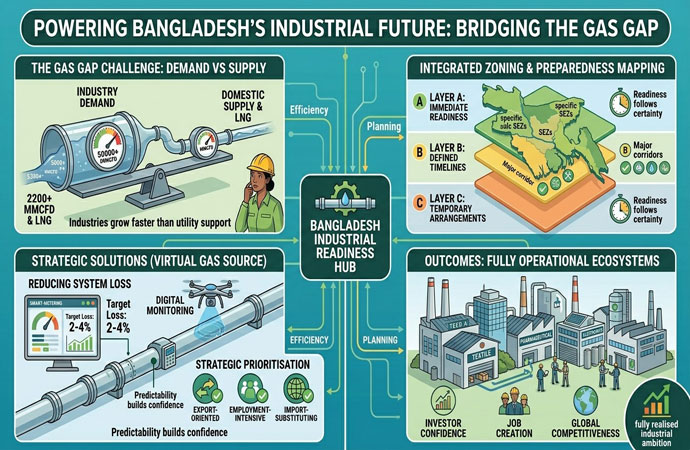
Bangladesh's industrial growth is accelerating through economic zones, infrastructure expansion and manufacturing diversification. Yet many industries continue facing uncertainty after investment decisions are made because utility preparedness often lags industrial approval itself. As gas demand rises faster than supply, Bangladesh may now need to focus not only upon energy availability but also upon "gas readiness" - the ability to ensure that industries can become operational within predictable timelines.
Gas has become the core industrial question
Bangladesh's industrialisation is entering a new phase with expanding economic zones, stronger connectivity and rising manufacturing investment. Yet one challenge is becoming increasingly visible: industries are growing faster than the utility systems supporting them. Bangladesh currently produces roughly 2,000-2,200 MMCFD of gas against demand exceeding 4,000 MMCFD during peak periods, with the shortfall increasingly met through imported LNG. The larger concern is not only supply shortage, but whether industries can receive dependable utility support before becoming fully operational. Investors often complete construction and bank borrowing while waiting for gas confirmation, creating uncertainty for industries, banks and employment generation. Industrialisation ultimately succeeds not merely when factories are built, but when they become operational.
The future demand challenge
Bangladesh's gas demand may exceed 5,000 MMCFD by 2030 and potentially approach nearly 6,000 MMCFD or beyond by 2040 if industrialisation and urbanisation continue expanding at the present pace. Meanwhile, domestic reserves are gradually declining unless substantial new discoveries emerge. Under such circumstances, strategic management of available supply becomes increasingly important. The challenge therefore is no longer only about expanding supply. Increasingly, it is about synchronising industrial approval with realistic utility preparedness.
The Asian Lesson: Industrialisation Follows Utility Certainty
The experience of several Asian economies demonstrates this clearly. Vietnam's industrial expansion advanced alongside coordinated development of power, gas, ports and logistics infrastructure. China earlier developed industrial ecosystems through integrated infrastructure planning where utility readiness evolved together with manufacturing growth. India is now increasingly linking industrial corridor development with long-term energy and logistics preparedness. The broader regional experience suggests that industrial competitiveness depends not only upon labour cost or investment incentives, but also upon utility certainty.
Bangladesh's Emerging Missing Link
Bangladesh already possesses several important strengths including a large workforce, globally competitive manufacturing capability and expanding industrial infrastructure. Institutions like Bangladesh Export Processing Zones Authority have already demonstrated how planned industrial ecosystems can successfully attract investment and generate employment when infrastructure support remains dependable. However, the next phase of industrialisation may require stronger synchronisation between industrial approval and utility preparedness.
Why Industrial Gas Readiness Mapping Is Now Essential
One possible policy response may involve establishing a transparent industrial gas readiness framework. Economic zones and industrial clusters could potentially be categorised according to actual utility preparedness:
• Areas where gas supply is immediately available,
• Areas where supply may become available within defined timelines and
• Areas where temporary alternative arrangements may initially be necessary.
Such visibility could substantially improve investor confidence because industries would then align investment exposure with realistic operational expectations rather than prolonged uncertainty. In practical terms, industrial gas readiness mapping may soon become nearly as important as land allocation itself.
Strategic Prioritisation May Now Be Unavoidable
Bangladesh may also need to prioritise future gas allocation more strategically. Export-oriented, employment-intensive and import-substituting industries capable of generating stronger economic return may require accelerated consideration within industrial planning frameworks. Predictability itself may gradually become a major component of investment confidence.
Reducing System Loss May Become A Hidden Gas Source
Bangladesh may also need to focus more aggressively on reducing system loss within the gas sector. Officially, gas system loss in Bangladesh is generally reported within roughly 6-8 percent, significantly higher than many regional industrial economies where digitised monitoring and smart utility management have reduced losses closer to 2-4 percent. India, Vietnam and China have progressively improved efficiency through smart metering, GIS-based pipeline monitoring, leakage detection systems and stricter control of unauthorised usage. Even a modest reduction in leakage, illegal connections and unaccounted-for consumption could help preserve substantial gas volume over time, easing pressure on industrial supply without immediate new production. In many ways, improving efficiency and reducing system loss may itself become a virtual gas source for Bangladesh's future industrial growth.
The Way Forward
Several coordinated policy measures may therefore deserve urgent attention:
• aligning utility readiness with industrial approval,
• accelerating domestic gas exploration,
• maintaining balanced LNG support,
• reducing system loss through digital monitoring,
• improving industrial energy efficiency and
• strengthening coordination among energy authorities, economic zones and investment promotion agencies.
A national digital platform linking industrial approvals, projected gas demand and utility connection status may also improve transparency, planning accuracy and long-term forecasting.
Final Reflection
Bangladesh's industrial momentum remains real and promising. Yet industrial expansion ultimately depends not only upon investment announcements or infrastructure visibility, but upon whether factories can operate efficiently after approvals are granted. In the coming decade, gas readiness may become one of the defining indicators separating fully operational industrial ecosystems from partially realised industrial ambition. Bangladesh's future industrial competitiveness may therefore depend increasingly upon how effectively industrial planning and utility preparedness evolve together.
Major General (Retd) Md Nazrul Islam is a former executive chairman of BEPZA, a retired Major General of the Bangladesh Army, and a PhD researcher on technology, workforce transformation, and industrial competitiveness.
A Independent Newsweekly
© Copyright 2026 | Designed by ARK Reepon & Developed by Cosmos Group Software Team






Leave a Comment
Recent Posts
UNGA presidency: A significant ...
No matter how you look at it, Dr Khalilur Rahman's election as pre ...
On the trail of the Asian Wild ...
The conflict between humans and elephants has reached an extreme level ...
Electricity prices were hiked
Bishwajit Goswami’s work travels to Brooklyn, New Yo ..
The Intelligence That AI Is Missing
The One Man Who Could Give Trump Middle East Peace