


Column
Tagore’s Bangladesh

An Independent Newsweekly
Column
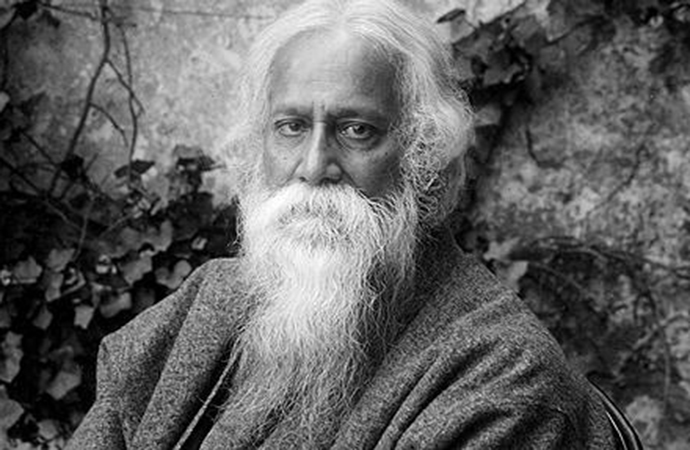
Rabindranath Tagore. Photo: Collected
Dr Lubna Ferdowsi, a researcher and educator whose work engages with society, culture, identity, public policy and questions of citizenship, wrote an excellent article on Rabindranath Tagore in the Daily Star recently.
Her question was simple: "Why does Tagore still trouble Bangladesh's idea of 'us'?" She stated the issue succinctly: it had to do with the imputation that "Tagore was Hindu, Indian and therefore culturally external to Bengali Muslims." Which Bengali Muslims, where and when? That is what she asked as she answered the two charges against Tagore: that he was an Indian and a Hindu to boot.
She answered the critics: "The problem with describing him as a foreign cultural presence in Bangladesh becomes clearer when we look at geography. Tagore died in 1941. India and Pakistan were created six years later; Bangladesh appeared three decades after his death. To decide his cultural nationality retrospectively through today's passport borders is therefore historically awkward. More importantly, a substantial part of his life and literary imagination was formed in places that are now in Bangladesh." As for the "Hindu" label, Tagore was actually a Brahmo. Those who do not know the difference should pick up a college textbook on religion.
The main takeaway from all this is that if Bangladeshis are supposed to abjure Tagore because he was an Indian Hindu, well, he was neither Indian (as India is today) nor Hindu (as Hindu nationalists, say, are today).
The antagonism to Tagore is therefore not a geographical or a religious but a political one.
Dr Ferdowsi recalled the political history of that antagonism. "During the Pakistan period, Bengali culture became one of the arenas in which competing ideas of nationhood were fought over. In 1961, resistance to official hostility surrounding Tagore's birth centenary drew together intellectuals and cultural activists in East Pakistan and formed part of the context in which Chhayanaut emerged. In 1967, Pakistan's information and broadcasting minister, Khwaja Shahabuddin, announced restrictions on broadcasting Tagore songs regarded as inconsistent with Pakistan's cultural ideology. Writers, artists and intellectuals protested."
They protested because Pakistan was trying to expropriate a cherished part of the inherited Bengali identity by deporting Tagore ideologically. That attempt did not work. United Pakistan was born in 1947 and broke up in 1971. Tagore was born in 1861, died in 1941, and is reborn in every breath that Bengalis take today. Bangladesh was born in 1971 and, truth be told, is the most Bengali nation on earth. Bengali, the native language of Tagore, is far more prevalent in Bangladesh than it is in West Bengal. This is natural. Bengali is the linguistic marker of Bangladeshi sovereignty; Bengali is but the state language of West Bengal within sovereign India, where Hindi is the language of Indian administration.
Today, any attempt to portray Tagore as an alien influence would be nothing but a ploy to reject the legacy of the Language Movement of 1952 and its direct influence on the Liberation War that led to the creation of Bangladesh. Bangladesh, where Muslim Bengalis are in an overwhelming majority, cannot deny its umbilical link with the language of Tagore.
Acknowledging that link would not reduce in any way Bangladesh's place in the Islamic Ummah. Why should it?
For example, the vast majority of the people of Türkiye speak Turkish. Jalāl al-Dīn Muḥammad Rūmī, the Sufi mystic, poet and founder of the Mevlevi Order, was born in Balkh, in present-day Afghanistan. He wrote mostly in Persian. His shrine lies in Konya. The people of Türkiye treat him as a national emblem. True, he was a Muslim, but he was not Turkish. He became Turkish by drawing his life like a circle around Türkiye and its place in the wider world, both Muslim and non-Muslim.
Tagore drew Bengal (then within British India) like a circle around his Brahmo life. Why cannot he be Bangladesh's poetic mirror of itself?
The answer lies not in Tagore but in Bangladesh. Dr Ferdowsi's question cannot be answered until Bangladeshis decide who they actually are. Where and how do they place religion and culture within the realm of the nation? Is culture bounded by religion, or is culture an extensive experience of life? Where does the nation come in? Where and how do citizens come to have a nation? These questions cannot be answered definitively for all time, certainly not by others.
But they have to be answered here and now so that Amar Sonar Bangla remains in the red and green hearts of future generations fluttering like the flag of Bangladesh today.
The writer is the Principal Research Fellow of the Cosmos Foundation.
A Independent Newsweekly
© Copyright 2026 | Designed by ARK Reepon & Developed by Cosmos Group Software Team





Leave a Comment
Recent Posts
The government passes the test ...
One of the cornerstones of the political earthquake Bangladesh witness ...
The government hiked the price ...
The government hiked the price of a 12kg cylinder of liquefied petrole ...
Police in France stand accused of using excessive fo ..
The India-Pakistan Cold War
A week on from DNCC’s eviction drive, Mirpur-10 rema ..
Equal Service, Unequal Pensions: Time for a Fairer S ..