


Column
Housing Without Houses: The Hidden Cost of Bangladesh’s Signboard Urbanisation


An Independent Newsweekly




Column
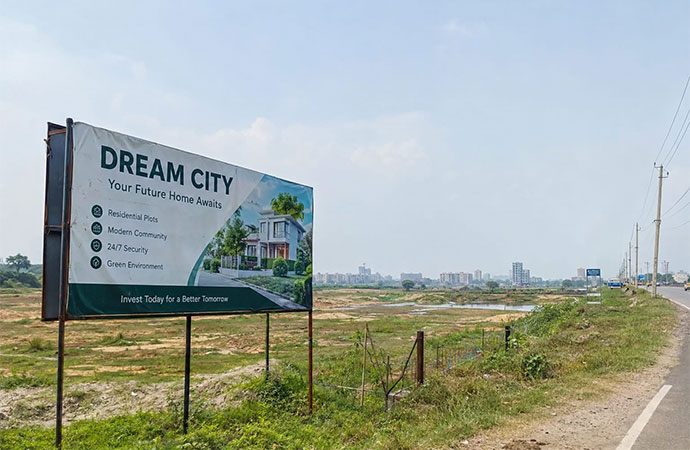
AI Generated Image
Anyone travelling along Mawa Road towards the Padma Bridge can see how easily the language of progress is being used to disguise a serious national risk. Signboards announce model towns, planned communities and future residential estates. But look beyond them and the promise collapses: no homes, no roads, no drainage, no utilities and no sign of an emerging neighbourhood-only farmland being prepared for speculation. A board may change the price of land, but it does not build housing. Bangladesh must confront the uncomfortable truth: too much of what is being sold as urban development is little more than farmland conversion with a marketing budget.
Land Under Pressure
Bangladesh has no surplus land to gamble with. Its 148,460 square kilometres must feed people, absorb floods, support industry, house families and sustain rivers and wetlands. The policy direction is already clear: the Land Use Control and Agricultural Land Protection framework was introduced to respond to rapid urbanisation, industrial expansion, infrastructure development and population growth that have been reducing cultivable land. It also reflects the state's recognition that unplanned land conversion threatens food security and requires zone-based land management. In a country of more than 170 million people, farmland is not a blank canvas for speculative profit. Wetlands and flood-flow areas are not idle land; they are protective infrastructure created by nature. Destroying them invites waterlogging, flooding and long-term ecological damage. The housing shortage is equally real. World Bank data show Bangladesh's urban population growth remained around 2.9 percent in 2025, while World Bank Group analysis has noted the need for approximately 250,000 new houses annually to address the deficit and future demand. UN-Habitat has also projected an 8.5 million urban housing deficit by 2030, which means the country cannot simply oppose development; it must insist on better development. The central problem is therefore stark: Bangladesh needs houses, but it is getting too many signboards.
When the Dream of Ownership Becomes a Risk
For many families, the dream of owning a modest home is built over a lifetime. It is paid for through savings, remittances, loans and sacrifice. That dream is being put at risk when people are persuaded to buy plots in places where roads, drainage, utilities, schools and markets may not arrive for decades, if they arrive at all. Once farmland is advertised as housing land, prices rise, cultivation declines and speculation takes hold. This is not harmless optimism. It is signboard urbanisation: a city imagined on paper, priced into land values and sold from the roadside before the public infrastructure or legal planning needed to make it real exists.
What the Government Can Do?
The answer is not to freeze urban growth or demonise every private developer. Bangladesh needs serious housing investment, and compact, serviced, well-connected development is essential if cities are to absorb growth without deepening inequality. The World Bank has warned that pressure on infrastructure, basic services, land, housing and the environment contribute to "messy and hidden" urbanisation in the region. That warning fits Bangladesh's dilemma: without stronger planning, the country may lose farmland without gaining liveable cities. A credible reform agenda should begin with the following steps.
1. Enforce land-use zoning. Agricultural land, wetlands, flood-flow areas and natural drainage channels must be mapped, protected and treated as national assets, not as blank spaces on a developer's map.
2. Audit housing projects and land use. Large projects should publicly disclose approvals, legal boundaries, acquired land, plots sold, environmental clearance, completed infrastructure and expected habitation timelines.
3. Apply a "No Approval, No Advertisement" rule. No developer should advertise, sell plots or put up signboards until approvals and project boundaries have been verified, and every approved project should display a registration number and QR code showing its legal status.
4. Create a public digital land-use map. Development authorities, land offices, local governments and environmental agencies should share project information on one platform so buyers can compare advertising claims with official approvals.
5. Tie approvals to infrastructure delivery. Large projects should proceed in phases, with roads, drainage, utilities and community facilities completed before later phases are marketed.
6. Promote compact and affordable housing. Bangladesh should encourage denser development, redevelopment of underused urban land, rental housing, serviced apartments and satellite communities connected by public transport.
7. Measure success by homes, not plots. A housing project should be judged by completed homes, occupied units, working infrastructure and community facilities-not by acres acquired or plots sold.
These rules would not punish responsible developers; they would expose unserious ones. Serious investors benefit when the market is governed by clear approvals, verified boundaries and visible infrastructure. Buyers deserve protection from speculative land practises, and the country deserves a housing market that rewards completed homes rather than the sale of expectations.
From Signboards to Homes
The road to the Padma Bridge should stand for national ambition, not reckless land conversion. Bangladesh needs homes, jobs and urban growth, but it also needs food security, flood protection and honest land markets. Those goals can coexist only when planning comes before promotion and regulation comes before speculation.
A signboard cannot build a neighbourhood. If Bangladesh is serious about housing, it must demand liveable communities, working infrastructure and land-use decisions that protect the future rather than sell it off to speculation.
Major General (Retd.) Md. Nazrul Islam is the former Executive Chairman of BEPZA and former Executive Member (Planning) of BEZA. He is a PhD researcher focusing on technology, workforce transformation, and industrial competitiveness, and the author of the Zi-DoNa Trilogy.
A Independent Newsweekly
© Copyright 2026 | Designed by ARK Reepon & Developed by Cosmos Group Software Team





Leave a Comment
Recent Posts
A Battle for the Soul of The N ...
Two disturbing incidents came to light this week, even as they went un ...
Dhaka seeks concrete measures ...
State Minister for Foreign Affairs Humaiun Kobir on Thursday urged Sou ...
Bangladesh Embassy in Ireland begins operations
Dinesh Trivedi stresses proper preparations before T ..
The Hope Deficit: Why Bangladesh’s Revolution Must M ..
Iqbal Bahar Chy: Finding freedom in the unplanned